
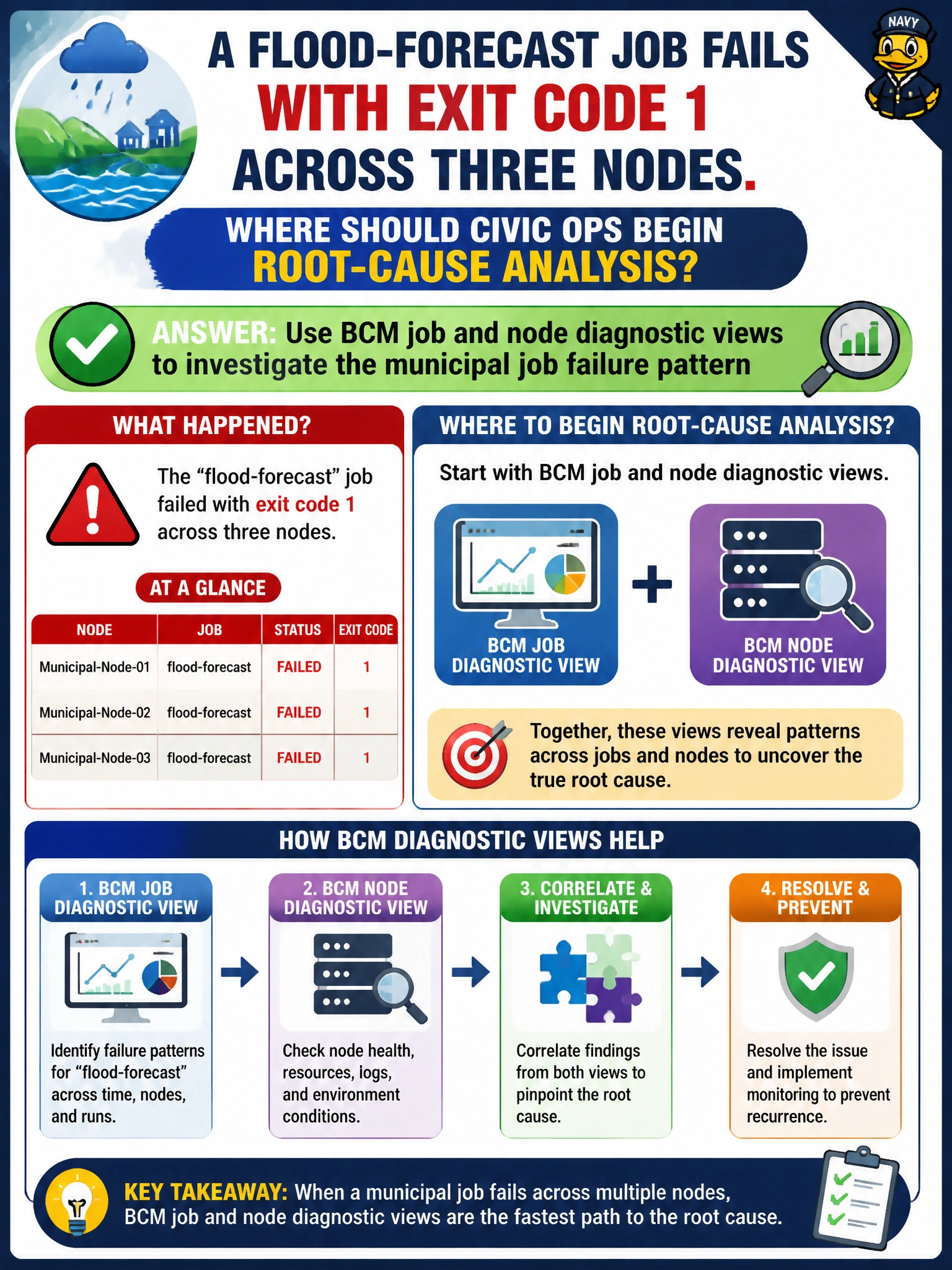
A flood-forecast job fails with exit code 1 across three nodes. Where should civic ops begin root-cause analysis?
Select an answer to reveal the explanation.
Short Explanation
Exit code 1 on three flood-forecast nodes is a pattern, not a lottery—open BCM’s job and node views first. That is how civic ops see whether it is image, node health, or the job itself. Swapping every GPU or deleting the dataset before diagnosis just creates a bigger incident.
Full Explanation
A flood-forecast job failing with exit code 1 across three nodes is a patterned municipal failure; civic ops should begin with BCM job and node diagnostic views to investigate whether the fault is the job, the image, shared data, or node health. Consistent multi-node exit codes are evidence, not randomness. Replacing all GPUs in the data center before collecting any logs is wasteful hardware theater that destroys the chance to correlate failures with software or data issues. Ignoring exit codes because flood models are “expected to fail randomly” normalizes silence and prevents learning from real defects. Deleting the flood-forecast dataset to clear the error may destroy the only reproducible input that triggers the bug and creates a bigger incident for emergency management. Exam caveat: diagnostics first does not forbid later hardware replacement—only that evidence from BCM job/node views must lead the decision. Operational check: open BCM job diagnostics for the failed flood-forecast job IDs, compare node health and logs across the three nodes, check image/driver sameness and dataset mount status, form a hypothesis (code vs data vs node), and only then apply a targeted fix rather than fleet-wide GPU swaps.