
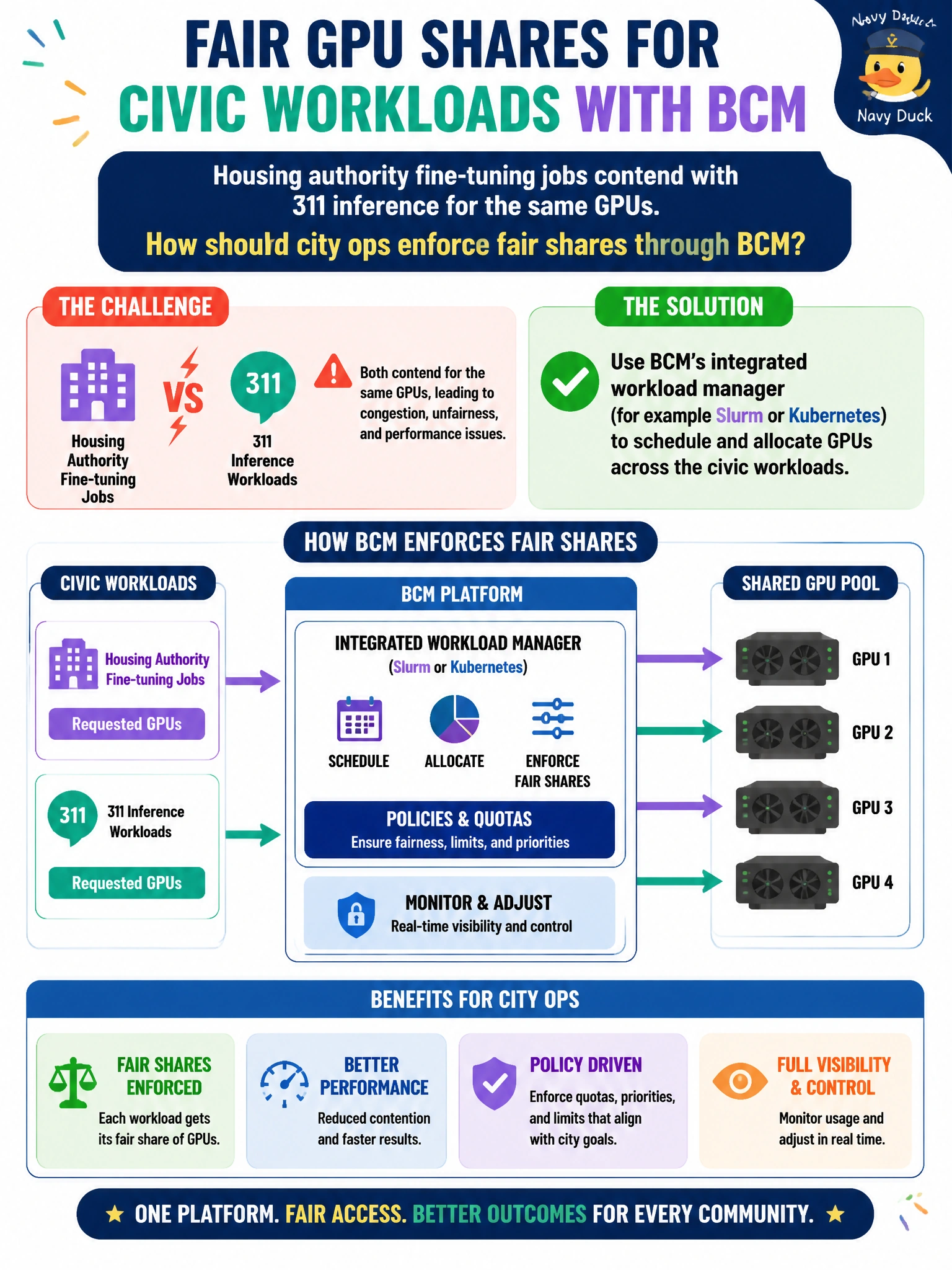
Housing authority fine-tuning jobs contend with 311 inference for the same GPUs. How should city ops enforce fair shares through BCM?
Select an answer to reveal the explanation.
Short Explanation
When housing fine-tunes and 311 inference fight over GPUs, you need a traffic cop, not a hallway race. BCM’s workload manager—Slurm or Kubernetes in that civic stack—sets fair shares so both services get airtime. SSH scavenger hunts and unrestricted login-node grabs just recreate the fight.
Full Explanation
Housing authority fine-tuning contending with 311 inference for the same GPUs is a scheduling and allocation problem, not a hallway race. Through BCM, city ops should use the integrated workload manager—commonly Slurm or Kubernetes in NVIDIA AI cluster stacks—to schedule jobs and allocate GPUs with fair-share or quota policies across civic tenants. That enforces both services get capacity according to policy instead of whoever SSHs first. Asking analysts to manually SSH-race for free GPUs each morning recreates contention, destroys auditability, and bypasses queues, reservations, and accounting. Deleting the 311 models so housing jobs always win is politically and operationally unacceptable: 311 is a citizen-facing service, and “fairness” that destroys production models is sabotage, not governance. Disabling scheduling and running unrestricted docker --gpus all on login nodes collapses multi-tenant isolation, invites GPU grabs on shared login hosts, and undoes BCM’s workload integration. Exam caveat: the exact fair-share knobs differ between Slurm and Kubernetes, but the exam concept is using the BCM-integrated workload manager—not ad-hoc device grabs. Operational check: define partitions/queues or namespaces for housing versus 311, set GPU quotas or priorities, submit competing test jobs, and confirm neither tenant can monopolize the civic pool outside policy.