
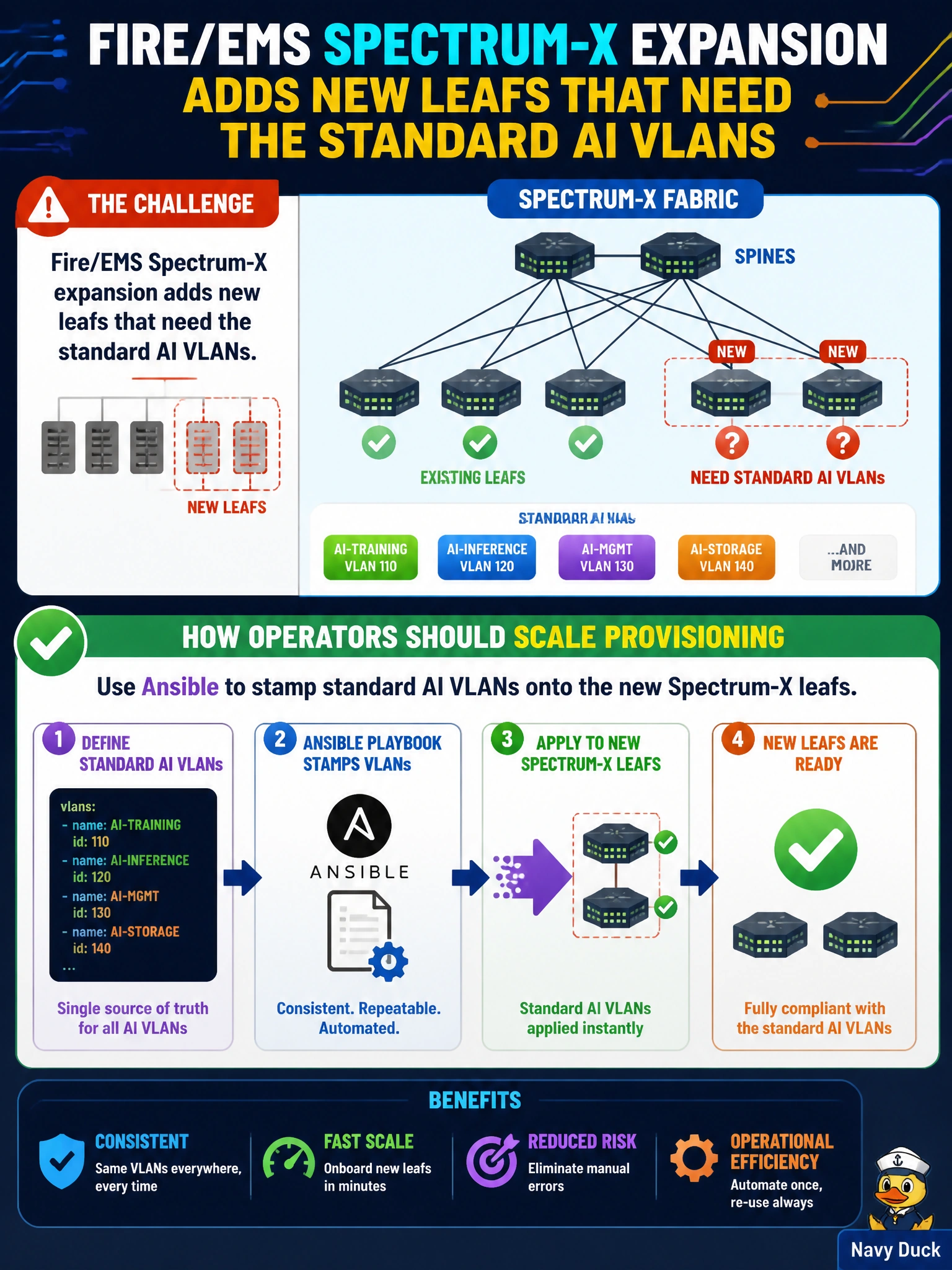
Fire/EMS Spectrum-X expansion adds new leafs that need the standard AI VLANs. How should operators scale provisioning?
Select an answer to reveal the explanation.
Short Explanation
You can't count on NVIDIA AIR to emulate standard AI VLANs and have the new Spectrum-X leafs actually configured. Let Ansible stamp the standard AI VLANs onto Spectrum-X so expansion stays fast and consistent.
Full Explanation
Fire/EMS Spectrum-X expansion that adds new leafs needing standard AI VLANs should scale provisioning with automation. Using Ansible to stamp standard AI VLANs onto the new Spectrum-X leafs applies the municipal VLAN package quickly and consistently across Fire/EMS sites, matching the urgency and uniformity public-safety fabrics require during growth. Using NetQ to push standard AI VLAN configuration onto the new Spectrum-X leafs is the wrong tool for this job; NetQ is built for telemetry and validation, not for stamping consistent VLAN configuration across new leaves. Using BGP EVPN signaling to auto-create standard AI VLANs on new Spectrum-X leafs misapplies the overlay control plane; EVPN distributes reachability, it doesn't provision the standard local VLAN set the question asks for. Using NVIDIA AIR to emulate standard AI VLANs for the new Spectrum-X leafs design only simulates the fabric in a lab; it does not configure the production leafs Fire/EMS expansion actually needs. Exam caveat: stamping VLANs still requires correct inventory role mapping and post-apply verification; automation amplifies mistakes if the standard VLAN set itself is wrong. Operational check: maintain an Ansible playbook for the standard Fire/EMS AI VLAN set, target newly installed Spectrum-X leafs via inventory, apply, verify VLAN presence and reachability, then document the leaf as production-ready. Reuse the same VLAN stamp playbook for Fire/EMS DR leafs so primary and standby Spectrum-X sites stay VLAN-identical.