
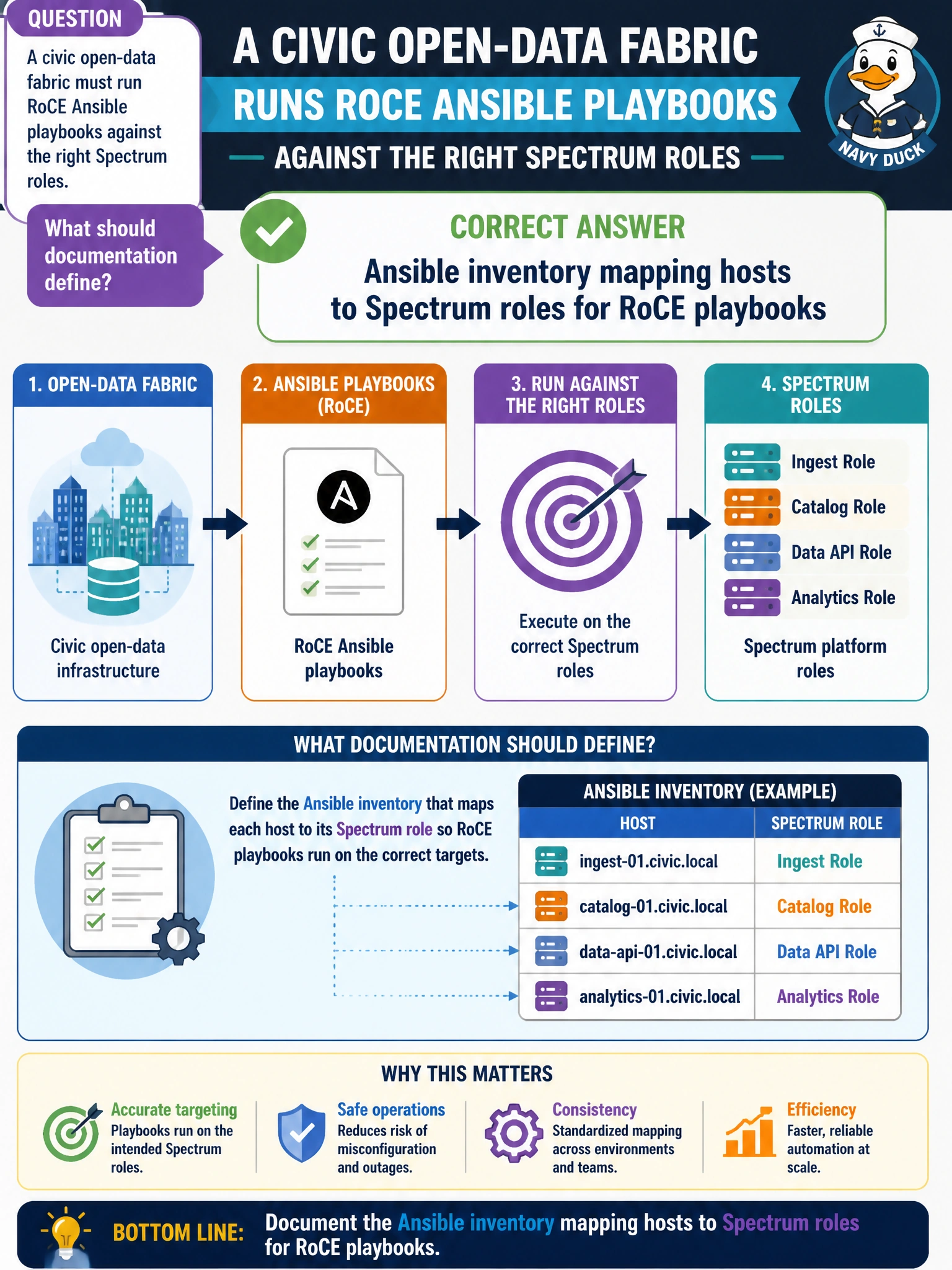
A civic open-data fabric must run RoCE Ansible playbooks against the right Spectrum roles. What should documentation define?
Select an answer to reveal the explanation.
Short Explanation
RoCE playbooks are only as smart as their inventory. Document Ansible inventory that maps hosts to Spectrum roles so the civic open-data fabric hits the right switches for RoCE automation.
Full Explanation
A civic open-data fabric running RoCE Ansible playbooks must target the correct Spectrum roles, which starts with documented inventory design. Ansible inventory that maps hosts to Spectrum roles for RoCE playbooks ensures border, AI leaf, and other role groups receive the RoCE-related settings appropriate to each municipal function instead of a blunt one-size apply. Ansible group variables defining RoCE MTU settings for Spectrum ports only set a link-level parameter; they do not document which hosts belong to border, AI leaf, or other Spectrum roles, so RoCE playbooks still lack the role-based host targeting they need. Ansible inventory grouping hosts by rack location for RoCE deployment describes physical placement rather than Spectrum role membership, so it cannot direct playbooks to the specific border or AI leaf switches that require RoCE configuration. Ansible vault configuration securing SSH keys for Spectrum switches protects credentials but does not map hosts to Spectrum roles, so it cannot tell RoCE playbooks which devices to target or prevent changes to the wrong civic devices. Exam caveat: keep inventory in source control beside the playbooks and validate group membership whenever Spectrum-X leafs are added or roles change. Operational check: document and maintain Ansible inventory groups for Spectrum roles on the open-data fabric, limit RoCE playbooks to the correct groups, run a dry-run to confirm host targeting, then apply and verify RoCE settings only on those roles.