
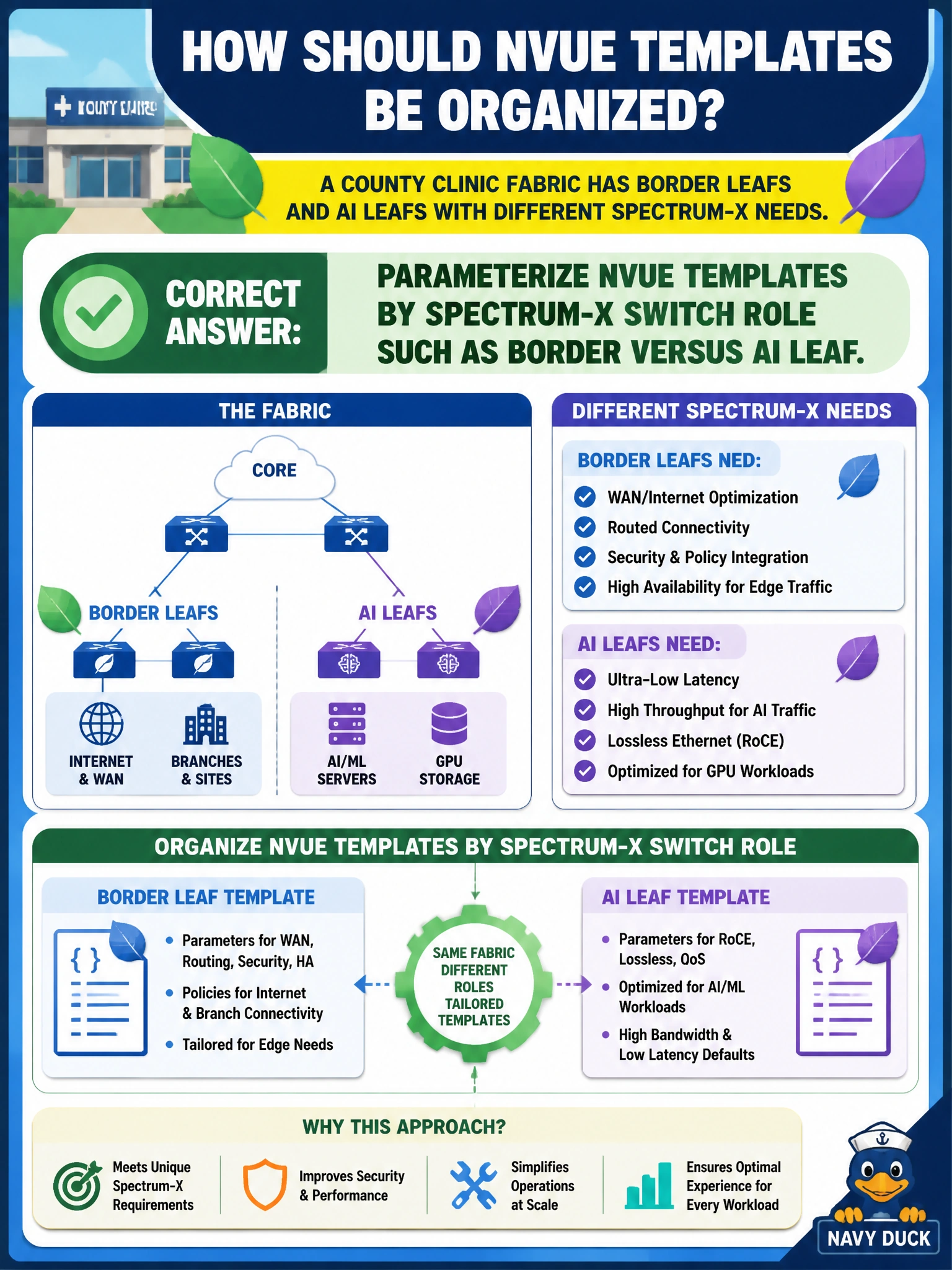
A county clinic fabric has border leafs and AI leafs with different Spectrum-X needs. How should NVUE templates be organized?
Select an answer to reveal the explanation.
Short Explanation
Border leafs and AI leafs aren’t twins. Parameterize NVUE templates by Spectrum-X switch role so the county clinic fabric gets the right knobs for each job.
Full Explanation
A county clinic fabric with border leafs and AI leafs has different Spectrum-X roles—edge policy and uplink behavior versus AI leaf RoCE/QoS and tenant attachment—so NVUE templates must be organized by role. Parameterizing templates by Spectrum-X switch role (border versus AI leaf) lets civic operators share common building blocks while injecting role-specific variables for VLANs, EVPN, RoCE, and QoS without forcing a single incorrect config everywhere. Standardizing NVUE templates on AI leaf Spectrum-X lossless settings and extending them to border leafs forces border leafs into AI-only RoCE/QoS tuning that ignores edge policy and uplink behavior, creating operational defects. Parameterizing NVUE templates by link speed and cable length while sharing a Spectrum-X role profile ignores the border versus AI leaf split, so role-specific settings get lost in physical-layer variables and drift increases across the county clinic estate. Managing Spectrum-X tuning with interactive NVUE revisions applied separately per fabric prevents automated apply, review diffs, and idempotent remediation, leaving the county clinic estate without consistent, auditable templates. Exam caveat: parameterization still needs clear inventory or group mapping so the correct role template targets the correct devices; wrong group membership defeats role-aware design. Operational check: define border and AI leaf NVUE template variants or parameters, map county clinic switches to roles in inventory, apply to a pilot of each role, and confirm rendered config matches the civic role standard before full rollout.