
A city GPU node shows the wrong InfiniBand state in ibstat after a driver update. What should engineers do first?
Select an answer to reveal the explanation.
Short Explanation
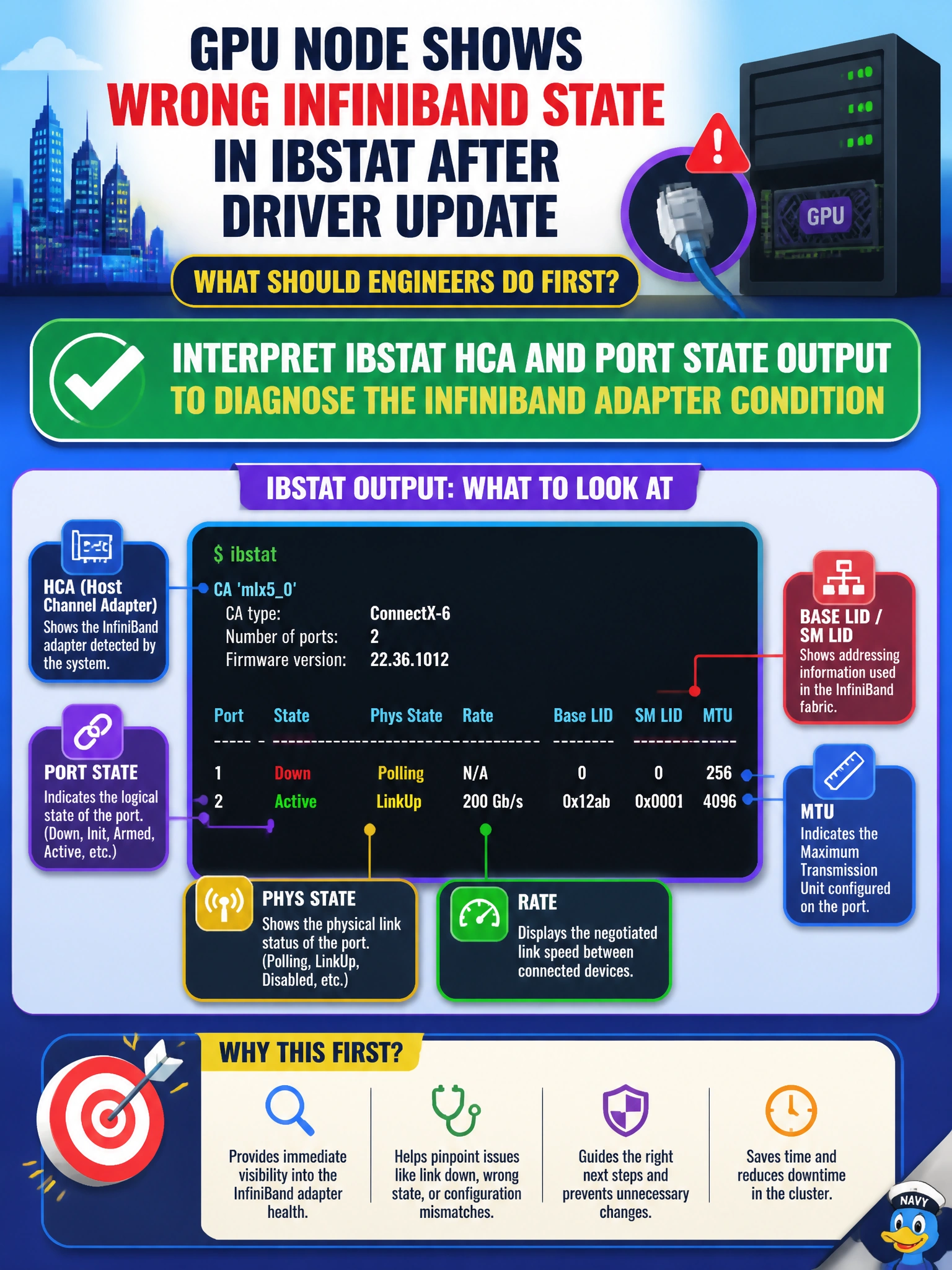
Driver updates can leave the IB adapter in a weird mood. Read ibstat first — HCA and port state tell you whether the city GPU node’s InfiniBand link is Active, Down, or still half-awake after the update.
Full Explanation
After a driver update on a city GPU node, InfiniBand adapter state is the first fact engineers must establish before changing fabric or storage. ibstat reports Host Channel Adapter (HCA) presence, port physical and logical state (for example Down, Init, Armed, Active), link width/speed, and related counters that show whether the municipal GPU node’s InfiniBand path is healthy, stuck, or still renegotiating after the driver reload. Interpreting that local output decides the next step: reload/rebind the driver, reseat a cable, escalate to fabric diagnostics, or clear a false alarm. Checking UFM fabric events to correlate subnet manager state with the host port report shifts focus to the fabric before confirming the local HCA and port condition shown by ibstat, so it is not the right first step after a single-node driver update. Reinstalling the MLNX_OFED driver stack to resync kernel modules with adapter firmware is premature before reading ibstat to establish the actual adapter state and may cause unnecessary disruption on a node that only needs interpretation of existing output. Reviewing Spectrum-X Ethernet interface counters to assess fabric congestion around the GPU node examines Ethernet fabric metrics rather than the InfiniBand adapter state reported by ibstat, so it does not address the local link question first. Exam caveat: ibstat is host-local; it does not replace ibdiagnet or subnet-manager views when many nodes fail together, but it remains the correct first command after a single-node driver change. Operational check: run ibstat on the affected city GPU node, confirm the HCA is listed and the port reaches Active with expected rate/width, then only escalate if local state is clean yet workload RDMA still fails.