
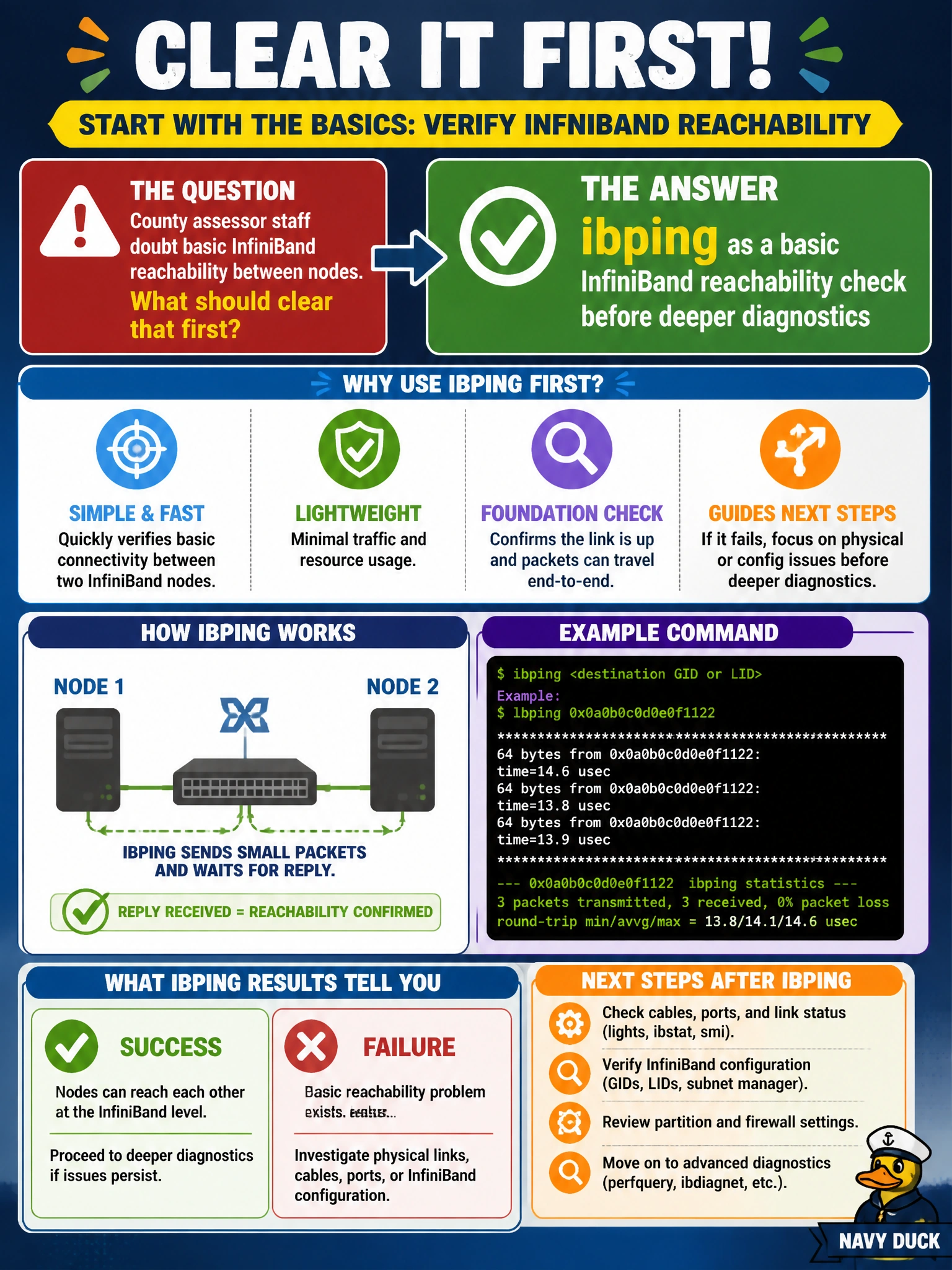
County assessor staff doubt basic InfiniBand reachability between nodes. What should clear that first?
Select an answer to reveal the explanation.
Short Explanation
Before the deep dive, ask if the remote node even answers. Use ibping as the basic InfiniBand reachability check for county assessor connectivity doubts.
Full Explanation
When county assessor staff doubt basic InfiniBand reachability between nodes, the first clearing step is ibping as a basic InfiniBand reachability check before deeper diagnostics. Confirming that nodes answer IB pings establishes L2/RDMA reachability cheaply and prevents premature ibdiagnet fabric topology scans, ib_write_bw bandwidth tests, or ibstat local port checks when the remote side simply is not reachable.
Why the other options fail by concept: ibdiagnet validates fabric topology and link errors across switches, which is heavy and poorly ordered when the question is “does this peer answer?”. ib_write_bw measures RDMA bandwidth performance between two hosts and assumes a working path, wasting time if nodes may not even answer IB pings. ibstat reports only local HCA port state, link rate and physical link layer status, so it cannot confirm reachability to a remote node.
Exam caveat: ibping success does not prove latency or bandwidth SLOs—it only clears basic reachability. Failure also needs context (wrong LID/GID, SM issues, partition keys). After ibping passes, escalate to latency/bandwidth or UFM health as the assessor symptom demands.
Operational check: between the disputed county assessor nodes, run ibping first; if it fails, open UFM/SM and path checks before ibdiagnet fabric topology scans, ib_write_bw bandwidth tests, or ibstat local port checks; if it passes, proceed to the metric that matches the remaining complaint (latency or bandwidth) with civic baselines.