
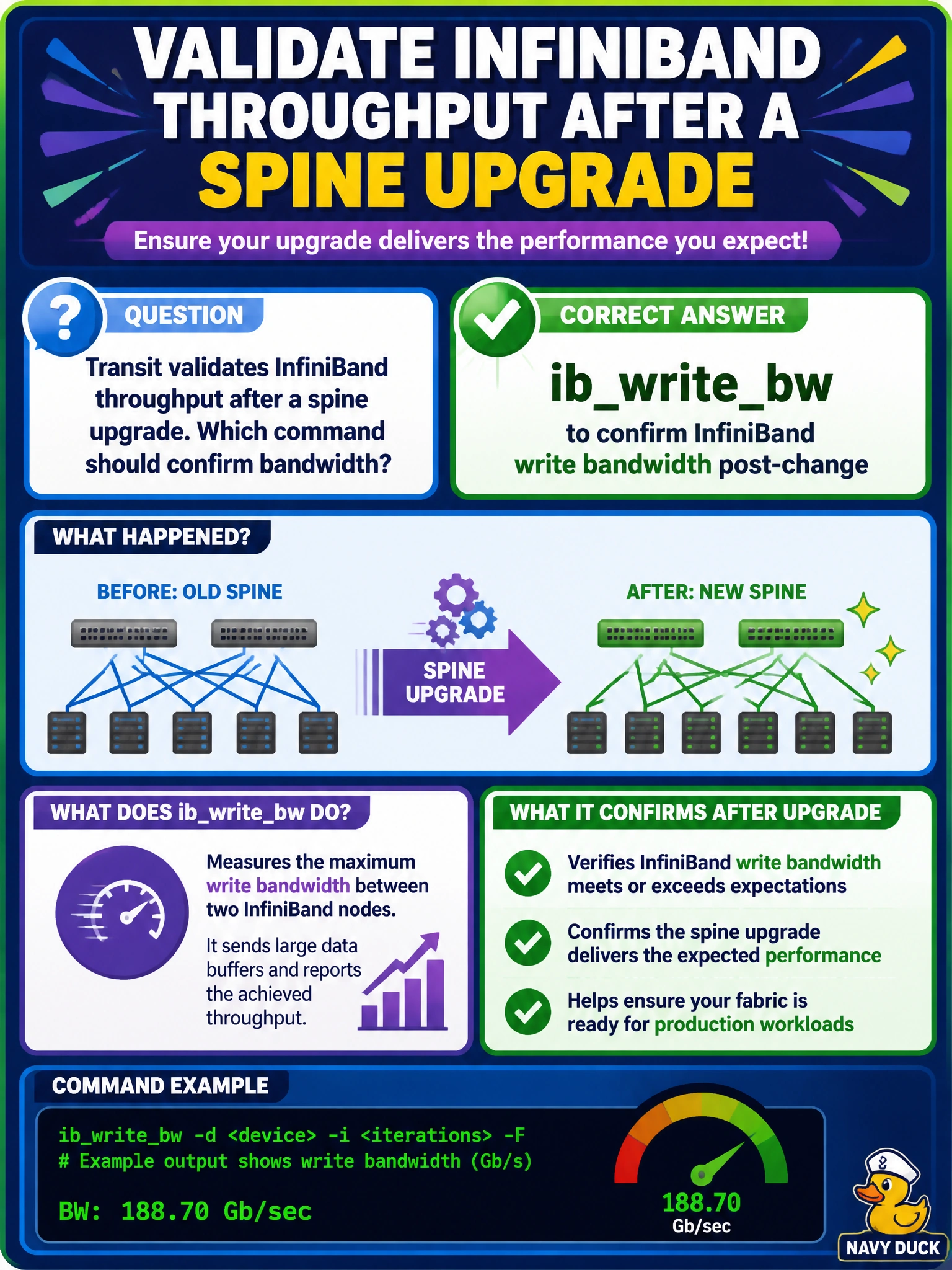
Transit validates InfiniBand throughput after a spine upgrade. Which command should confirm bandwidth?
Select an answer to reveal the explanation.
Short Explanation
After a spine upgrade, prove the pipe is wide—not just lit. Run ib_write_bw so transit can confirm InfiniBand write bandwidth post-change.
Full Explanation
After a transit spine upgrade, validating InfiniBand throughput requires proving sustained write bandwidth, not merely latency or reachability. The ib_write_bw command confirms InfiniBand write bandwidth post-change, which matches an acceptance metric focused on pipe capacity across the upgraded civic fabric that carries transit AI traffic.
Why the other options fail by concept: ibping to verify InfiniBand spine connectivity after upgrade proves basic reachability, not sustained throughput, and cannot close a bandwidth gate. ib_write_lat to measure InfiniBand write latency after upgrade measures latency, not bandwidth, and does not satisfy a bandwidth acceptance metric after spine work. perfquery to collect InfiniBand port counters after upgrade collects port-counter data but does not measure sustained write bandwidth, so it provides no quantitative post-change throughput proof for municipal acceptance.
Exam caveat: run ib_write_bw with representative sizes and concurrency, and test paths that actually traverse the upgraded spines. Healthy latency with collapsed bandwidth is a real failure mode after fabric changes—do not close transit acceptance on latency tools alone when bandwidth was the stated gate.
Operational check: post spine upgrade, execute ib_write_bw between agreed transit endpoints across the upgraded path, compare to pre-change bandwidth baselines, archive results with the change record, and keep the change open until write bandwidth meets the municipal acceptance threshold.