
A county clinic InfiniBand incident was fixed at the subnet manager. How should closure be confirmed?
Select an answer to reveal the explanation.
Short Explanation
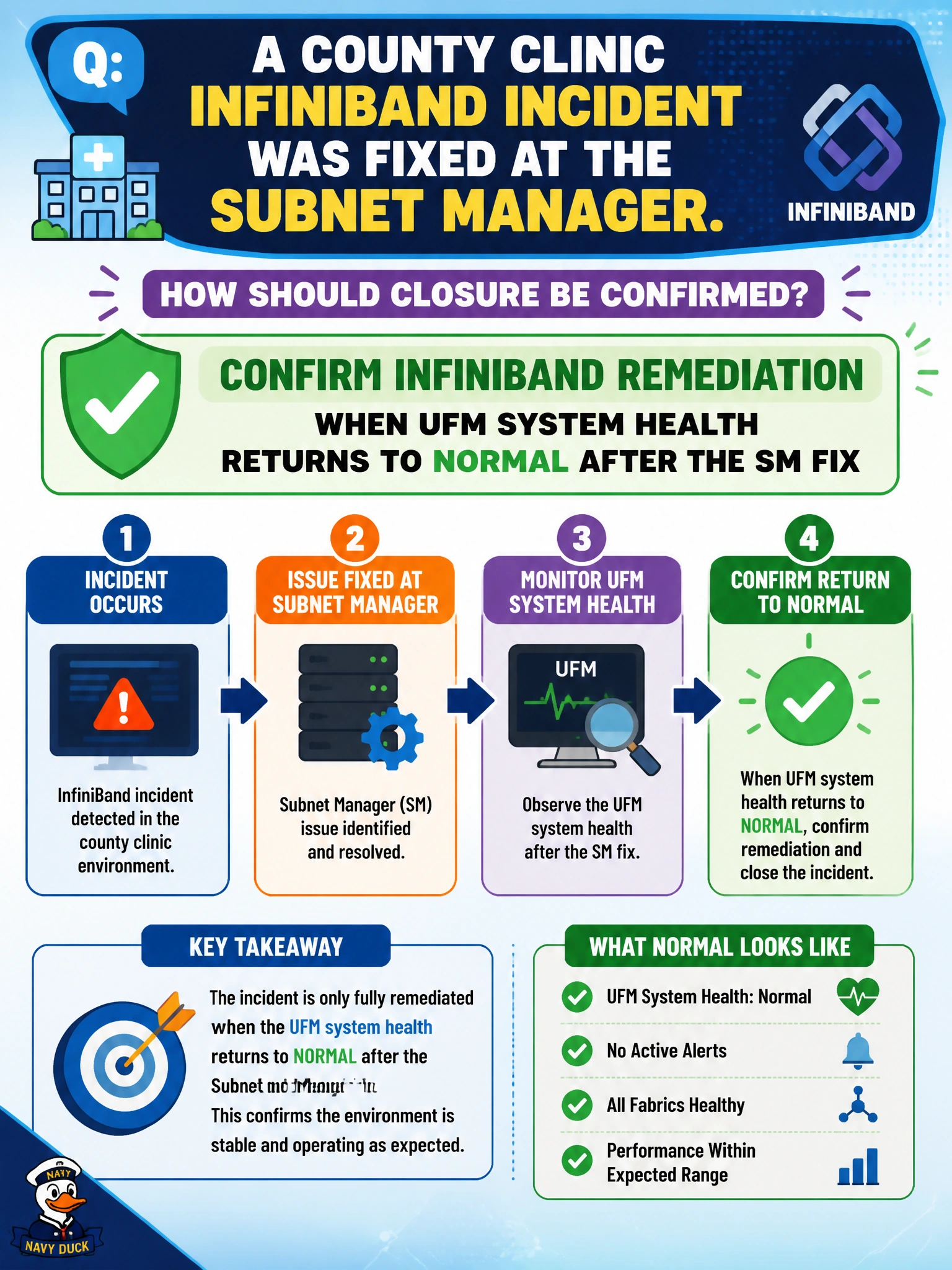
Fixing the SM is only half the story—show the dashboard recovered. Confirm clinic InfiniBand remediation when UFM system health returns to normal after the SM fix.
Full Explanation
After a county clinic InfiniBand incident is fixed at the subnet manager, closure should be confirmed when UFM system health returns to normal after the SM fix. Remediation without health verification leaves the municipal ticket half-closed and risks silent residual SM/HA degradation that can stall clinic AI jobs again under load.
Why the other options fail by concept: validating closure by checking SM partition configuration in OpenSM startup settings verifies partition settings, not UFM system health, so it offers no proof that the SM fix resolved the incident. Confirming closure by reviewing UFM performance telemetry for sustained fabric bandwidth recovery measures data-plane throughput, not UFM system health, so it cannot confirm SM/HA recovery or control-plane stability. Verifying remediation by inspecting InfiniBand GUID assignments in SM routing tables checks routing entries, not UFM system health, so it does not confirm that the fabric is healthy after the SM fix.
Exam caveat: “SM restarted” is not identical to “UFM system health normal.” Confirm HA role stability and absence of recurring health alarms for a soak period appropriate to clinic risk, not just a single green snapshot taken seconds after the fix.
Operational check: after the SM fix, re-open UFM system health, verify normal status and stable SM/HA roles, attach screenshots or export to the clinic incident record, soak briefly under representative traffic if feasible, and only then close with a note that post-fix health matched civic expectations.