
A school-district GPU lab needs repeatable interconnect triage. What should operators establish?
Select an answer to reveal the explanation.
Short Explanation
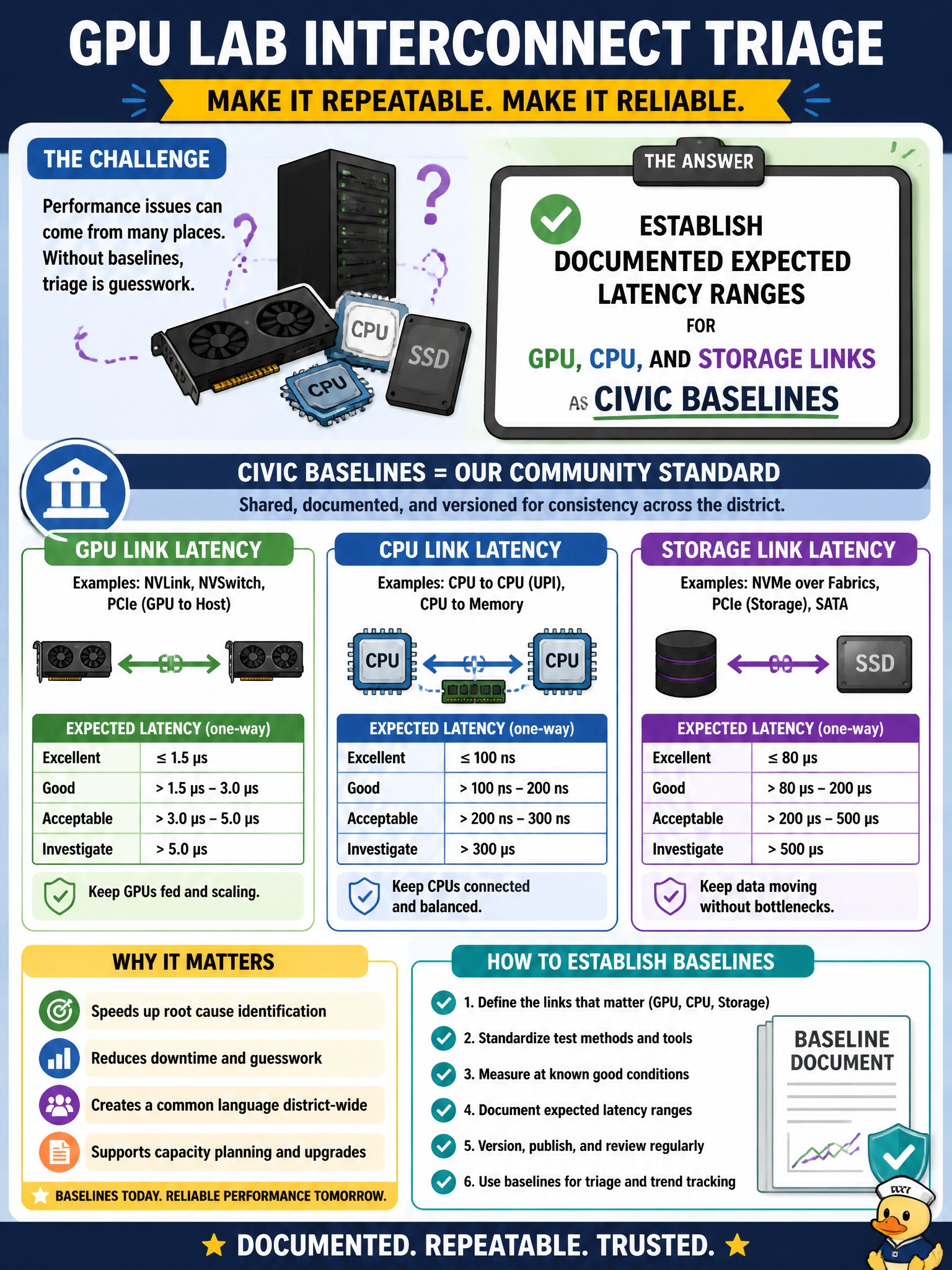
Without a baseline, every number looks like a debate. Document expected latency ranges for GPU, CPU, and storage links so the school-district lab can triage against civic norms.
Full Explanation
A school-district GPU lab needs repeatable interconnect triage, which starts with documented expected latency ranges for GPU, CPU, and storage links as civic baselines. Numeric baselines turn raw measurements into pass/fail decisions and prevent on-call arguments based on memory or vendor marketing.
Why the other options fail by concept: a lookup table mapping GPU model numbers to expected bandwidth from the product datasheet fails as a civic baseline because vendor bandwidth specs describe ideal conditions, not latency measured on this school district's actual GPU, CPU, and storage interconnects with its own tools and topology; a datasheet number is not a substitute for a measured, method-matched baseline. A single vague “fast enough” note provides no actionable threshold for municipal ops. Baselines only for HDMI monitors ignore the fabric interconnects that actually govern AI job performance.
Exam caveat: baselines must specify tool, message size, path type, and topology (same leaf versus cross-spine), because absolute latency numbers are meaningless without method. Refresh baselines after major Spectrum/InfiniBand or NIC changes so the school district does not chase false regressions.
Operational check: publish and version civic latency ranges for GPU, CPU, and storage links in the lab runbook; on each triage, measure with the documented method, compare to those ranges, and file deviations with the numeric delta rather than qualitative “feels slow” language.