
Housing authority training nodes updated NIC firmware. What should operators do next for interconnects?
Select an answer to reveal the explanation.
Short Explanation
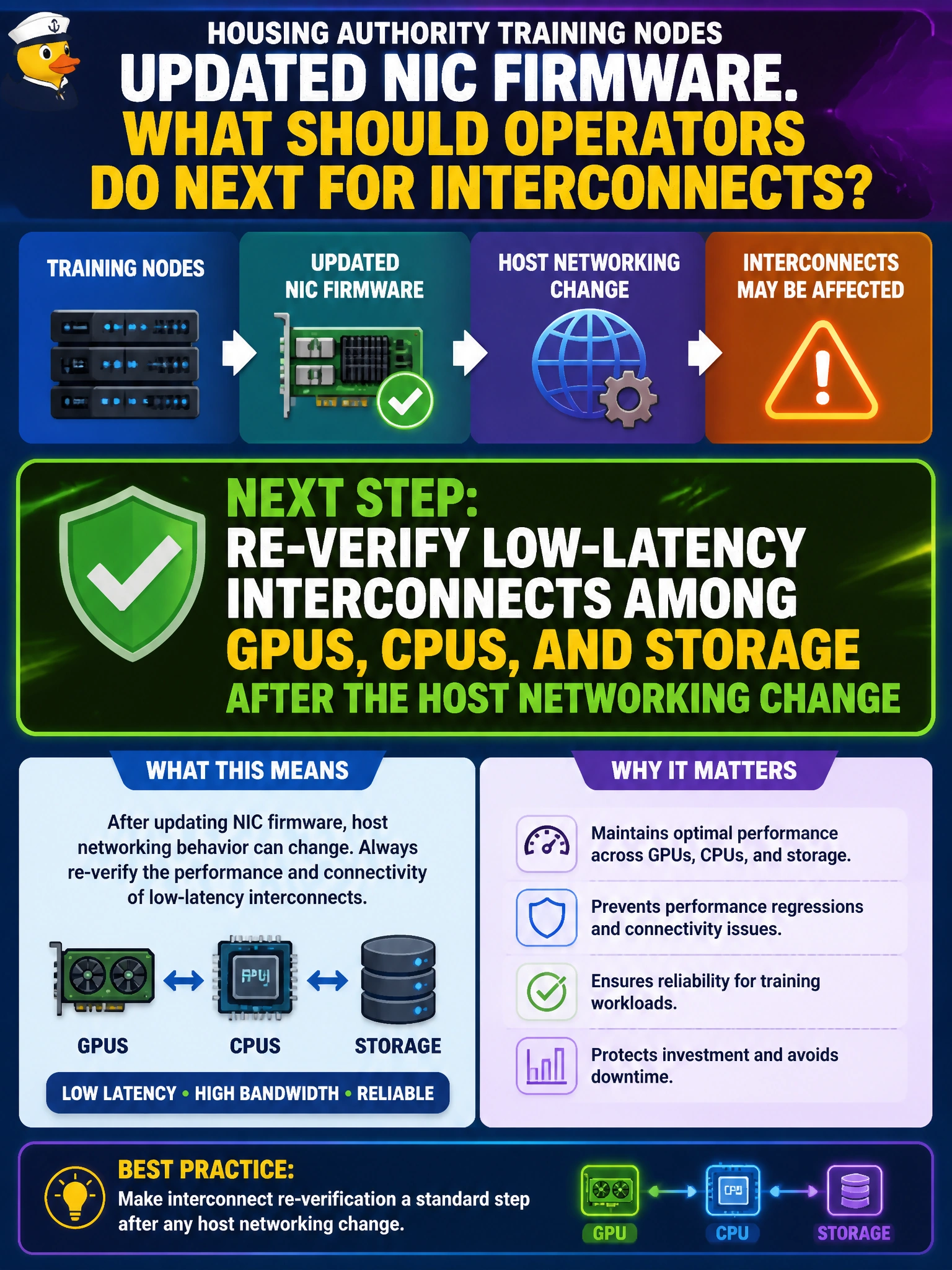
NIC firmware is a host networking change, so retest the stopwatch. Re-verify low-latency GPU, CPU, and storage interconnects on housing authority training nodes afterward.
Full Explanation
Housing authority training nodes that updated NIC firmware experienced a host networking change that can alter RDMA capabilities, interrupt moderation, firmware offloads, or driver/firmware pairings. Operators must re-verify low-latency interconnects among GPUs, CPUs, and storage after that change so civic training paths remain inside budget.
Why the other options fail by concept: Re-validating PCIe enumeration and GPU device visibility across training nodes after the update does not address the low-latency interconnect paths among GPUs, CPUs, and storage that the NIC firmware change can affect. Planning a comprehensive interconnect retest for the next scheduled maintenance window fails because it defers verification past the point where the firmware change is already live and carrying housing-authority training traffic; a regression introduced now stays undetected for however long until that future window arrives, instead of being caught right after the change. Re-running distributed storage throughput tests on training nodes to confirm fabric performance after firmware update checks throughput rather than the low-latency GPU, CPU, and storage interconnects that the NIC firmware change can alter.
Exam caveat: NIC firmware success at the driver level does not equal unchanged latency. Retest with the same civic baselines and tools used before the update, and watch for one-sided regressions (for example storage RDMA worse while GPU peer latency unchanged).
Operational check: after NIC firmware on housing authority training nodes, re-run GPU, CPU, and storage interconnect latency validations, compare to pre-change numbers, and roll back or escalate firmware if any path class exceeds the documented ranges.