
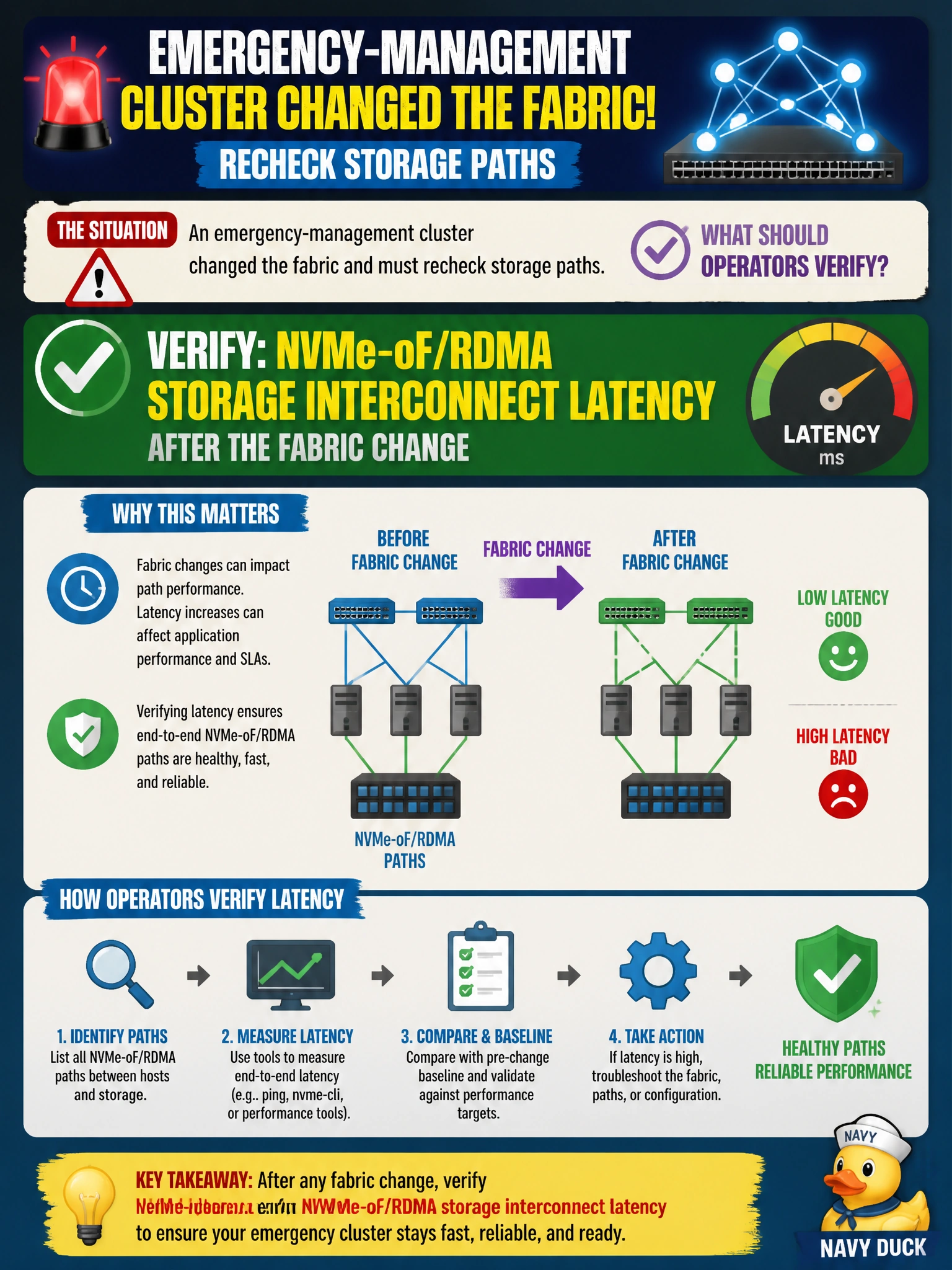
An emergency-management cluster changed the fabric and must recheck storage paths. What should operators verify?
Select an answer to reveal the explanation.
Short Explanation
Fabric changes can bruise storage paths even when GPUs still smile. Recheck NVMe-oF/RDMA storage interconnect latency for emergency-management after the change.
Full Explanation
An emergency-management cluster that changed the fabric must recheck storage paths because fabric work can alter RDMA reachability, QoS, ECMP hashing, or lossless behavior affecting NVMe-oF. Operators should verify NVMe-oF/RDMA storage interconnect latency after the fabric change so municipal AI jobs that depend on fast storage do not silently miss budgets.
Why the other options fail by concept: physical cable continuity checks at the new line card port connections fail as the validation step here because confirming a cable is physically connected does not measure RDMA storage latency; a continuity-passing link can still carry a congested or misconfigured NVMe-oF path. Skipping storage latency checks forever after any change institutionalizes blind spots. Reviewing CPU interrupt coalescing settings on GPU cluster nodes after the fabric change fails because that host-side tuning parameter does not verify NVMe-oF/RDMA storage interconnect latency; it addresses a different layer of the stack than the storage path the change could have affected.
Exam caveat: NVMe-oF/RDMA latency can regress even when GPU-to-GPU tests still pass. Retest with the same tools and baselines used before the change, and include multipath or dual-rail paths if the emergency-management design uses them—checking only one path can miss asymmetric damage.
Operational check: after the fabric change window, run the documented NVMe-oF/RDMA latency suite against emergency-management storage targets, compare to pre-change baselines, and keep the change open until storage interconnect latency is within civic tolerance.