
A city GPU fabric acceptance test must prove end-to-end low latency. What should the design cover?
Select an answer to reveal the explanation.
Short Explanation
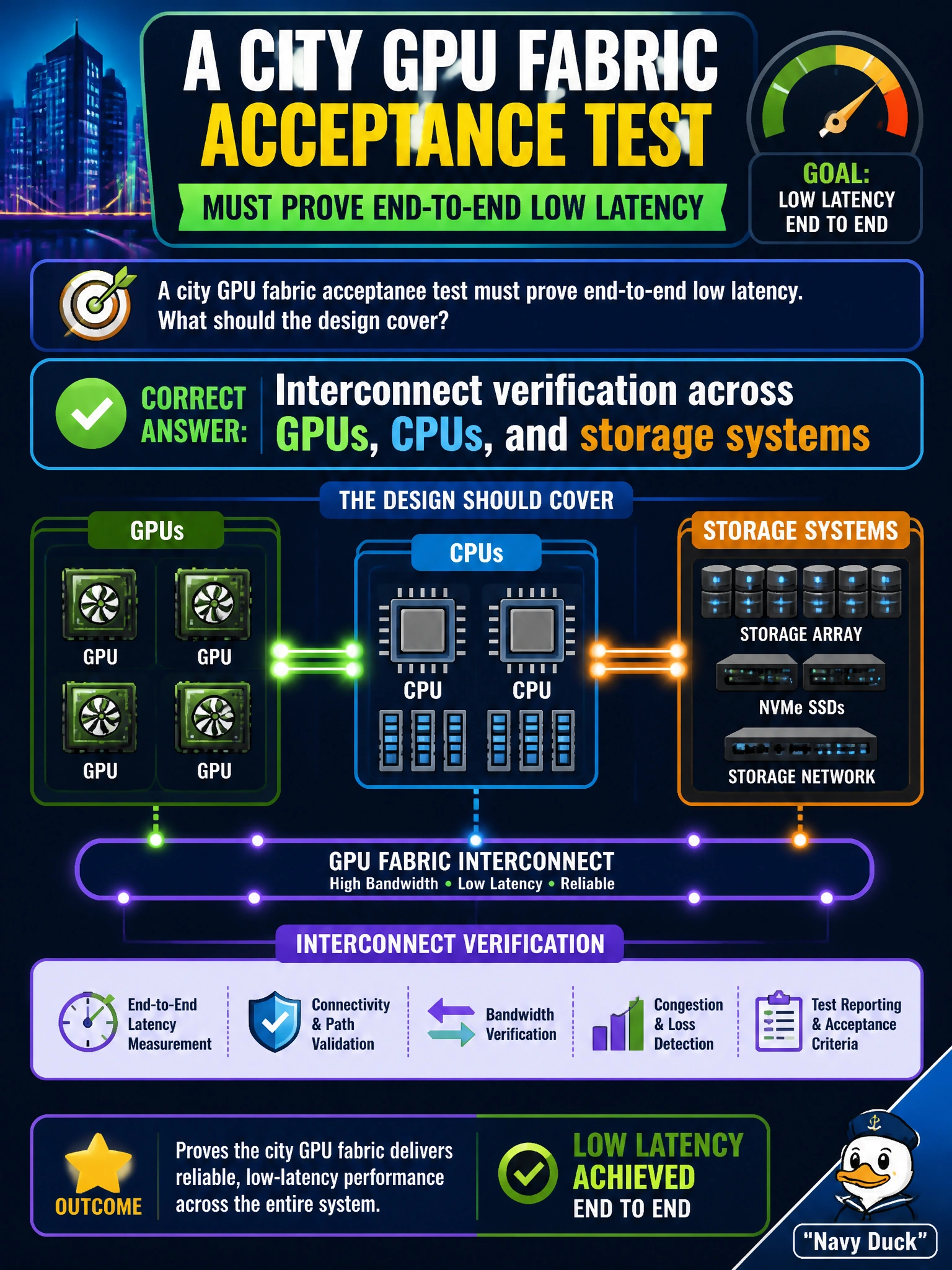
Acceptance is a three-lane checklist: GPUs, CPUs, and storage. You'll want city fabric interconnect verification across all three, not just management-switch control-plane latency, since that won't reveal AI data-path latency.
Full Explanation
A city GPU fabric acceptance test that must prove end-to-end low latency has to cover interconnect verification across GPUs, CPUs, and storage systems. End-to-end civic AI performance depends on all three; acceptance that exercises only one class of path leaves latent budget failures for production training and inference.
Why the other options fail by concept: latency validation of management switch control plane traffic validates the wrong network plane for AI workloads, since it ignores the GPU, CPU, and storage data fabric. Bandwidth testing between GPUs in one rack using collective libraries proves an incomplete slice of the design, because it measures throughput rather than end-to-end latency and skips CPU and storage paths. Cable continuity confirmation with link training status polling provides no quantitative evidence for municipal acceptance criteria, because it confirms physical layer status rather than measured latency.
Exam caveat: acceptance should record numeric results against pre-agreed ranges, not binary “looks fine.” Include representative RDMA or fabric-native tests for GPU and storage paths, and do not treat management-switch control-plane latency as a proxy for AI interconnect health.
Operational check: execute and archive interconnect latency (and, where required, bandwidth) tests for GPU, CPU, and storage paths as part of the city fabric acceptance package; fail the gate if any path class is missing from the evidence set or exceeds the documented civic thresholds.