
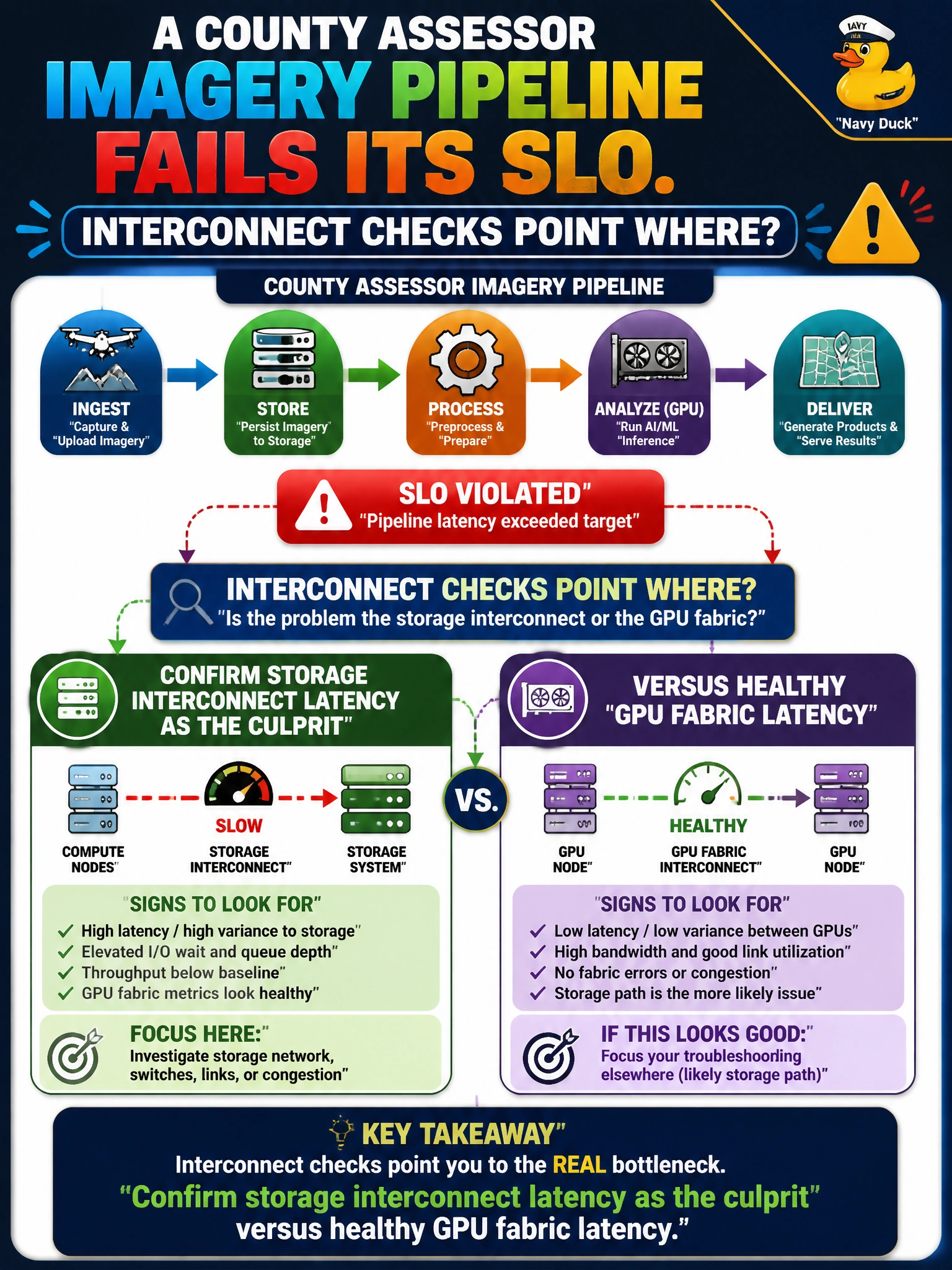
A county assessor imagery pipeline fails its SLO. Interconnect checks point where?
Select an answer to reveal the explanation.
Short Explanation
Assessor imagery can stall on storage while GPUs look innocent. Confirm storage interconnect latency versus healthy GPU fabric latency before you rip out the wrong piece.
Full Explanation
When a county assessor imagery pipeline fails its SLO, interconnect checks should decide whether storage path latency is the culprit while the GPU fabric latency remains healthy. Imagery pipelines often stall on storage fetch or writeback even when GPU collectives look fine; confirming that distinction prevents ripping out the wrong municipal AI component.
Why the other options fail by concept: tuning the NCCL tree algorithm to optimize GPU fabric collective transfer throughput profile ignores the storage path latency evidence the stem implies and attacks the wrong layer. Upgrading GPU NVLink fabric bandwidth after a storage read stall is observed is an extreme, non-proportional response that treats the GPU fabric when the evidence points to storage. Raising GPU SM clock limits to recover imagery tile processing throughput addresses neither the measured storage path nor the assessor SLO in a disciplined way.
Exam caveat: healthy GPU fabric latency does not imply healthy storage; the converse is also true. Clock domain and measurement methodology must match the path under test (RDMA/NVMe-oF versus GPU peer). Confirm the imagery job’s data path actually uses the suspect storage interconnect before declaring root cause.
Operational check: compare storage interconnect latency to GPU fabric latency for the assessor pipeline’s nodes in the failure window; if storage exceeds civic baselines while GPU paths are within range, escalate storage/fabric owners with those dual measurements and hold off on raising GPU SM clock limits until storage is cleared or fixed.