
Transit inference regresses after fabric work. How should engineers validate low-latency paths?
Select an answer to reveal the explanation.
Short Explanation
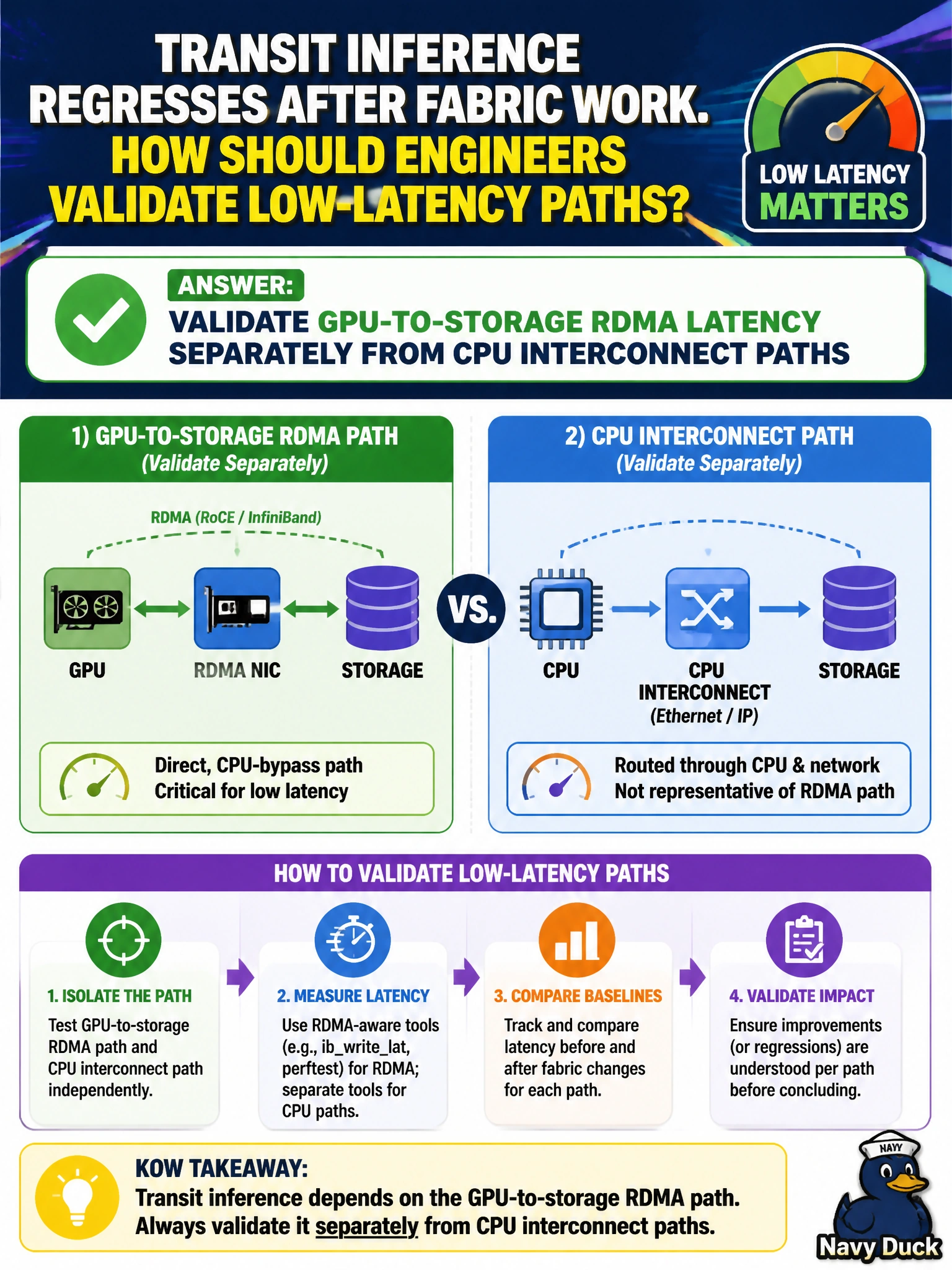
Inference can limp even when one path looks fine. Validate GPU-to-storage RDMA latency apart from CPU paths so transit engineers know which interconnect actually broke the budget.
Full Explanation
Transit inference that regresses after fabric work needs path isolation, not a single blended health story. Engineers should validate GPU-to-storage RDMA latency separately from CPU interconnect paths so a storage-path regression cannot hide behind a healthy GPU peer measurement, and vice versa. Separate validation maps the civic inference budget to the interconnect that actually broke.
Why the other options fail by concept: assuming every interconnect is healthy if one GPU peer ping succeeds overgeneralizes from a narrow sample and misses storage or CPU path faults. Checking only chassis fans skips latency entirely and cannot explain inference regression. Blending GPU, CPU, and storage latency into one opaque average erases which path failed and blocks targeted remediation on the transit fabric.
Exam caveat: RDMA latency tests (for example write-latency tools on InfiniBand or RoCE fabrics) are not interchangeable with management ICMP. Also separate east-west GPU collectives from north-south storage paths in the runbook so transit on-call does not apply the wrong fix.
Operational check: after fabric work, measure GPU-to-storage RDMA latency and CPU-related interconnect latency as distinct checks against prior baselines; if inference remains slow, open the ticket against the failing path class with numbers, not against “the fabric” as a whole.