
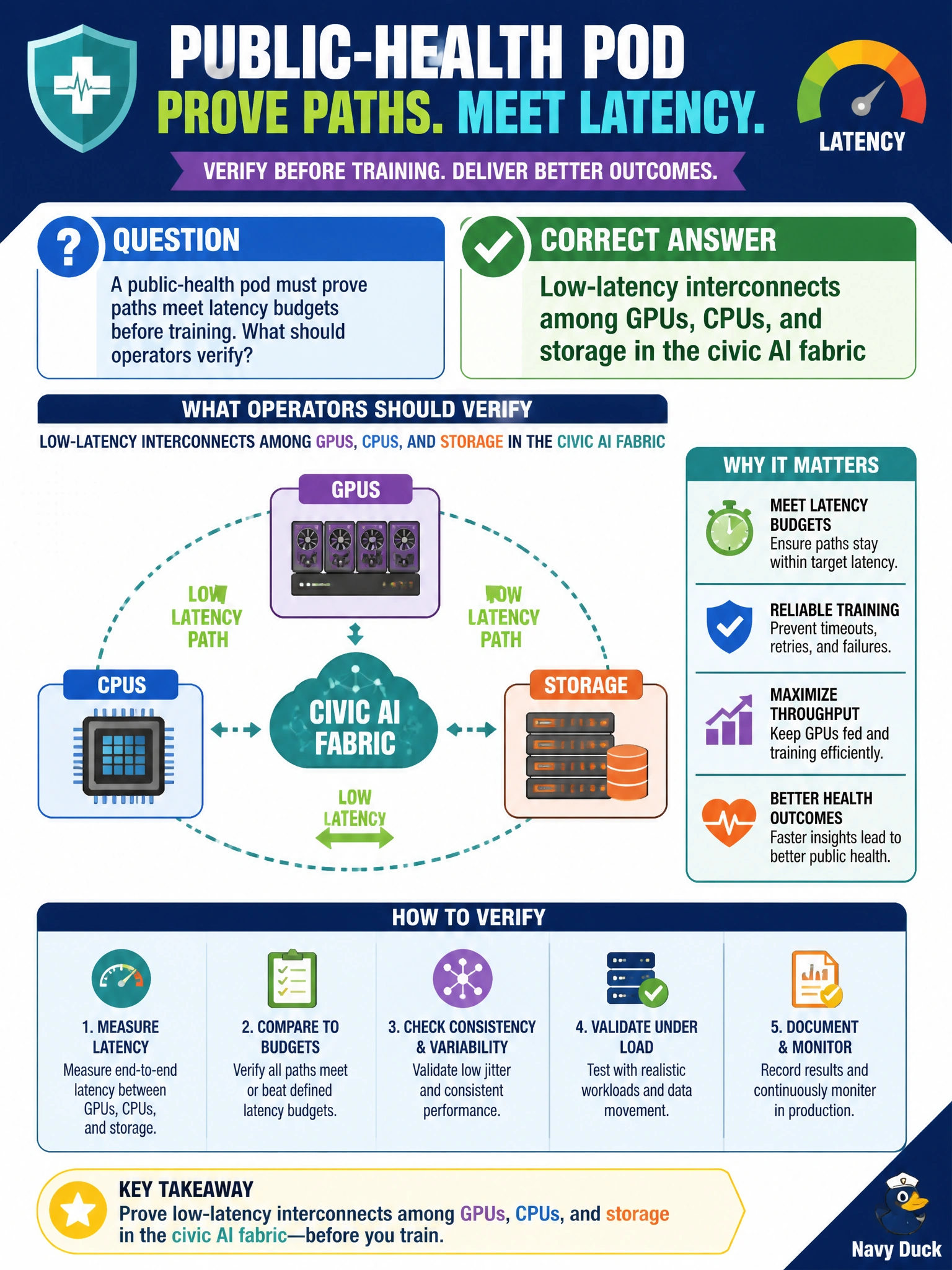
A public-health pod must prove paths meet latency budgets before training. What should operators verify?
Select an answer to reveal the explanation.
Short Explanation
Training budgets care about the whole hop chain, not one happy LED. Verify low-latency interconnects among GPUs, CPUs, and storage before the public-health pod starts training.
Full Explanation
A public-health pod that must prove paths meet latency budgets before training cannot stop at a single happy endpoint check. Operators must verify low-latency interconnects among GPUs, CPUs, and storage in the civic AI fabric, because training throughput and step time depend on the full data path—collective GPU traffic, host CPU involvement, and storage I/O—not on any one subsystem alone.
Why the other options fail by concept: Round-trip latency on the management VLAN between hosts and the top-of-rack switch measures only the management-plane hop to the access switch and does not prove GPU fabric, CPU, or storage RDMA latency across the AI data path. TCP round-trip time between the job scheduler and the management network interface fails because it measures the control/management plane, not the GPU, CPU, and storage data paths that actually carry training traffic; a healthy management-interface RTT says nothing about whether the AI fabric itself meets its latency budget. Published NVMe storage array throughput specifications from the equipment vendor fail as proof because a datasheet number describes the vendor's lab conditions, not this public-health pod's actual measured interconnect latency; acceptance needs measured evidence, not a spec sheet.
Exam caveat: “low latency” must be defined with numeric thresholds per path type (GPU-GPU, GPU-storage, CPU-facing links). Meeting a GPU peer latency target while storage NVMe-oF/RDMA misses budget still fails the pod’s training SLO. Measure under representative load, not idle pings alone.
Operational check: before starting public-health training, run documented latency checks across GPU, CPU, and storage interconnects against civic baselines, archive the results with the change ticket, and block the training start if any path exceeds the agreed budget.