
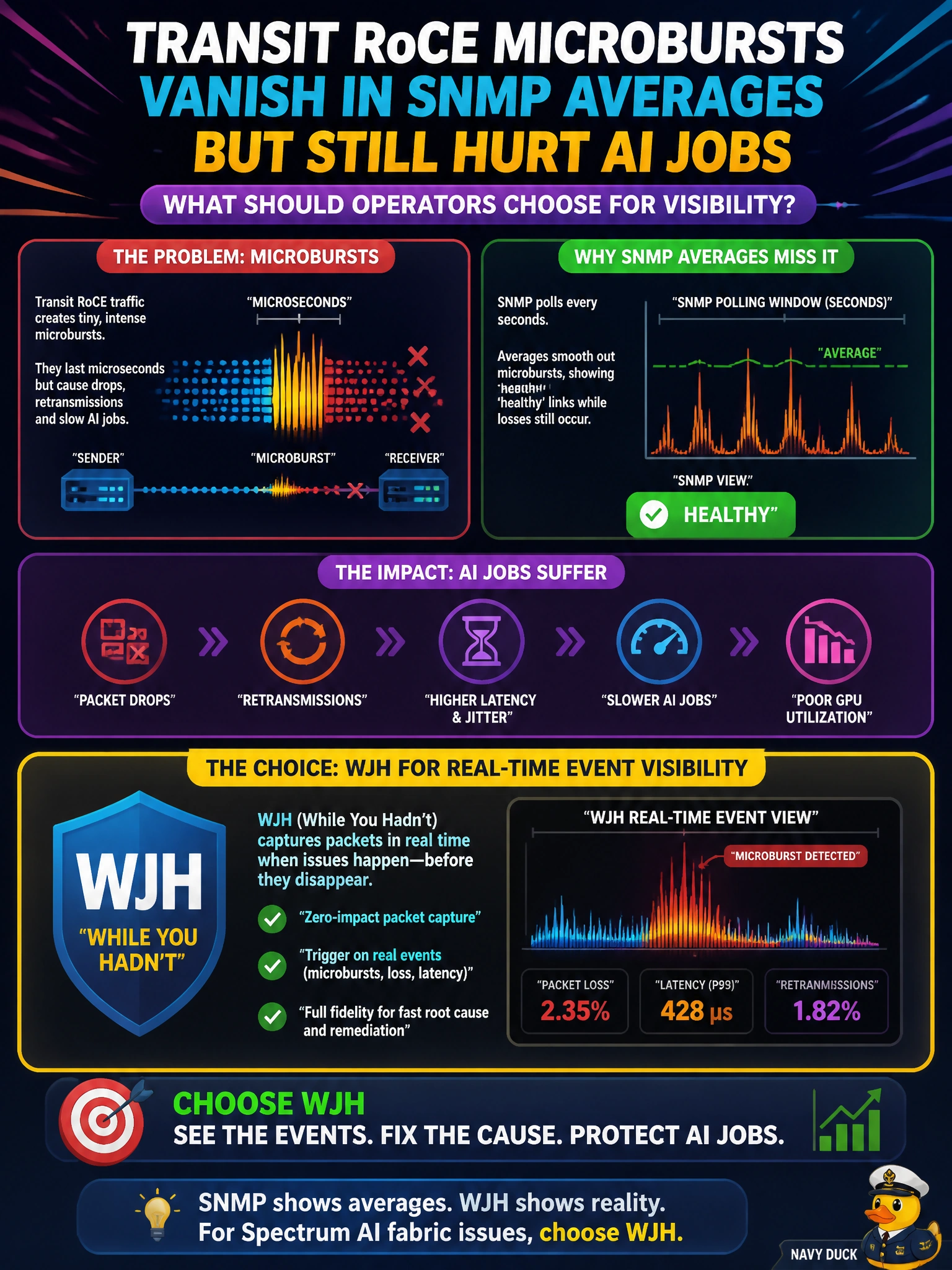
Transit RoCE microbursts vanish in SNMP averages but still hurt AI jobs. What should operators choose for visibility?
Select an answer to reveal the explanation.
Short Explanation
SNMP counters polled for capacity planning won’t catch microbursts. Choose WJH for real-time event visibility when transit RoCE spikes spank the Spectrum AI fabric.
Full Explanation
When transit RoCE microbursts vanish in SNMP averages but still hurt AI jobs, operators should choose WJH for real-time event visibility into Spectrum AI fabric issues. Microbursts are short-lived; SNMP interface counters polled for capacity planning routinely miss them while RDMA/RoCE flows experience loss, PFC storms, or latency spikes. WJH captures Spectrum events as they happen, giving municipal transit ML operators visibility into fabric issues that averaging erases.
Polling SNMP interface counters for capacity planning fails because SNMP poll intervals and averages cannot resolve microburst timescales or provide real-time event visibility into RoCE discards. Exporting sFlow samples for traffic profiling fails because sampled data cannot resolve microsecond microbursts or provide per-event switch visibility; microbursts commonly degrade RoCE AI jobs even when long-term averages look fine. Tuning ECN thresholds for RoCE congestion control fails as a visibility choice because it is a remediation action, not an event-detection tool; it adjusts congestion behavior rather than revealing the transient discard and latency events that WJH captures in real time.
Exam caveat: WJH provides real-time Spectrum event visibility; it does not by itself retune congestion control or buffer configuration. After WJH identifies the event class, apply the appropriate RoCE/PFC/ECN or topology fix.
Operational check: On the transit Spectrum AI fabric, enable WJH, reproduce or wait for a RoCE-sensitive workload period, confirm microburst-related or discard events appear in WJH while SNMP averages stay flat, and update the runbook so microburst complaints start with WJH rather than polling SNMP interface counters for capacity planning.