
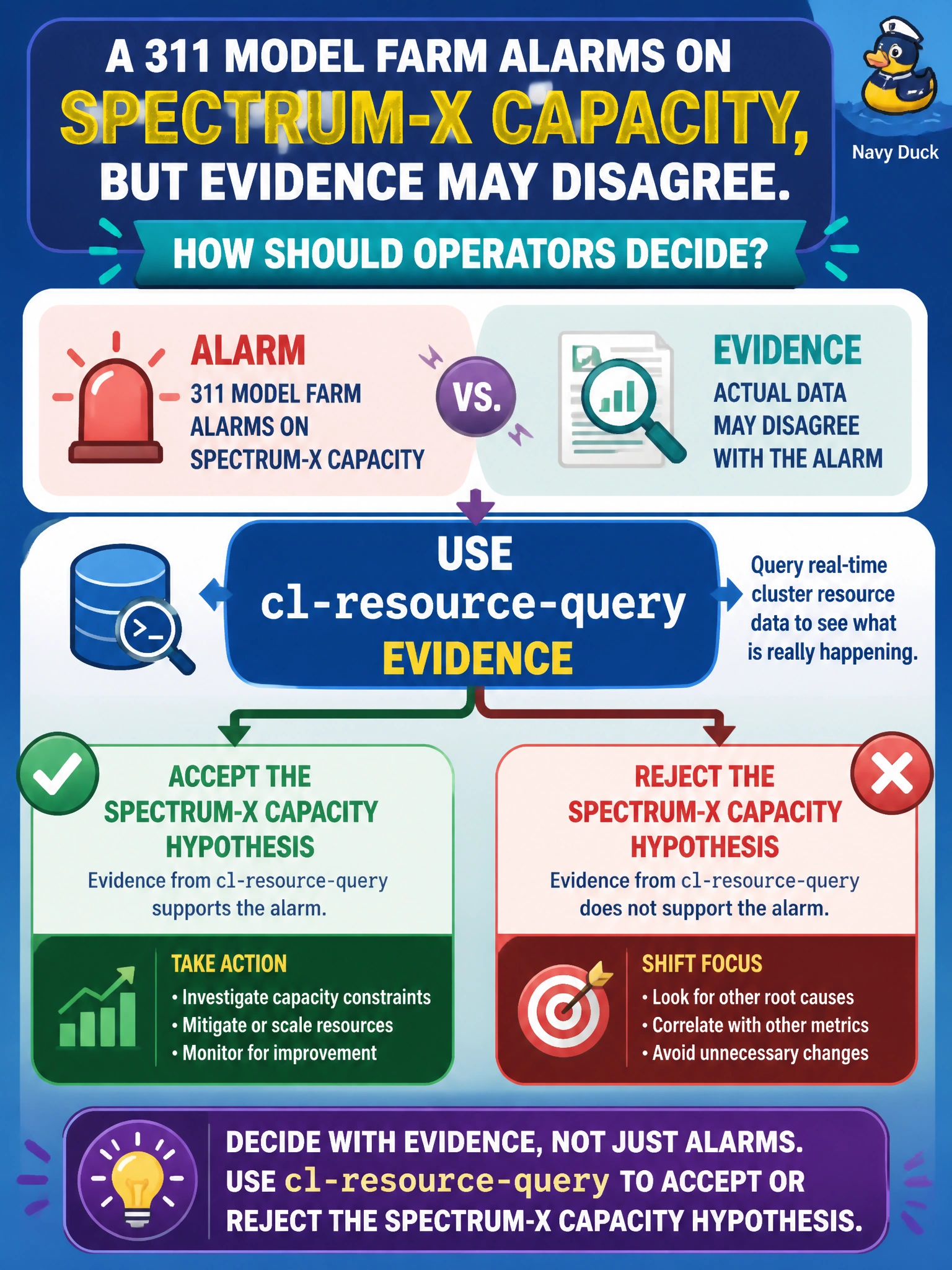
A 311 model farm alarms on Spectrum-X capacity, but evidence may disagree. How should operators decide?
Select an answer to reveal the explanation.
Short Explanation
NVLink counters and Slurm queue depth measure the wrong fabric entirely. Run cl-resource-query against Spectrum-X so you're accepting or rejecting that capacity alarm with real ASIC table evidence.
Full Explanation
When a 311 model farm alarms on Spectrum-X capacity but evidence may disagree, operators should use cl-resource-query evidence to accept or reject the Spectrum-X capacity hypothesis. Alarms are hypotheses until measured: querying allocation confirms whether capacity is truly constrained or whether the alert is noisy, mis-thresholded, or symptomatic of another fault. Municipal 311 AI platforms avoid both under-reaction and wasteful expansion by insisting on that evidence gate.
Inspecting NVLink bandwidth counters to confirm the Spectrum-X congestion source fails as expensive misdirection—NVLink is a separate GPU interconnect, not Spectrum-X, so its counters cannot validate the Spectrum-X capacity hypothesis or replace cl-resource-query. Reviewing Slurm queue depth to validate the Spectrum-X bandwidth saturation claim fails operationally; queue depth reflects job backlog, not fabric capacity, so it cannot confirm Spectrum-X exhaustion and should not replace cl-resource-query evidence. Examining reported InfiniBand fabric telemetry to confirm Spectrum-X capacity exhaustion fails as destructive anti-observability—InfiniBand is a different fabric from Spectrum-X, so its telemetry cannot confirm Spectrum-X capacity and relying on it hides future genuine exhaustion.
Exam caveat: Accept or reject based on cl-resource-query evidence; do not treat the tool output as optional decoration after a decision already made. If evidence confirms pressure, act; if not, tune alerts and continue triage elsewhere.
Operational check: On the alarming 311 Spectrum-X fabric, run cl-resource-query, compare against alert thresholds and historical baselines, formally accept or reject the capacity hypothesis in the ticket, and only then approve expansion, alert tuning, or alternate root-cause investigation.