
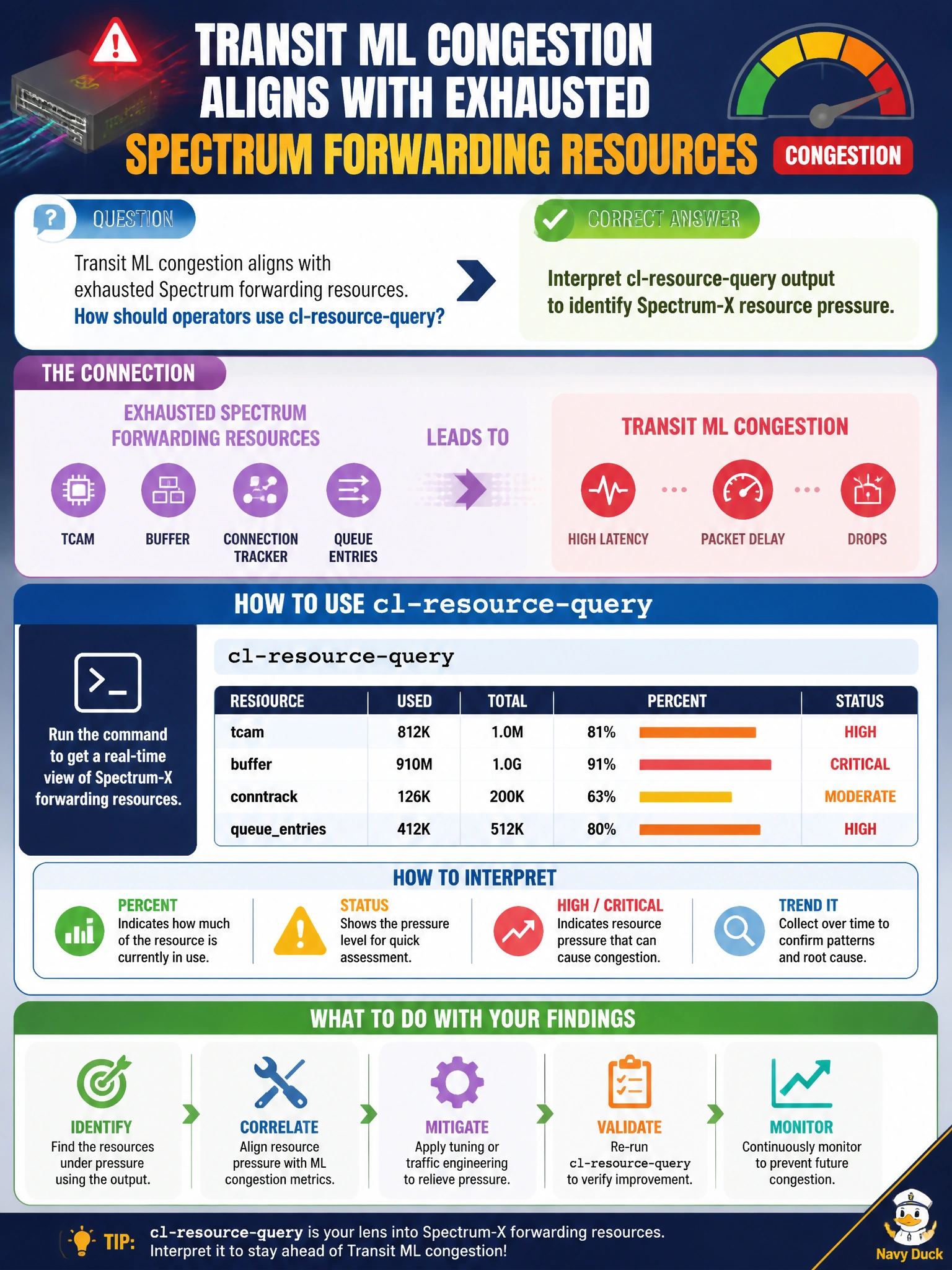
Transit ML congestion aligns with exhausted Spectrum forwarding resources. How should operators use cl-resource-query?
Select an answer to reveal the explanation.
Short Explanation
The tool already drew the pressure map—read it. Use cl-resource-query output to spot Spectrum-X resource pressure behind that transit ML congestion.
Full Explanation
When transit ML congestion aligns with exhausted Spectrum forwarding resources, operators should interpret cl-resource-query output to identify Spectrum-X resource pressure. The tool value is analytical: reading which resource pools are depleted or near limit explains why forwarding performance collapses under ML east-west load. Using cl-resource-query output to provision Spectrum-X link speed and breakout modes misapplies the tool, which is meant to reveal resource pressure, not to configure link speed or breakout modes.
Using cl-resource-query output to provision Spectrum-X link speed and breakout modes fails because it confuses diagnosis with configuration and abandons the evidence the tool provides. Checking cl-resource-query output to validate InfiniBand partition membership for hosts fails conceptually: Spectrum-X Ethernet resource counters do not report InfiniBand partition membership, and the tool is meant to measure forwarding resource pressure, not validate host partition membership. Reviewing cl-resource-query output to confirm RoCE ECN marking thresholds on queues fails operationally—the tool shows forwarding resource allocation and depletion, not queue ECN threshold configuration, and it cannot confirm threshold settings for an active congestion incident.
Exam caveat: Interpretation requires understanding baseline versus pressure. Not every elevated counter is exhaustion; compare against capacity and correlate with the transit ML traffic pattern that triggered the incident.
Operational check: During the congestion window, run cl-resource-query on implicated Spectrum-X switches, identify the constrained resource classes, map them to recent scale changes (routes, ACLs, tunnels), and decide whether to reduce scale, change profiles, or expand capacity. Record the interpreted findings in the transit NOC ticket.