
A transit ML platform’s GPU pods must attach InfiniBand/RDMA devices in Kubernetes. What deployment should operators choose?
Select an answer to reveal the explanation.
Short Explanation
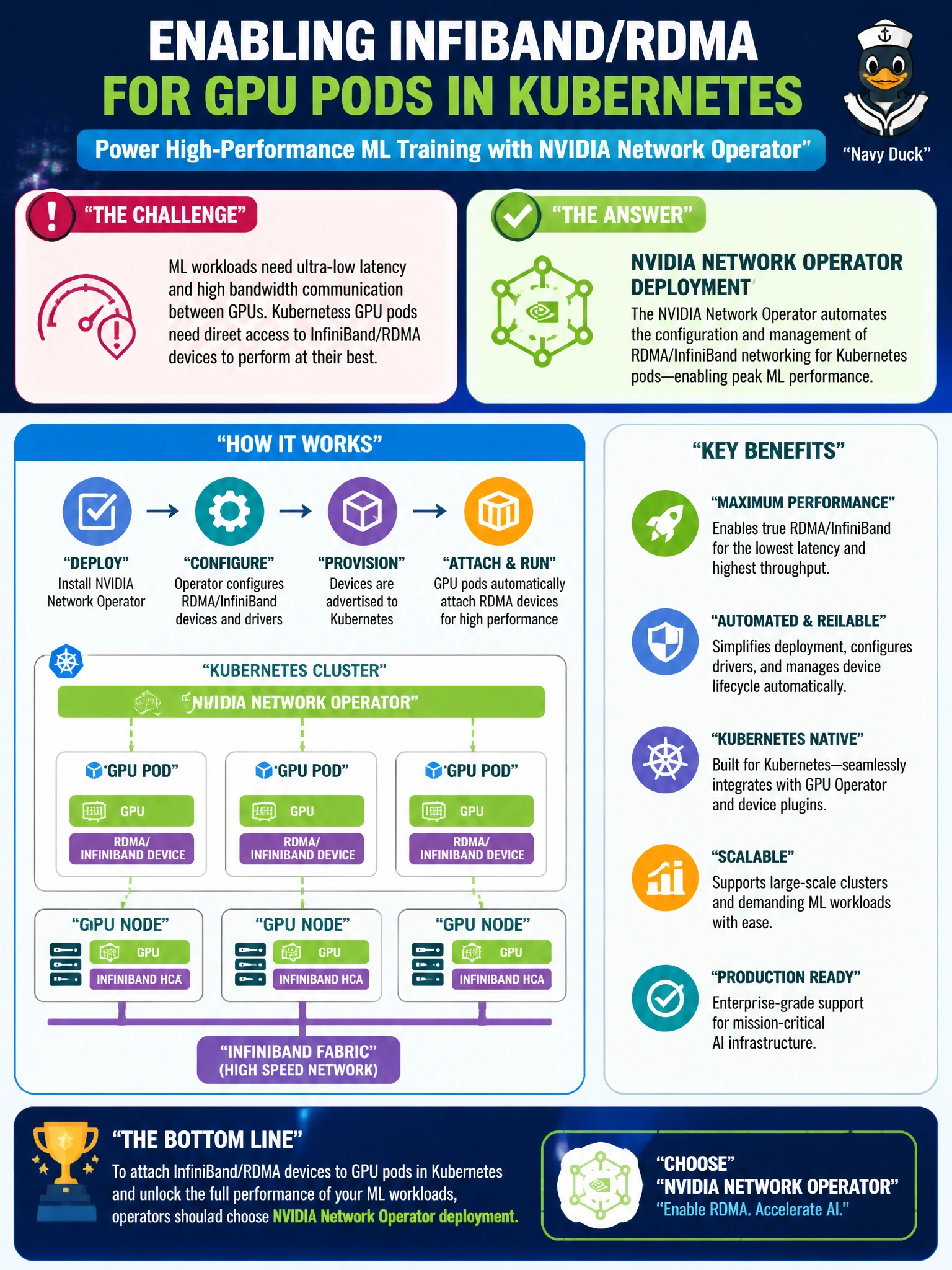
Transit GPUs need a real RDMA driveway, not an SR-IOV Ethernet VF detour. Choose NVIDIA Network Operator deployment so Kubernetes pods can attach InfiniBand/RDMA devices.
Full Explanation
A transit ML platform whose GPU pods must attach InfiniBand/RDMA devices in Kubernetes should choose NVIDIA Network Operator deployment. That deployment is the supported way to enable RDMA/InfiniBand attachment for Kubernetes pods on NVIDIA-centric fabrics: it installs and manages the components that advertise RDMA devices to the kubelet and wire secondary networks for fabric-attached workloads. Transit congestion and forecasting models that rely on GPU collectives need that fabric path, not a Multus bridge CNI secondary attachment.
A Multus secondary attachment with bridge CNI for GPU pod networking fails because bridge CNI does not expose InfiniBand RDMA devices or deliver the low-latency fabric path those ML pods require. An SR-IOV Network Operator deployment for Ethernet VFs in GPU namespaces fails because Ethernet virtual functions cannot carry InfiniBand RDMA traffic or provide the fabric-level latency those ML pods require. Manual host-device CNI configuration with static InfiniBand driver install on nodes fails because it lacks the operator-managed lifecycle to advertise RDMA devices to Kubernetes pods and ensure consistent fabric attachment across the cluster.
Exam caveat: Network Operator deployment assumes compatible NVIDIA drivers, MOFED/RDMA stacks, and InfiniBand fabric readiness on the nodes. The operator cannot create RDMA where the host or fabric is not prepared.
Operational check: Deploy the Network Operator on the transit ML Kubernetes platform, confirm RDMA resources are advertised on GPU workers, attach a test pod with InfiniBand/RDMA, and validate RDMA connectivity between GPU pods before promoting production congestion models to fabric-attached networking.