
A public-health Kubernetes cluster needs inference pods to use RDMA/InfiniBand interfaces. What should operators deploy?
Select an answer to reveal the explanation.
Short Explanation
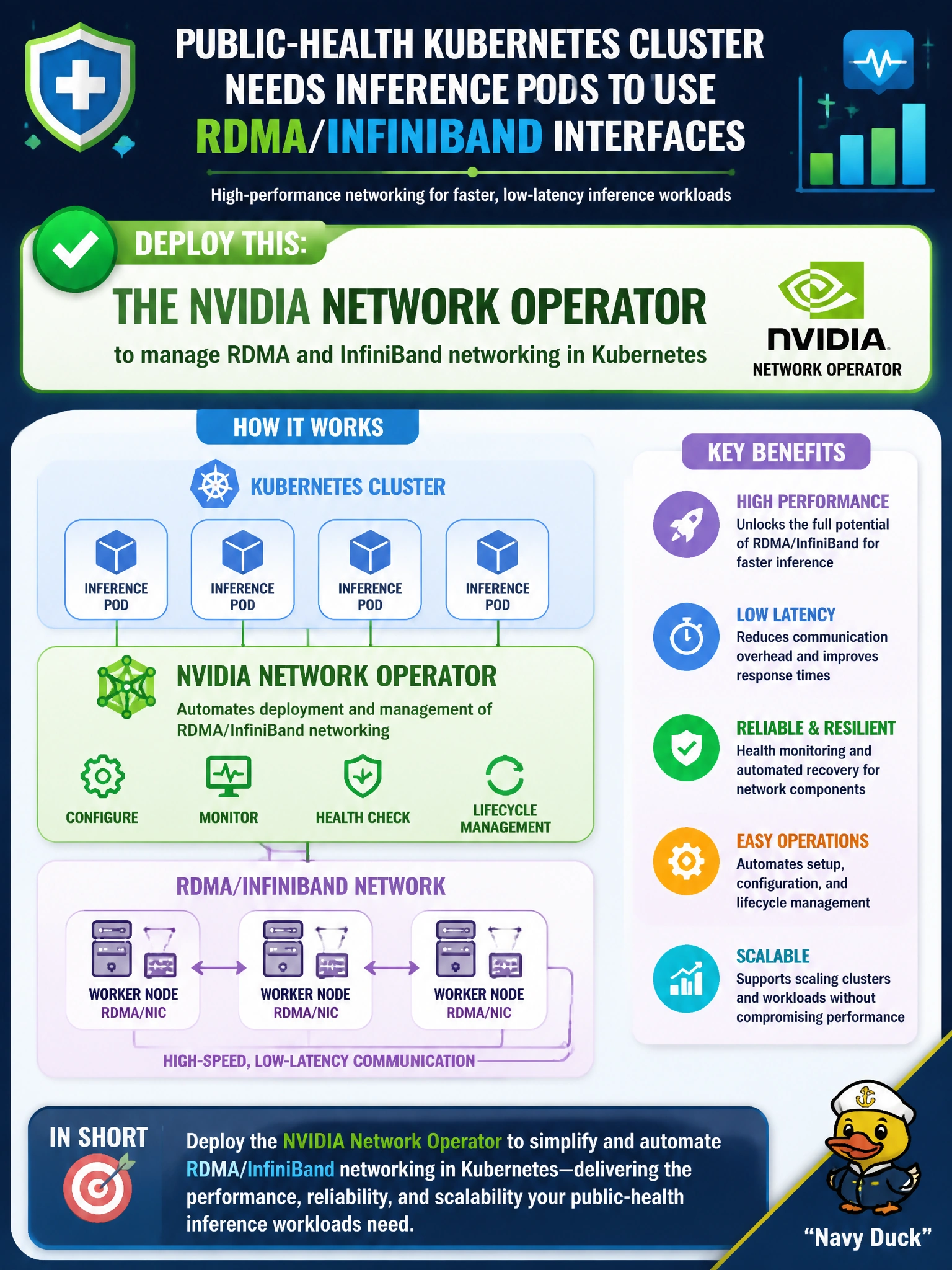
Pods don’t magically grow InfiniBand NICs. Deploy the NVIDIA Network Operator so the public-health cluster can hand RDMA/IB interfaces to inference workloads.
Full Explanation
A public-health Kubernetes cluster that needs inference pods to use RDMA/InfiniBand interfaces should deploy the NVIDIA Network Operator to manage RDMA and InfiniBand networking in Kubernetes. The Network Operator orchestrates the device plugins, drivers, and secondary-network plumbing required so pods can request and attach RDMA-capable interfaces. For civic inference workloads that depend on low-latency GPU fabric paths, that operator-managed path is the supported enablement model rather than ad-hoc host networking hacks.
The Multus CNI to add secondary interfaces for pods requiring high-performance fabrics fails because Multus is only a CNI multiplexer; it does not manage RDMA or InfiniBand device plugins, drivers, or fabric attachment, so it cannot make IB/RDMA devices schedulable Kubernetes resources on its own. The SR-IOV Network Operator to expose virtual functions for pod networking on nodes fails because SR-IOV only exposes generic virtual functions and does not provide the NVIDIA RDMA/InfiniBand device plugins, drivers, or fabric plumbing that inference pods require. The Calico CNI with BGP peering to optimize pod overlay routing for inference traffic fails because Calico handles IP overlay routing and BGP peering, not RDMA/InfiniBand device plugins, IB hardware exposure, or secondary fabric attachment for pods.
Exam caveat: Installing the Network Operator is necessary enablement, not automatic proof that every inference Deployment is RDMA-ready. Workloads still need correct resource requests, network attachment definitions, and node labeling consistent with municipal policy.
Operational check: Deploy the NVIDIA Network Operator into the public-health cluster, verify operator pods are healthy, confirm RDMA device plugins and InfiniBand-related CRDs or network attachments appear, and schedule a canary inference pod that successfully binds an RDMA/IB interface before wider rollout.