
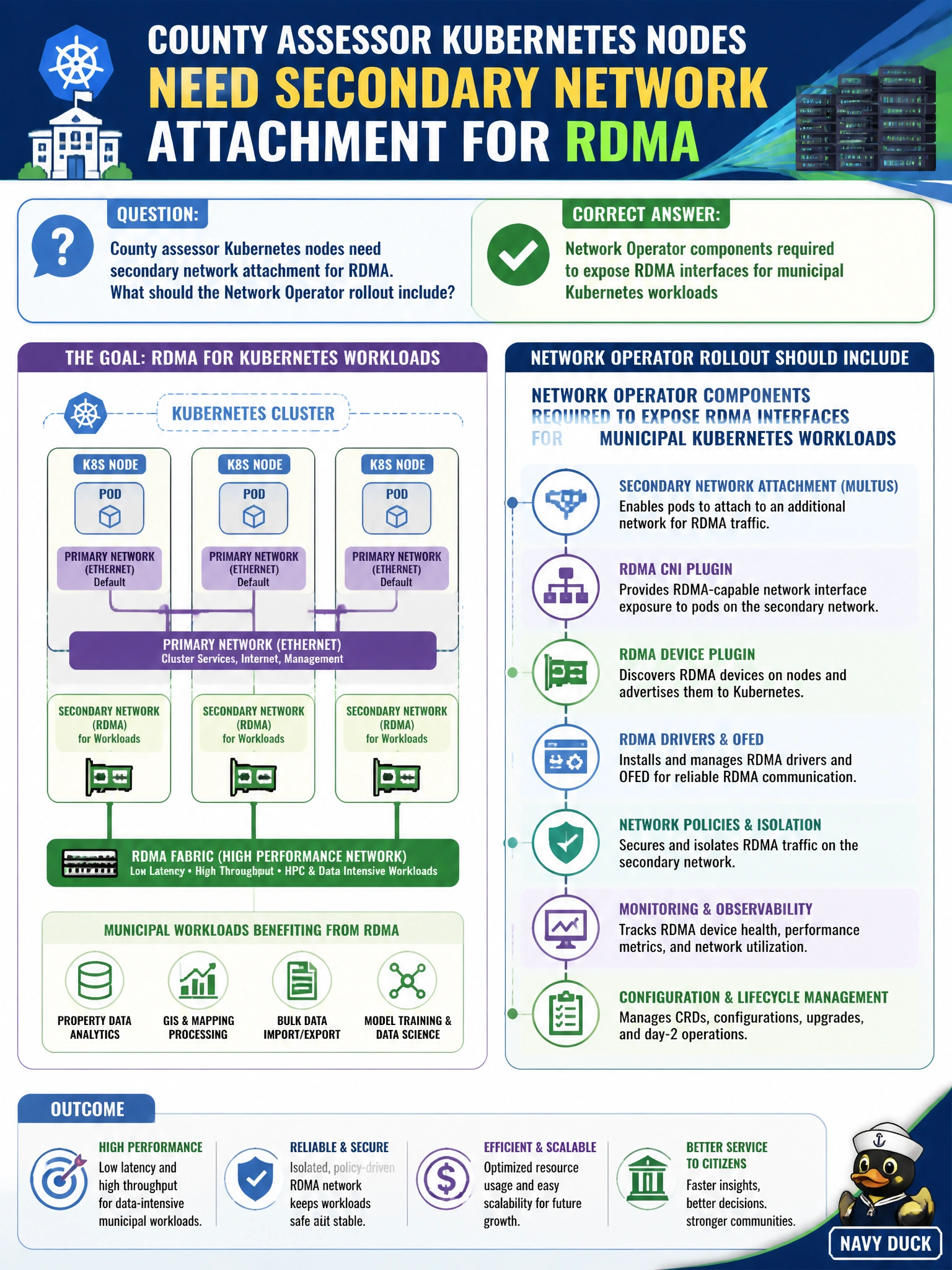
County assessor Kubernetes nodes need secondary network attachment for RDMA. What should the Network Operator rollout include?
Select an answer to reveal the explanation.
Short Explanation
SR-IOV VLAN segmentation over standard Ethernet isn’t going to expose RDMA interfaces for your county assessor nodes. Roll out the Network Operator pieces that actually expose RDMA interfaces on the county assessor Kubernetes nodes.
Full Explanation
For county assessor Kubernetes nodes that need secondary network attachment for RDMA, the Network Operator rollout must include the components required to expose RDMA interfaces for municipal Kubernetes workloads. That typically means the operator control plane plus device plugin and secondary-network pieces that create attachable RDMA/InfiniBand interfaces. A complete rollout is what turns InfiniBand from a host capability into a Kubernetes-schedulable network resource for assessor analytics.
Deploying SR-IOV Network Operator policies for municipal VLAN segmentation over standard Ethernet fails because it only segments regular Ethernet traffic and does not expose RDMA devices or secondary RDMA networks. Deploying Multus bridge CNI attachments for municipal pod connectivity using the default TCP stack fails because it provides ordinary TCP/IP pod connectivity rather than the attachable RDMA/InfiniBand interfaces secondary RDMA networking depends on. Using Host-device CNI attachments mapping physical NICs directly for municipal low-latency application pods fails as an incomplete approach: it maps a physical NIC but does not include the operator control plane, device plugin, and secondary-network pieces needed to expose RDMA as a Kubernetes-schedulable resource for worker workloads.
Exam caveat: Network Operator components is the conceptual answer; exact CRD and plugin names can vary by version. Focus on the requirement that RDMA interfaces are exposed for workloads, not on memorizing every subchart name.
Operational check: Review the county assessor Network Operator Helm values or manifests for RDMA/IB enablement, apply the rollout, verify device plugins and secondary network attachments exist on workers, and run a sample pod that receives an RDMA interface via the secondary network path.