
Water-utility on-call repairs an InfiniBand link and needs confirmation it is healthy again. What should they check?
Select an answer to reveal the explanation.
Short Explanation
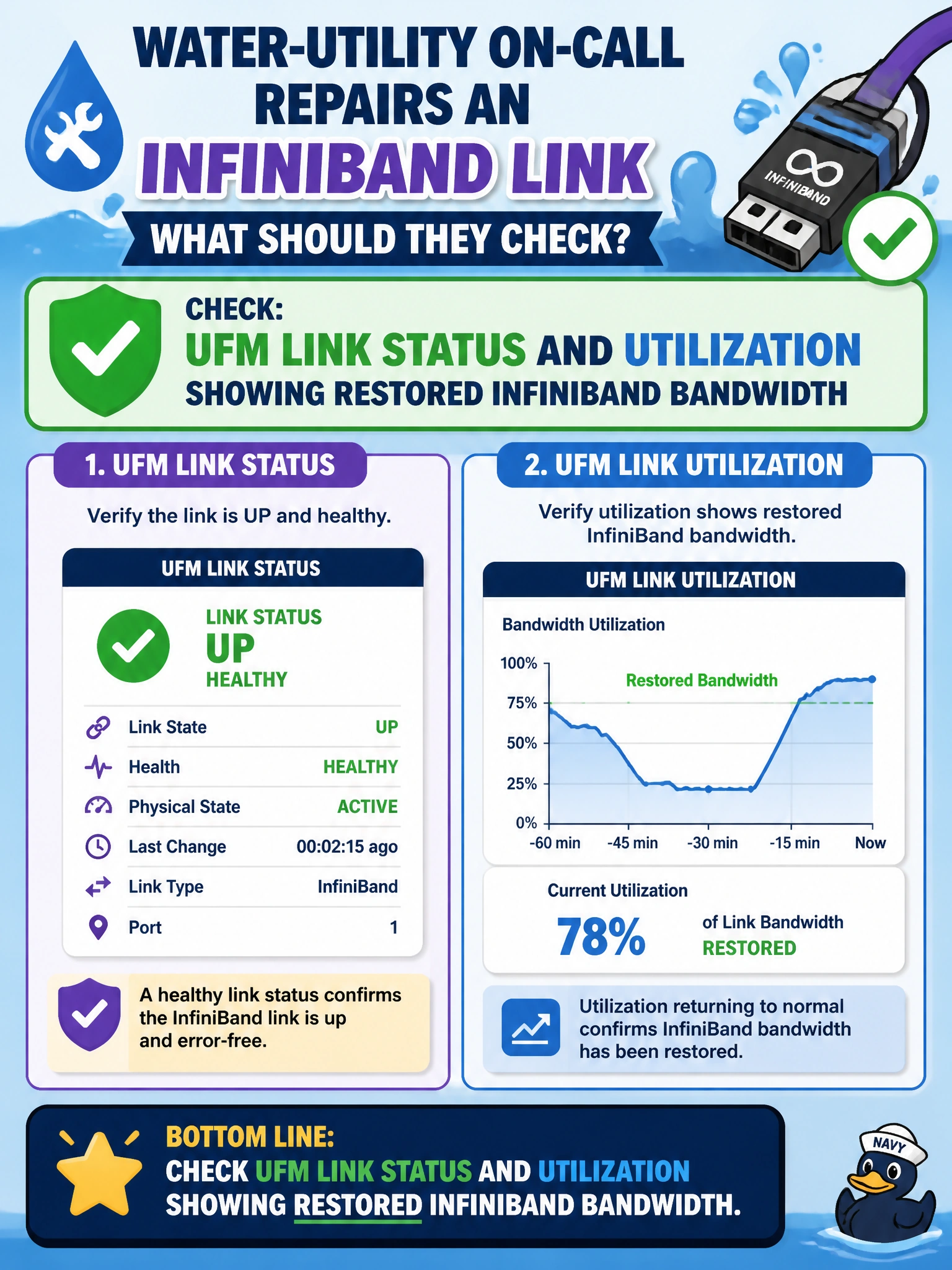
Cable reseated? Great — now prove the water still flows. Check UFM link status and utilization so water-utility on-call can confirm restored InfiniBand bandwidth after the repair.
Full Explanation
After water-utility on-call repairs an InfiniBand link, confirmation that it is healthy again requires checking UFM link status and utilization showing restored InfiniBand bandwidth. Closing the incident without fabric metrics leaves open the risk that an optical, connector, or port issue remains intermittent under load. UFM evidence that the link is up, stable, and carrying expected bandwidth is the civic standard for IB repair validation.
Checking UFM optical transceiver temperature telemetry indicating stable thermal operation fails by concept because stable temperature alone does not confirm the repaired link is actually up and passing traffic at expected bandwidth—a transceiver can read thermally normal while still being down, errored, or underutilized. Checking UFM subnet manager failover state reflecting standby manager election readiness fails because subnet-manager redundancy is a control-plane property of the fabric as a whole; it says nothing about whether this specific repaired link and its ports are healthy. Checking UFM congestion control settings displaying historic traffic throttling profiles fails because historic throttling configuration describes past policy, not the current state and bandwidth of the link that was just repaired.
Exam caveat: validate the same plane you repaired—InfiniBand repairs close with UFM IB link and utilization metrics, not Ethernet adjacency tables or ticket workflow alone. Operational check: after the repair, confirm UFM shows the link up, error counters quiet, and utilization returning under a brief water-utility test flow; only then clear the incident and note the UFM evidence in the runbook.