
School-district staff see InfiniBand job slowdowns and need a fabric correlation habit. What should they learn to do?
Select an answer to reveal the explanation.
Short Explanation
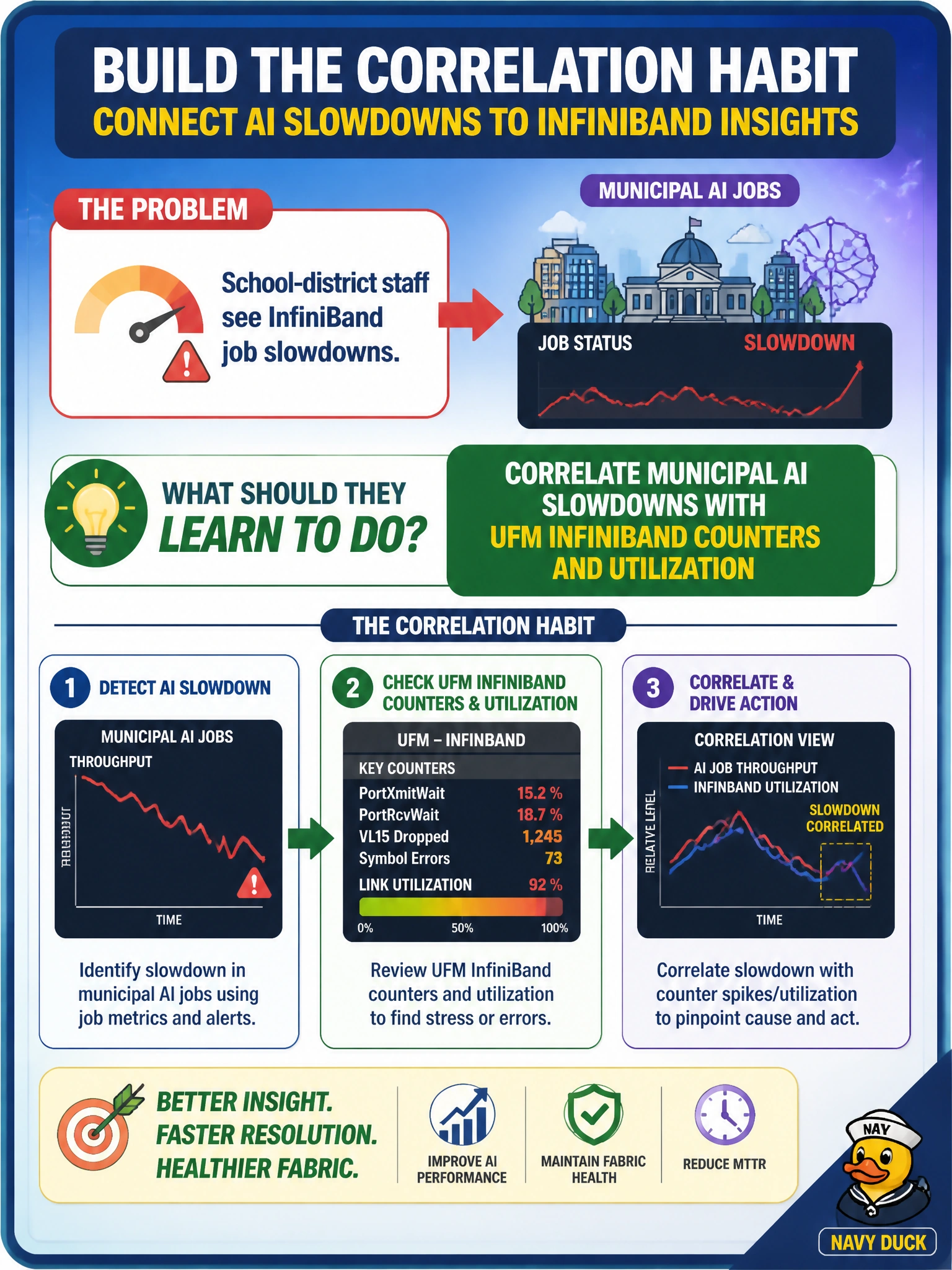
Slow jobs without fabric numbers is just storytelling. Teach school-district staff to correlate municipal AI slowdowns with UFM InfiniBand counters and utilization.
Full Explanation
School-district staff who see InfiniBand job slowdowns need a fabric correlation habit: correlate municipal AI slowdowns with UFM InfiniBand counters and utilization. Job logs alone rarely distinguish GPU compute stalls from IB congestion, symbol errors, or hot links, so teaching staff to pull UFM evidence beside job timestamps builds the correct civic troubleshooting loop before escalating hardware swaps.
Blaming GPUs only and never opening UFM during slowdowns fails by concept because it ignores the fabric as a first-class failure domain and wastes cycles on the wrong subsystem. Ignoring fabric counters because job logs are always sufficient alone fails because application logs seldom encode IB utilization or link errors. Correlating only Ethernet DHCP leases with InfiniBand training stalls fails because DHCP lease events do not explain IB data-plane slowdowns on the teaching fabric.
Exam caveat: correlation means time-aligning workload symptoms with UFM IB metrics—not random Ethernet management events or GPU-only narratives when the stem points at fabric habit. Operational check: on the next school-district slowdown, capture job timestamps, open matching UFM counter and utilization windows, record whether IB health explains the stall, and escalate to GPU-deep analysis only after fabric correlation is documented.