
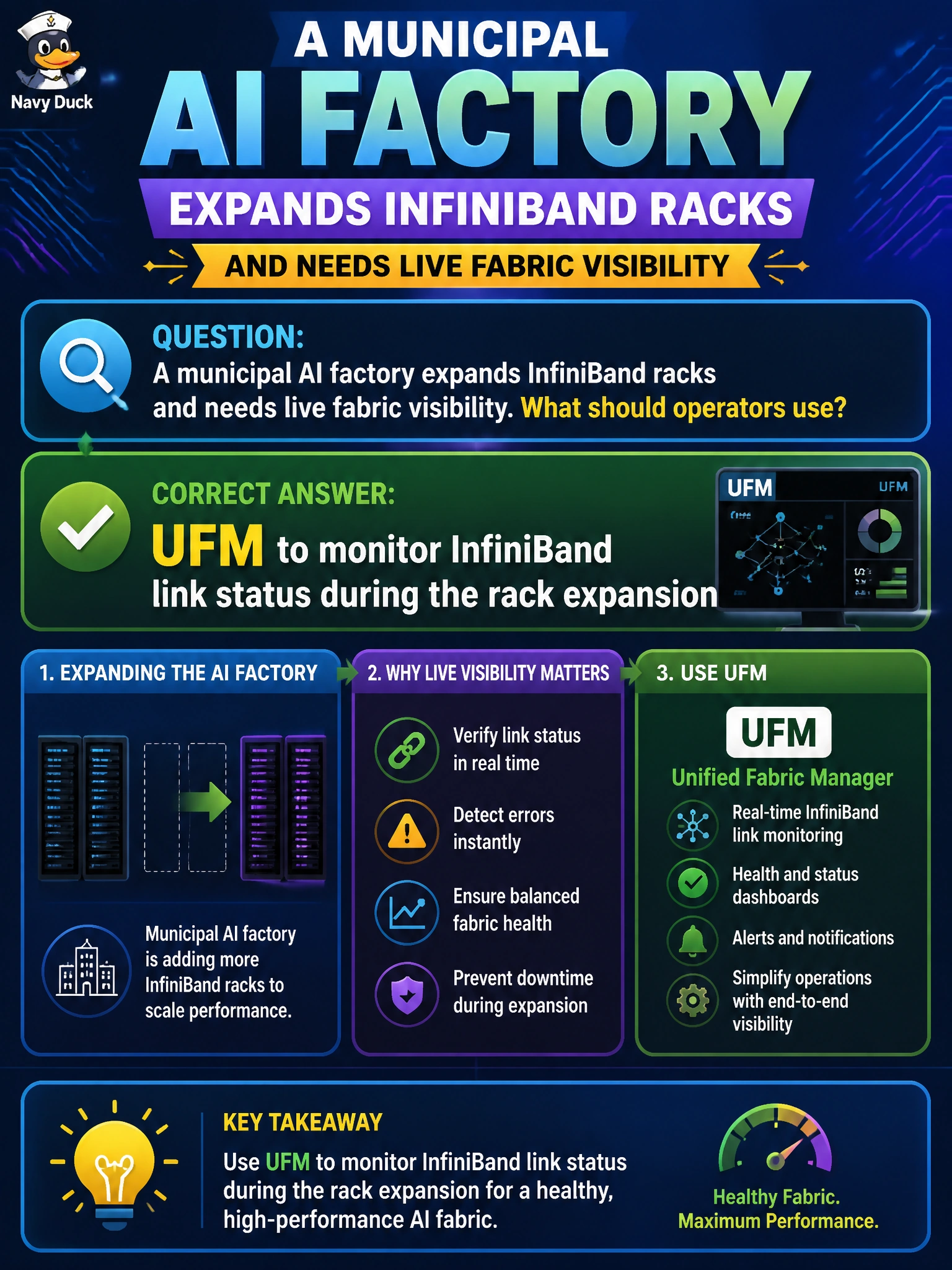
A municipal AI factory expands InfiniBand racks and needs live fabric visibility. What should operators use?
Select an answer to reveal the explanation.
Short Explanation
Growing the IB row without a fabric dashboard is flying blind. Use UFM to watch InfiniBand link status while the municipal AI factory expands racks.
Full Explanation
As a municipal AI factory expands InfiniBand racks, operators need live fabric visibility and should use UFM to monitor InfiniBand link status during the expansion. UFM is the InfiniBand-focused platform for topology, link state, and related health views, so rack adds, new spines, and HCA attachments can be watched in real time rather than inferred after jobs fail. That continuous IB visibility is the right civic ops choice during growth windows.
Relying only on NetQ to track InfiniBand fabric events during the rack expansion fails by concept because NetQ is not the InfiniBand link-state plane and does not provide fabric-wide IB link correlation, history, or multi-rack situational awareness. Using DCGM to report GPU utilization as fabric visibility during expansion fails because DCGM observes GPU metrics, not IB link state or IB fabric topology. Relying on ibdiagnet scans after maintenance to audit InfiniBand topology changes fails because after-the-fact scans are not the primary IB monitoring plane and cannot correlate expansion traffic to link state in real time.
Exam caveat: GPU utilization tools complement infrastructure metrics but do not replace UFM for InfiniBand link-status monitoring on the AI factory data fabric. Operational check: keep UFM open through the rack expansion, verify new links show healthy status as they come online, and pause go-live if UFM reports down or degraded IB links.