
Courts InfiniBand batch windows must not outrank daytime interactive inference. How should operators set QoS?
Select an answer to reveal the explanation.
Short Explanation
Matching service levels or separate partition keys alone won't make batch yield to the clerks. Set batch's InfiniBand QoS priority lower than daytime interactive inference, so you keep courts traffic responsive during business hours.
Full Explanation
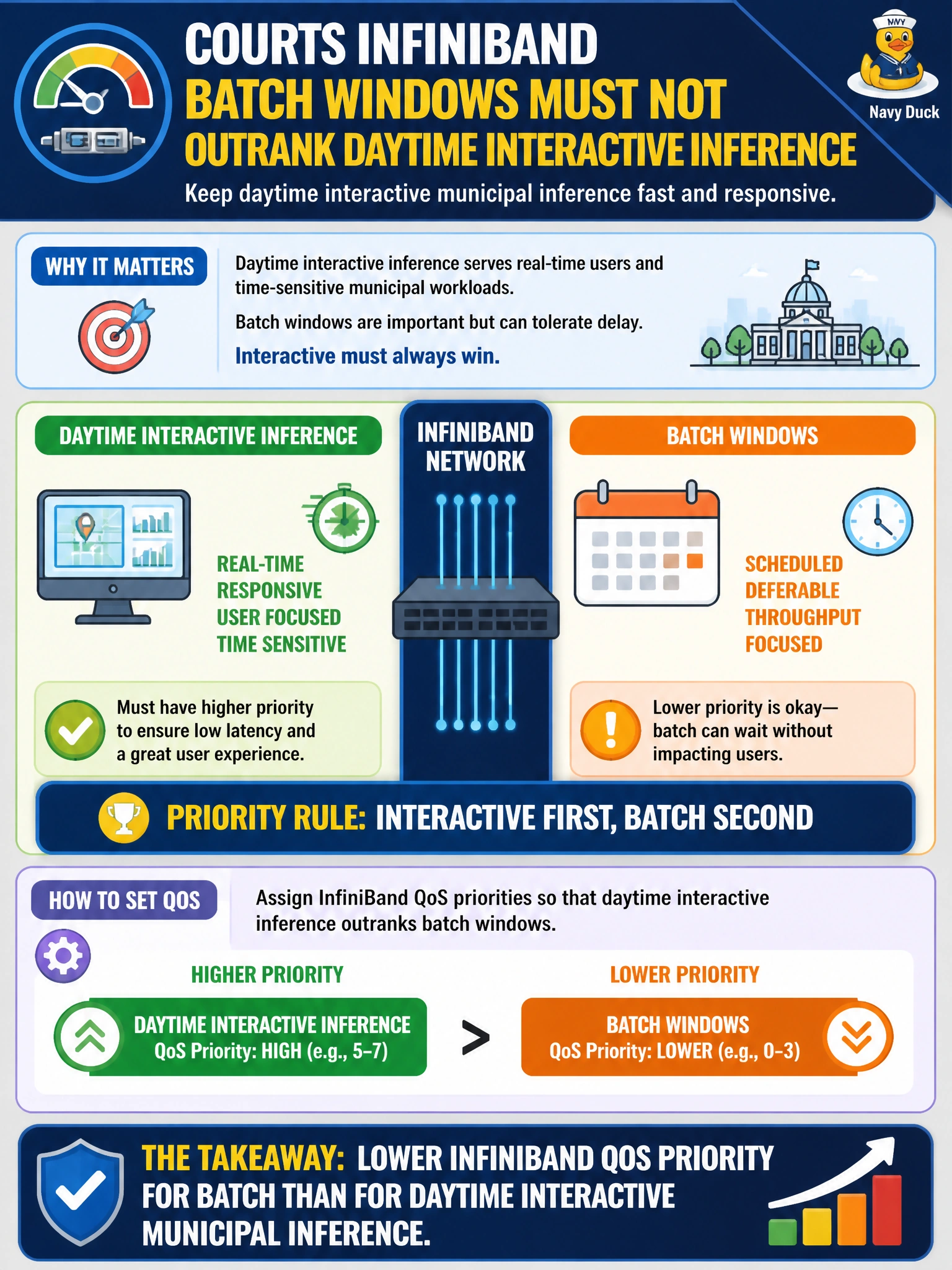
Courts InfiniBand batch windows must not outrank daytime interactive inference, so operators should set lower InfiniBand QoS priority for batch than for daytime interactive municipal inference. Clerks and court applications need responsive queues during business hours; overnight or off-hours batch must yield under QoS arbitration when both contend. That priority ordering matches civic operating hours and user-facing SLAs.
Assign matching InfiniBand service levels to batch and daytime interactive municipal inference fails because it gives batch the same standing as daytime interactive municipal inference, letting bulk work compete on equal terms with the clerks the stem protects. Create dedicated InfiniBand partition keys for batch and daytime interactive municipal inference flows fails because separate partitions alone do not establish the needed priority ordering—batch can still contend for the same fabric resources without a lower QoS priority. Enable InfiniBand adaptive routing for batch while preserving daytime interactive service levels fails because adaptive routing changes path selection, not QoS arbitration; it does not ensure batch yields to daytime interactive municipal inference when both contend.
Exam caveat: dedicated partition keys alone are not QoS priority—separating batch and daytime interactive municipal inference into different partitions does not by itself make batch yield to the higher service level that interactive courts inference needs. Operational check: map daytime interactive inference to a higher IB service level than batch, overlap a batch window with business hours in test, and confirm clerk-facing latency remains preferred in UFM/queue metrics.