
Public-works InfiniBand jobs fight unfairly for congested paths. What should operators select to improve multi-job fairness?
Select an answer to reveal the explanation.
Short Explanation
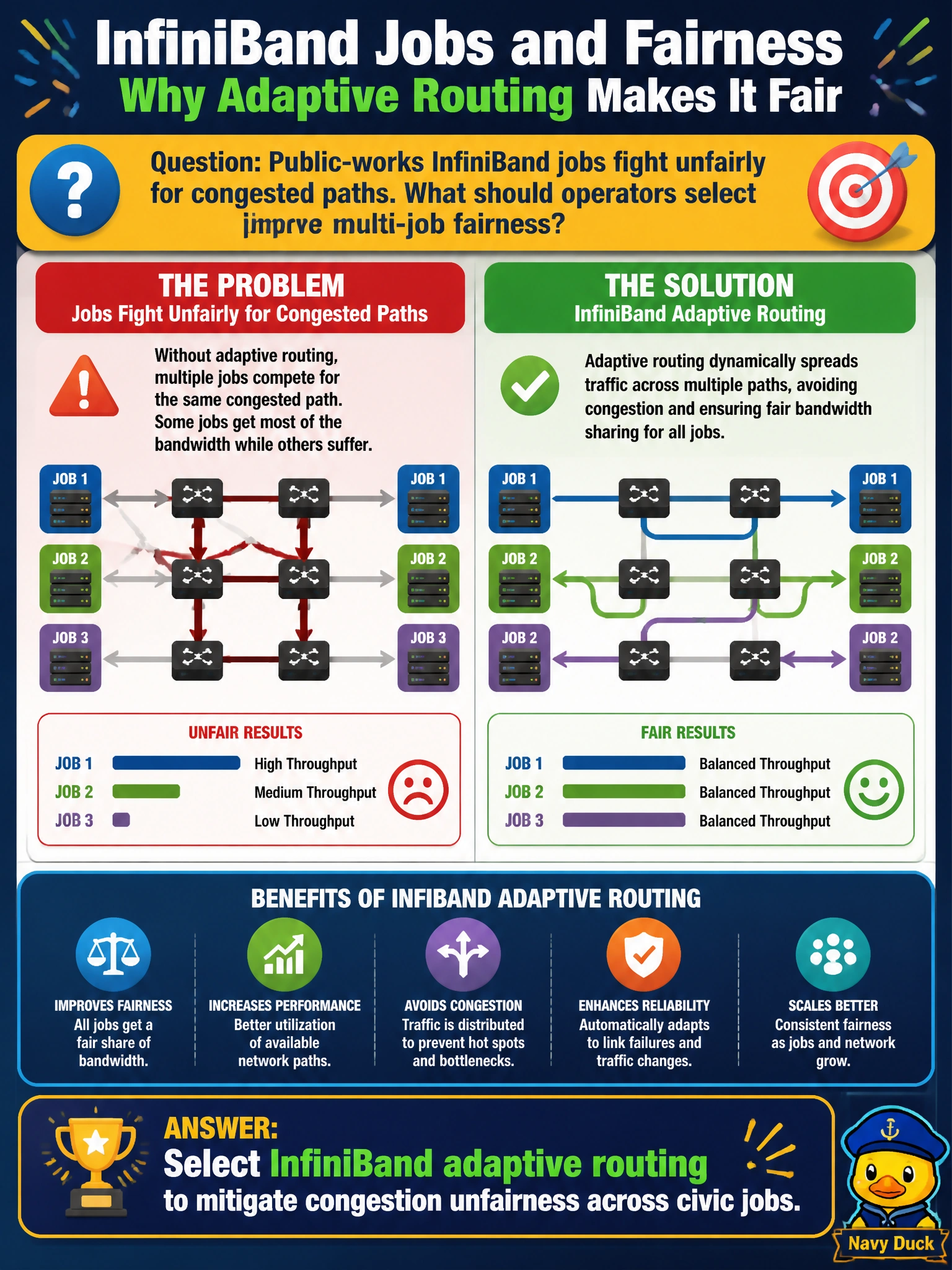
When jobs bully each other for the same clogged path, give the fabric smarter lanes. Select InfiniBand adaptive routing so public-works civic jobs share congestion more fairly.
Full Explanation
When public-works InfiniBand jobs fight unfairly for congested paths, operators should select InfiniBand adaptive routing to mitigate congestion unfairness across civic jobs. AR lets flows shift onto alternate paths so one job cannot permanently dominate a single hot link while others stall. That dynamic redistribution improves multi-job fairness under congestion on shared municipal IB fabrics.
Deterministic fat-tree routing with fixed shortest paths for civic jobs fails because it pins traffic to fixed routes, so congested links stay hot and later jobs cannot shift to alternate paths. InfiniBand partition enforcement with dedicated PKeys for civic jobs fails because PKeys isolate traffic by partition but do not redistribute flows across congested links or adapt to hot spots. Raising InfiniBand path MTU to 4096-byte frames to boost throughput for civic jobs fails because larger frames do not change path selection and cannot relieve congestion unfairness among competing jobs.
Exam caveat: adaptive routing improves path fairness under congestion; QoS improves class priority. If the stem emphasizes jobs fighting for congested paths rather than SLA class ranking, AR is the better fit. Operational check: enable AR on the public-works fabric, run concurrent jobs that previously collided on one path, and use UFM maps to confirm flows spread and completion-time variance narrows.