
City planning changes InfiniBand subnet-manager HA and must keep traffic classes correct. What should operators re-verify?
Select an answer to reveal the explanation.
Short Explanation
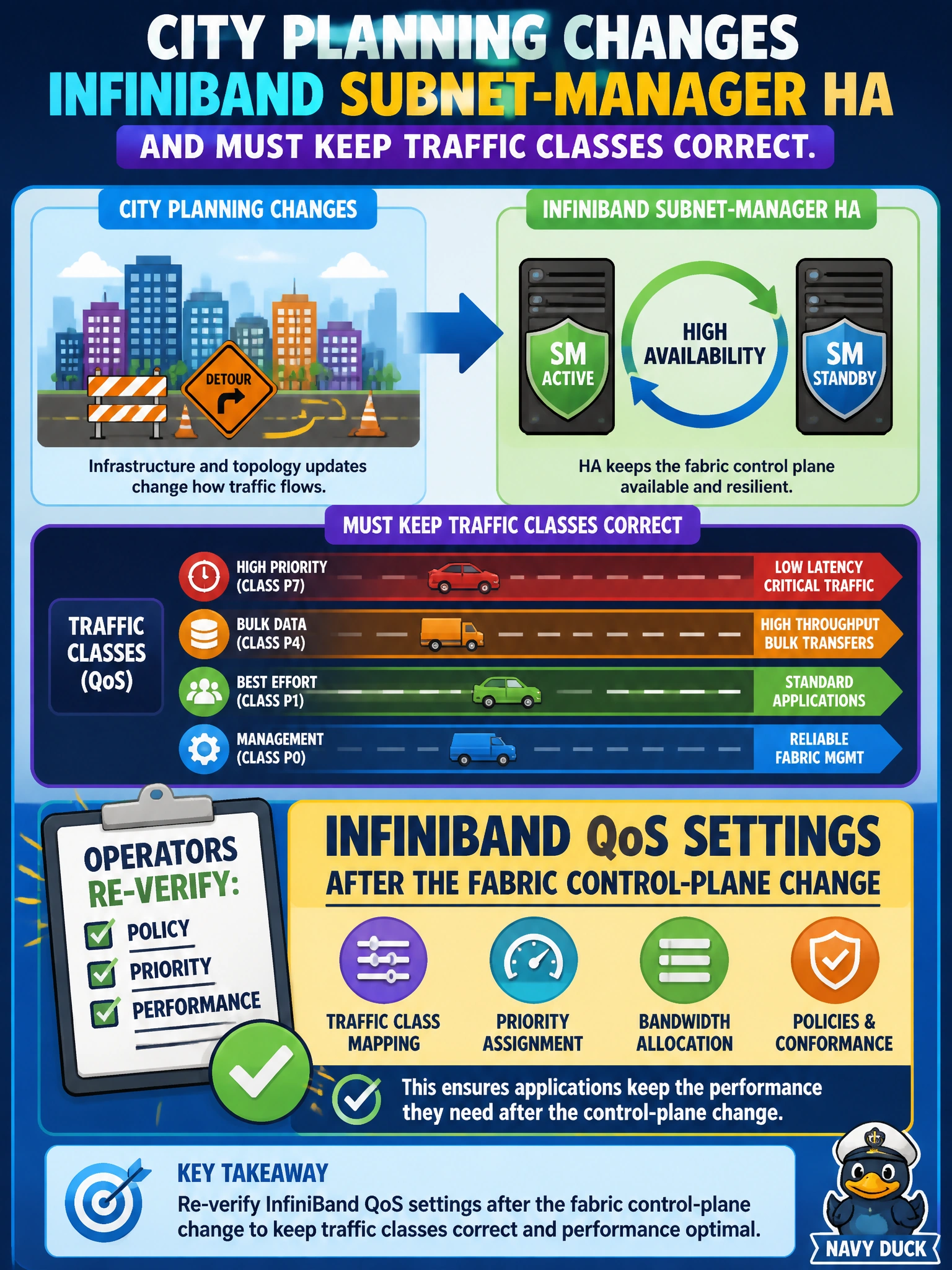
After you swap who runs the control room, re-check the traffic rules. City planning should re-verify InfiniBand QoS after subnet-manager HA changes so municipal classes still behave correctly.
Full Explanation
After city planning changes InfiniBand subnet-manager HA, operators must re-verify InfiniBand QoS settings because fabric control-plane changes can affect how service levels are programmed, restored, or applied after failover. SM/HA events touch the authority that distributes pathing and policy; confirming QoS still matches municipal traffic-class intent prevents silent priority drift for planning workloads. Checking only InfiniBand partition membership and PKey tables after the SM update fails by concept: partition keys control fabric access, not service-level programming, so they do not validate whether municipal traffic-class QoS survived the control-plane change. Checking only subnet-manager routing and master election state after the HA change fails because those confirm control-plane continuity, not whether QoS service-level mappings still match municipal traffic-class intent. Assuming subnet-manager HA automatically re-derives QoS from the physical topology fails because SM/HA failover is designed to preserve continuity of existing state, not to recompute service-level policy from topology; operators must still confirm the restored QoS mapping matches intent rather than trusting an automatic re-derivation that may not have happened.
Exam caveat: SM HA protects management continuity; it is not automatic proof that QoS class mappings survived unchanged—always re-check after control-plane work. Operational check: after the city-planning SM/HA change, compare QoS SL/VL maps in UFM to the pre-change baseline, run a quick mixed-class job, and sign off only when municipal traffic classes still behave as designed.