
Fire/EMS InfiniBand operations need clear expectations for when paths change under load. What should the NOC document?
Select an answer to reveal the explanation.
Short Explanation
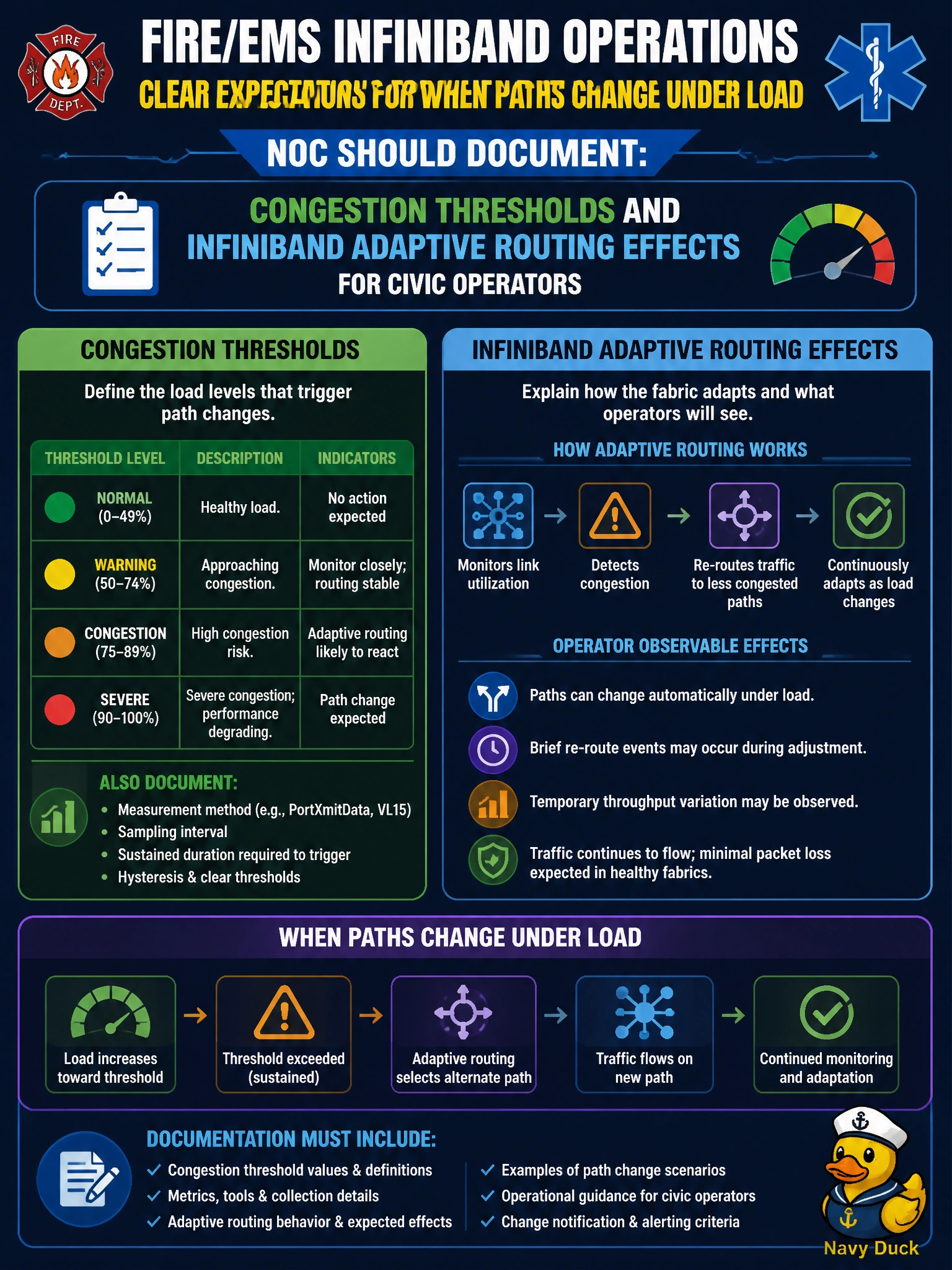
NOC folks shouldn’t guess when the fabric will change lanes. Document congestion thresholds and InfiniBand adaptive routing effects so Fire/EMS civic operators know what to expect under load.
Full Explanation
Fire/EMS InfiniBand operations need clear expectations for when paths change under load, so the NOC should document congestion thresholds and InfiniBand adaptive routing effects for civic operators. Runbooks that state which utilization or congestion signals trigger AR behavior, and what path changes look like in monitoring, prevent guesswork during incidents when emergency workloads share the fabric with other municipal jobs.
Documenting Subnet Manager failover timers and OpenSM master priority behavior fails because those cover control-plane failover mechanics, not the congestion-triggered path changes Fire/EMS operators need documented for load events. Documenting static deterministic routing tables and fat-tree forwarding paths for steady-state traffic fails because it describes fixed forwarding rather than when or how paths shift under load. Documenting PKey partition membership and virtual lane access controls fails because partitions and VLs isolate tenants and enforce access; they do not describe when or how adaptive routing reacts to congestion.
Exam caveat: PKeys, virtual lane access controls, QoS, and adaptive routing are distinct IB controls—documentation for path-change expectations belongs with AR and congestion thresholds, not partition membership or VL access controls.
Operational check: publish NOC thresholds (for example link utilization or congestion notifications) tied to expected AR behavior, walk Fire/EMS operators through a UFM example of path redistribution, and verify that static deterministic routing tables and fat-tree forwarding paths for steady-state traffic are not relied upon for congestion-driven path changes.