
Parks computer-vision InfiniBand training saturates a spine link. What should operators expect adaptive routing to do?
Select an answer to reveal the explanation.
Short Explanation
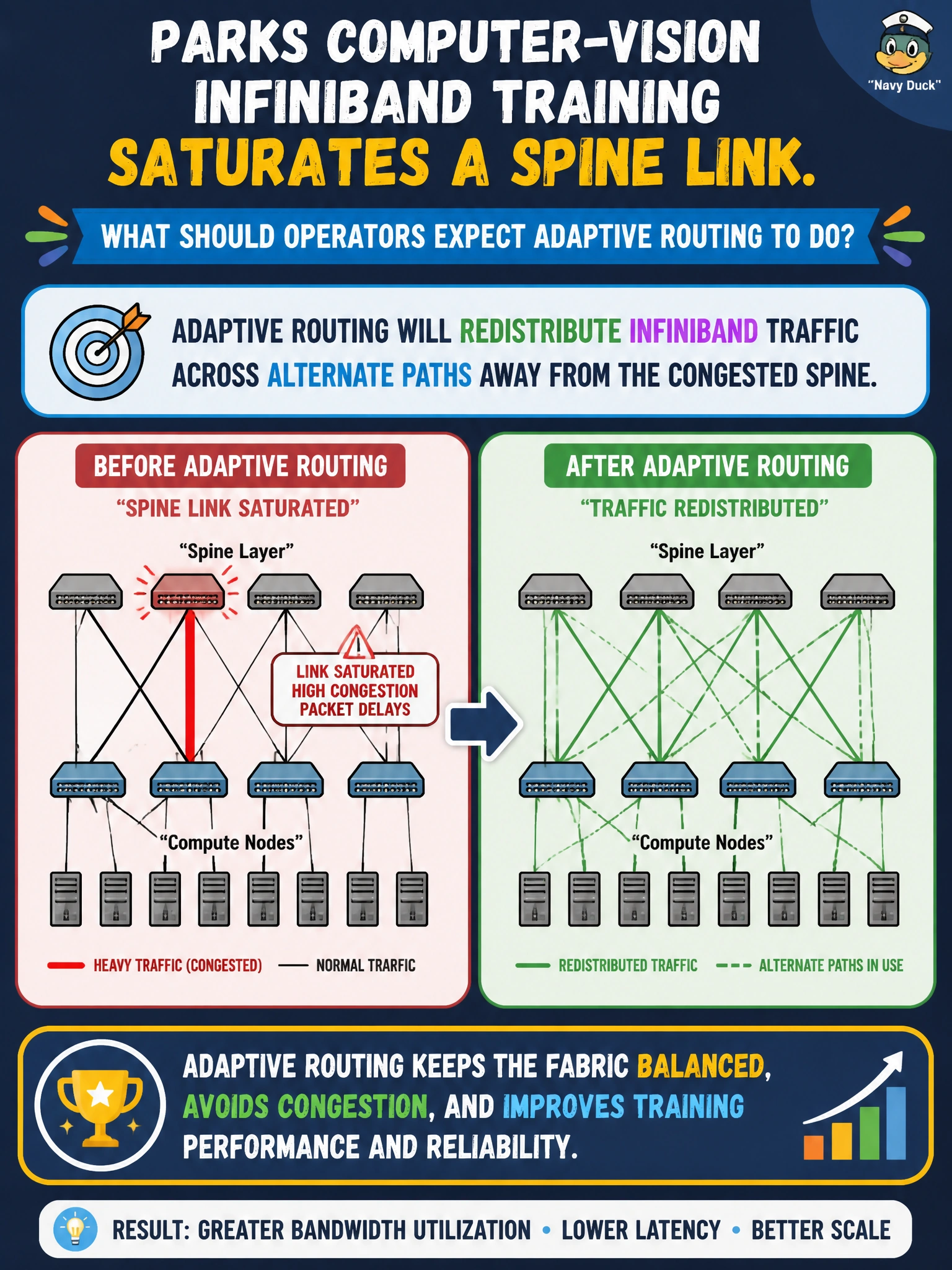
A saturated spine is a jammed main street — adaptive routing should send cars down side streets. Expect InfiniBand adaptive routing to spread parks CV training flows onto alternate paths away from that congested link.
Full Explanation
When parks computer-vision InfiniBand training saturates a spine link, operators should expect InfiniBand adaptive routing to redistribute traffic across alternate paths away from the congested spine. That is the defining behavior of AR under congestion: move flows onto less loaded routes so CV training collectives continue rather than concentrating forever on the hot spine that serves the parks fabric.
Applying static routing entries to hold training flows on fixed spine paths fails by concept because it locks traffic onto the congested spine instead of letting adaptive routing relieve the hot spot. Enabling link aggregation on the saturated spine link to increase effective bandwidth for all training fails because bundling more capacity onto the same already-congested spine does not redistribute flows the way adaptive routing does; it still concentrates CV traffic on one physical chokepoint instead of spreading it across the fabric's other paths. Triggering ECN-based congestion signals to throttle GPU traffic senders fails because it slows the GPUs rather than using InfiniBand adaptive routing to redistribute traffic across alternate paths.
Exam caveat: adaptive routing expects topological alternatives; if the parks design truly has no alternate spine paths, AR cannot invent capacity—design and cabling still matter. Operational check: with AR enabled, saturate a known spine during CV training and confirm in UFM that utilization rises on alternate paths while the original spine’s share drops, without changing PKeys or triggering ECN-based congestion signals to throttle GPU traffic senders.