
A 311 model-farm InfiniBand SLA requires responsive interactive inference queues. What should operators map that SLA to?
Select an answer to reveal the explanation.
Short Explanation
Prioritizing checkpoint bursts or weighting toward overnight training won't protect that SLA. Map the interactive-inference promise to explicit InfiniBand QoS so you give those queues actual priority.
Full Explanation
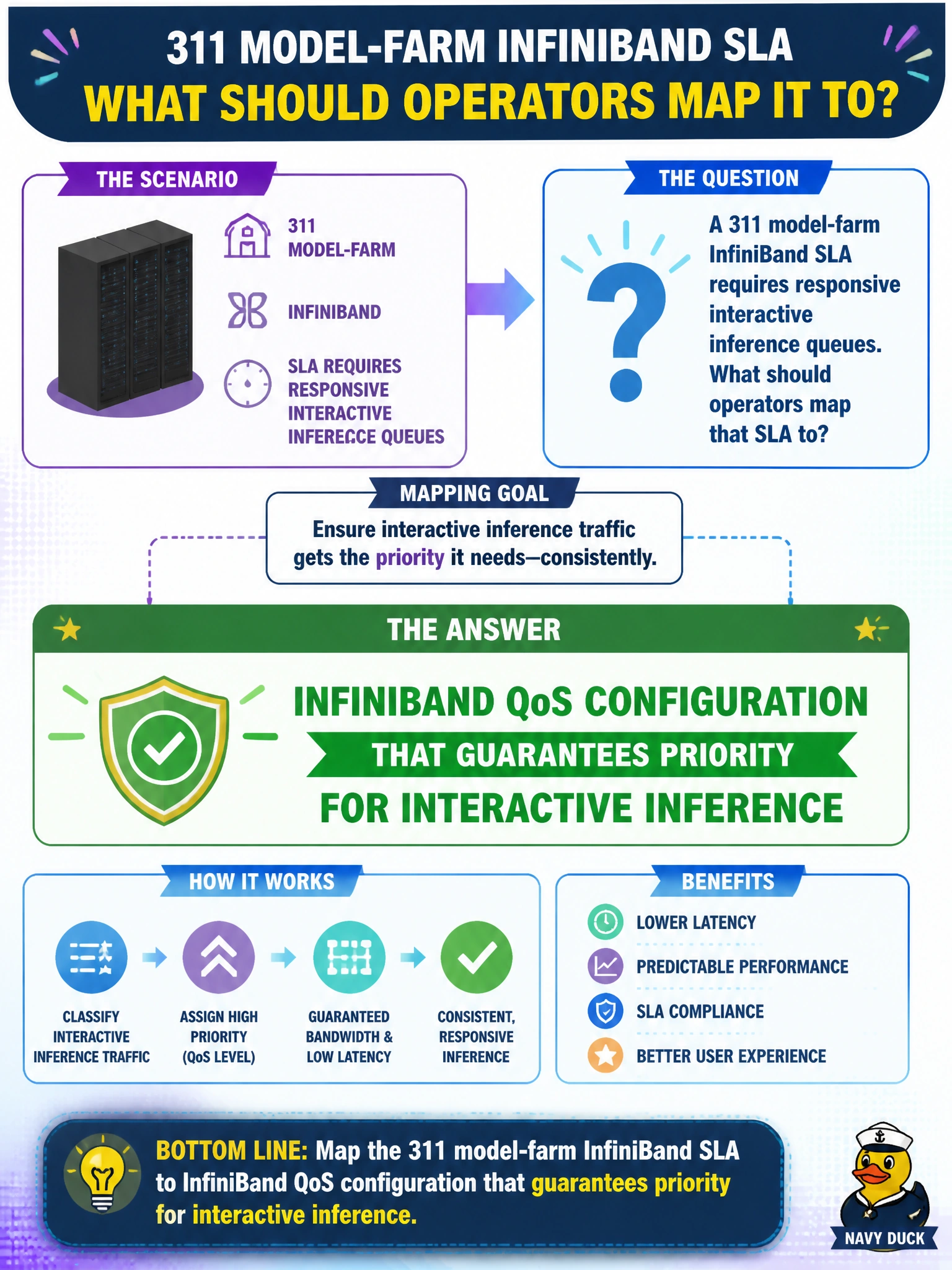
A 311 model-farm InfiniBand SLA that requires responsive interactive inference queues must be mapped to InfiniBand QoS configuration that guarantees priority for those interactive inference flows. SLA language alone does not enforce fabric behavior; SL/VL service levels and arbitration rules do. Mapping the civic promise to QoS is how operators turn a service objective into enforceable queue preference on the shared IB fabric.
InfiniBand QoS configuration that prioritizes checkpoint replication traffic bursts fails because it assigns fabric priority to bursty replication instead of interactive inference, leaving responsive queues unprotected exactly when the SLA is at risk. InfiniBand virtual lane mapping weighted toward overnight training throughput fails because it weights arbitration toward batch training and leaves interactive inference without the priority it needs to stay responsive. InfiniBand congestion tuning that favors background storage migration flows fails because inference RDMA traffic lives on IB; tuning that protects background migration cannot police contention for interactive inference queues.
Exam caveat: InfiniBand congestion tuning that favors background storage migration flows is not a substitute for explicit interactive-inference QoS when the SLA concerns responsive inference on IB. Operational check: encode the 311 interactive-inference SLA as explicit IB SL mappings in UFM/SM, run concurrent batch scrapes, and measure that interactive queue latency remains within the SLA while documenting the QoS policy for civic audit.