
Housing-authority InfiniBand path flaps decrease after fabric tuning. What should operators keep using?
Select an answer to reveal the explanation.
Short Explanation
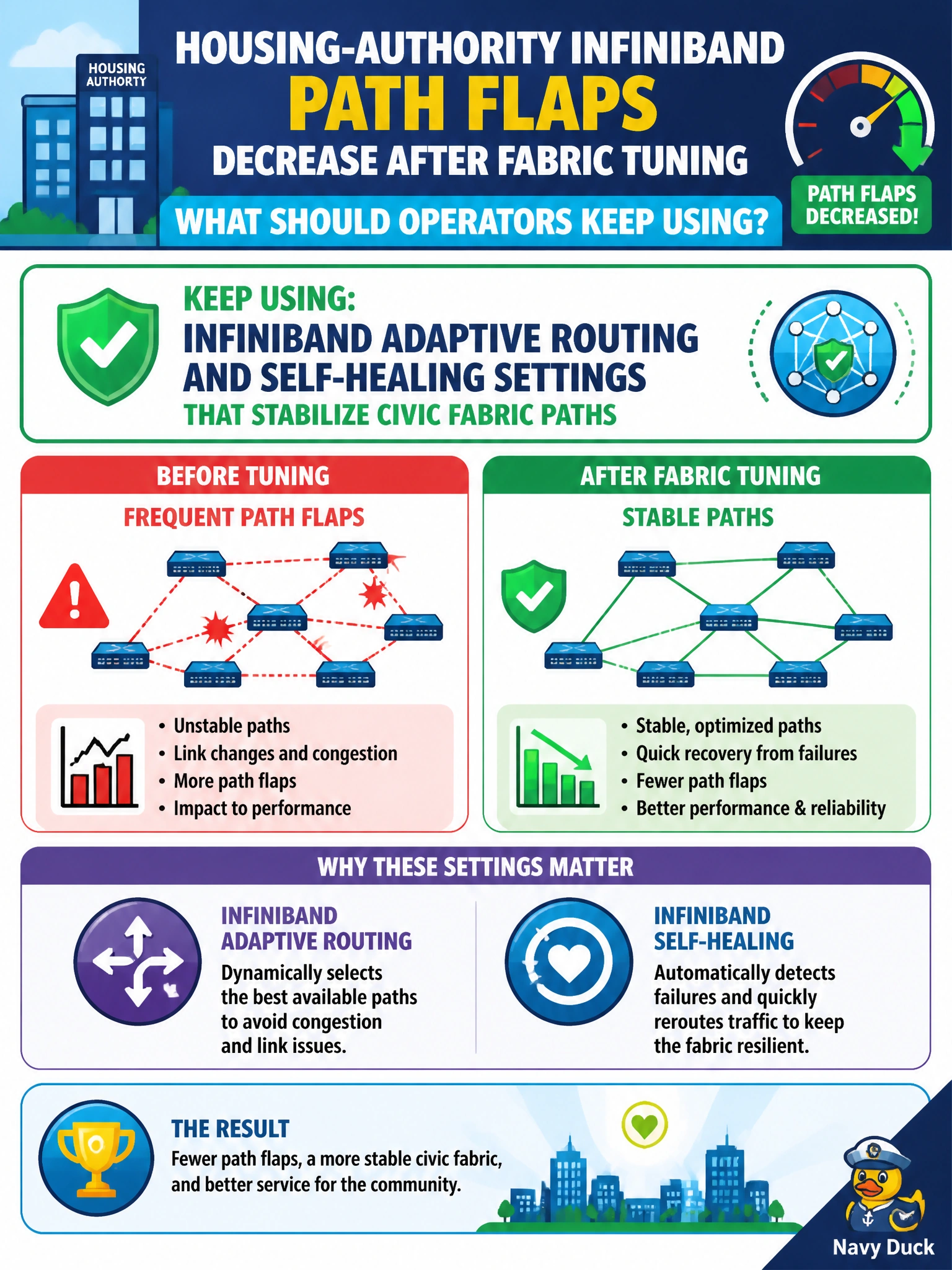
When path flaps calm down, don’t throw away the stabilizer. Keep InfiniBand adaptive routing and self-healing settings so the housing-authority civic fabric stays on steady paths.
Full Explanation
When housing-authority InfiniBand path flaps decrease after fabric tuning, operators should keep using InfiniBand adaptive routing and self-healing settings that stabilize civic fabric paths. Adaptive routing plus self-healing let the fabric reselect healthy paths and recover from transient link or route instability instead of oscillating or remaining on failed routes. Retaining those settings preserves the stability gain the municipal fabric just achieved.
InfiniBand congestion control thresholds tuned for sustained civic link throughput fail because they manage link load rather than route selection, so they cannot reselect healthy paths or preserve the resilience that reduced flaps. OpenSM minhop routing engine with adjusted sweep intervals for civic fabric rediscovery fails because it relies on periodic rediscovery instead of continuous self-healing, so transient flaps can persist between sweeps and recovery is not automatic. IPoIB partition keys and QoS levels refined to segment civic tenant traffic fail because they segment tenant traffic and manage quality of service rather than stabilize data paths, so they do not encode the adaptive/self-healing path stabilization approach.
Exam caveat: self-healing and adaptive routing stabilize data paths; SM HA protects the control plane—related but not identical. The stem’s flap reduction after tuning points to keeping AR/self-healing, not relying on IPoIB partition keys and QoS levels to stabilize paths.
Operational check: document that AR and self-healing remain enabled in SM/UFM for the housing-authority fabric, and verify flap counters stay low after the next maintenance window without substituting congestion-control threshold tuning for path stabilization.