
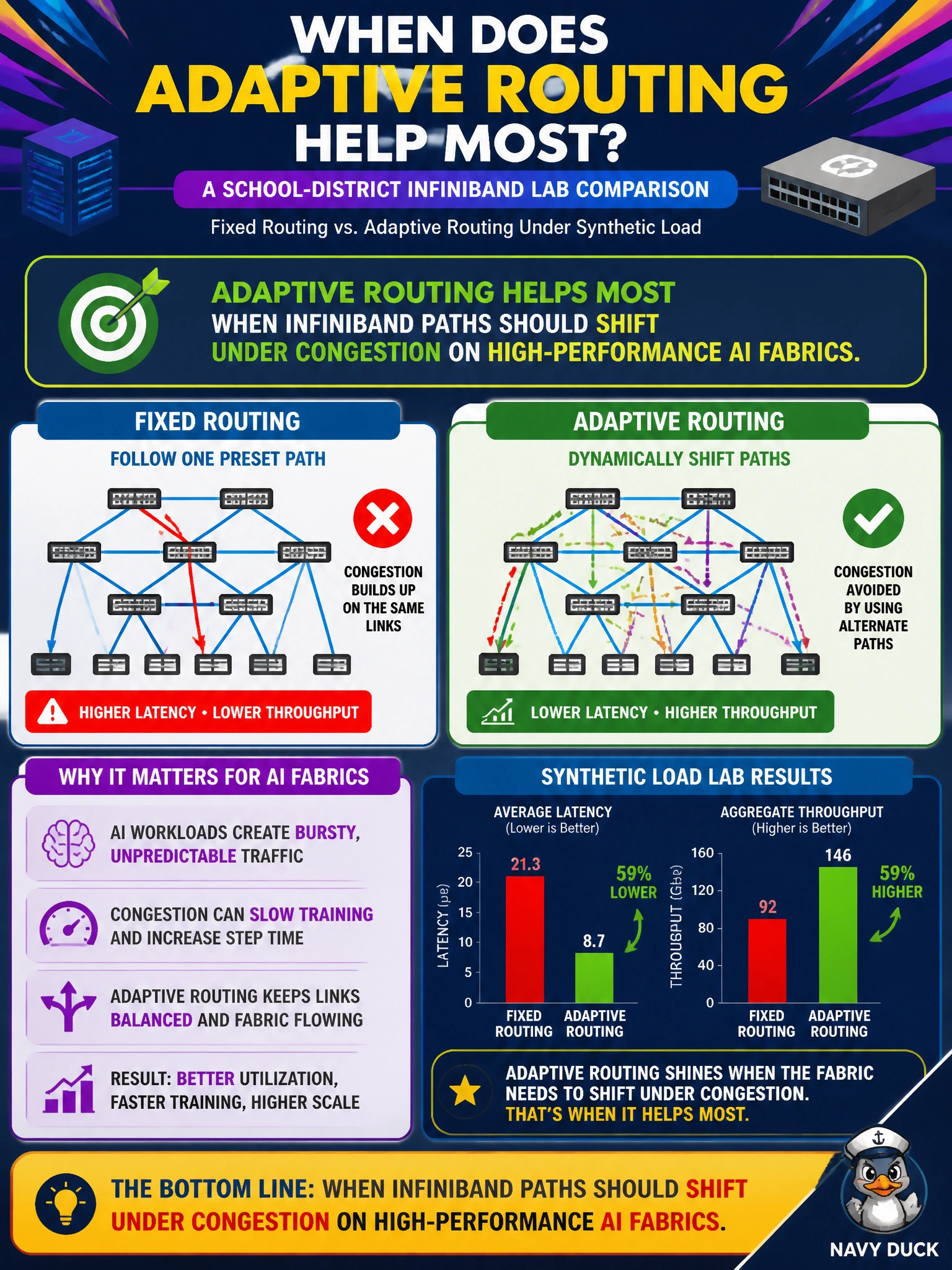
A school-district InfiniBand lab compares fixed routing with adaptive routing under synthetic load. When does adaptive routing help most?
Select an answer to reveal the explanation.
Short Explanation
Fixed routes are fine on an empty hallway; busy AI fabrics need the ability to change lanes. InfiniBand adaptive routing helps most when high-performance school-district paths should shift under congestion.
Full Explanation
In a school-district InfiniBand lab comparing fixed versus adaptive routing under synthetic load, adaptive routing helps most when InfiniBand paths should shift under congestion on high-performance AI fabrics. With alternate routes available, AR lets switches and the SM move flows off saturated links so teaching and research collectives keep making progress instead of queueing behind a static hot path. That is the regime where district labs see the clearest benefit versus fixed routing.
Insisting that AR helps when deterministic routing tables need strict ordering for benchmark repeatability fails by concept: AR chooses among multiple paths under load rather than enforcing a fixed sequence for repeatable tests. Preferring that static forwarding entries stay pinned during lossless fabric validation fails because that describes fixed, non-adaptive behavior rather than the congestion-driven path shifting that AR provides. Expecting subnet manager routing to remain stable across planned topology changes fails because that describes a static control-plane outcome, not the dynamic data-plane adaptation AR uses to relieve congestion.
Exam caveat: adaptive routing is not universally “always better”—on single-path islands or poorly monitored fabrics the gains vanish—but under multi-path congestion on AI fabrics it is the intended answer. Operational check: run the same synthetic AI load with AR off then on in the school-district lab and compare UFM hot-link duration and job completion time to demonstrate when path shifting helps most.