
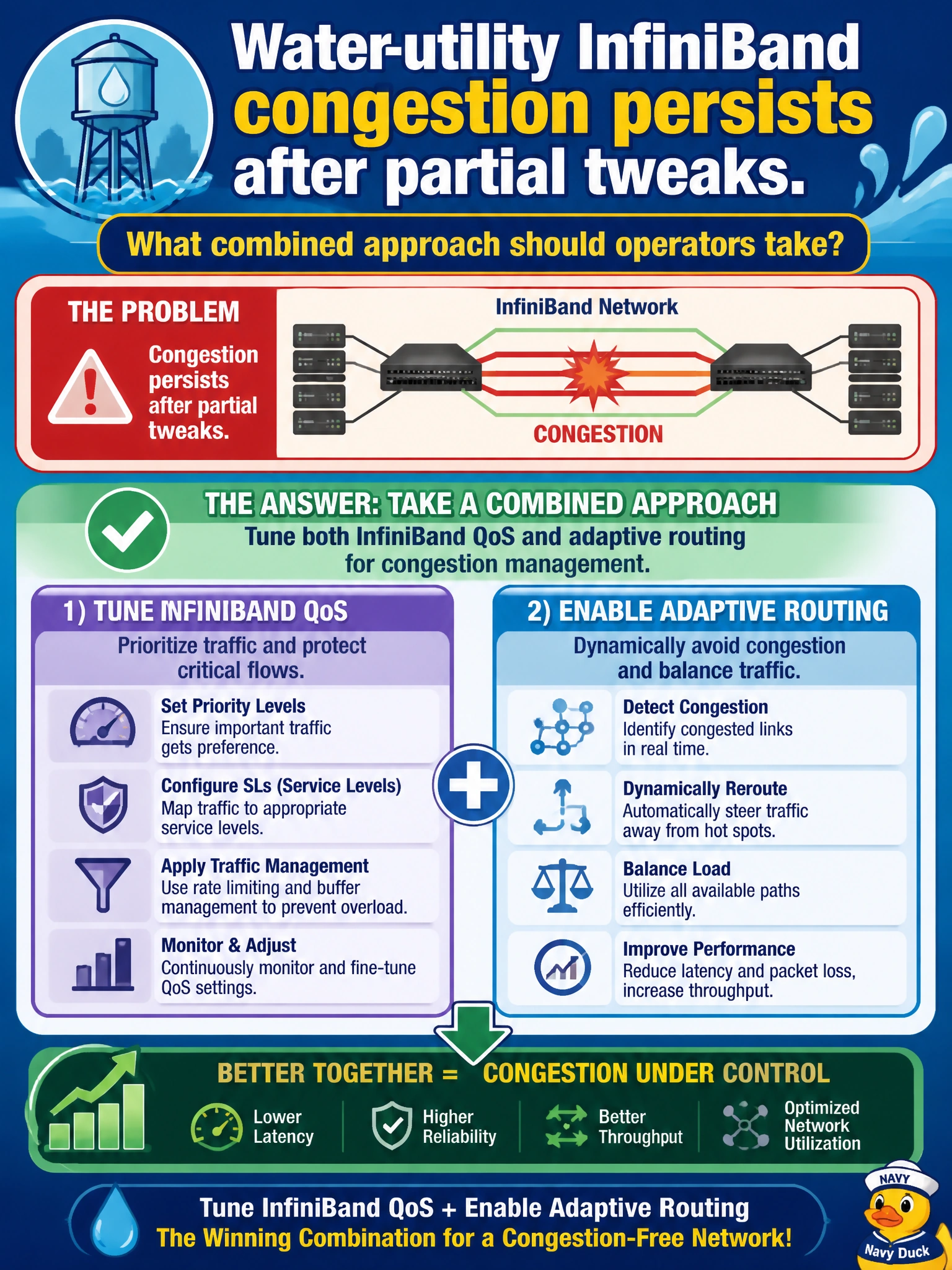
Water-utility InfiniBand congestion persists after partial tweaks. What combined approach should operators take?
Select an answer to reveal the explanation.
Short Explanation
Half a fix leaves the pipes still burping. Water-utility IB congestion needs both InfiniBand QoS and adaptive routing tuned together so priority and path choice work as a team.
Full Explanation
Water-utility InfiniBand congestion that persists after partial tweaks usually means one control plane was adjusted while the other was ignored. The combined approach operators should take is to tune both InfiniBand QoS and adaptive routing: QoS protects priority among municipal workload classes, while adaptive routing redistributes flows away from hot links. Together they address who wins on a path and which path is used—both required for durable congestion management on shared civic IB fabrics.
Tuning InfiniBand QoS and static routing tables for deterministic forwarding fails because it only addresses who wins priority on a path, not which path is used; static tables cannot redirect congestion-prone water-utility collectives off hot links when load shifts. Combining adaptive routing with PKey partitioning for tenant isolation fails because PKeys enforce isolation between tenants, not congestion priority; it leaves out QoS tuning for municipal workload classes, so priority traffic still isn't guaranteed on shared civic links. Adjusting virtual lane arbitration and MTU sizes for fabric efficiency fails because it tweaks low-level fabric parameters without implementing QoS priority or adaptive path selection; it won't redirect water-utility hot spots or protect priority municipal workloads.
Exam caveat: on the exam, a InfiniBand congestion question needs both IB QoS and adaptive routing working together—not a single partial lever. Operational check: apply coordinated QoS SL maps and AR enablement, then use UFM utilization views to confirm hot water-utility links drain and priority traffic keeps latency targets under mixed load.