
A city GPU InfiniBand fabric must start a large multi-rail job. What should operators verify first?
Select an answer to reveal the explanation.
Short Explanation
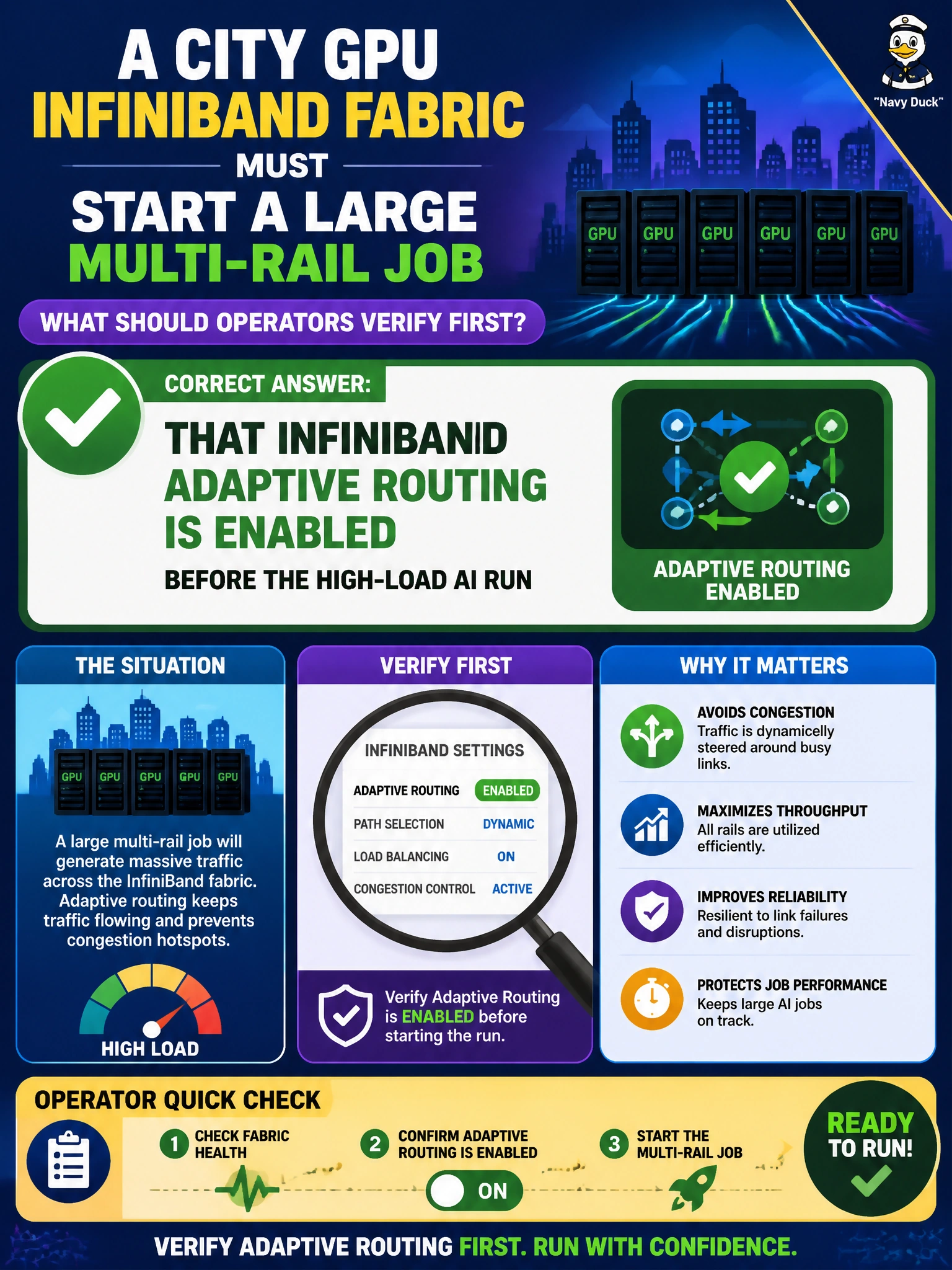
Pre-optimized static tables or SHARP group settings won't help once that multi-rail job starts congesting rails. Confirm InfiniBand adaptive routing is enabled before launch, so you let the fabric shift flows under load instead of locking onto one path.
Full Explanation
Before a city GPU InfiniBand fabric starts a large multi-rail job, operators should verify that InfiniBand adaptive routing is enabled so high-load AI runs can move flows when rails or spines congest. Multi-rail training amplifies collective traffic; relying on pre-optimized static routing tables still pins elephants to a subset of links and cannot react when congestion appears. Confirming AR readiness is a first-line civic bring-up check so the fabric can absorb the job’s burst without irreversible hot-spot pinning.
Relying on pre-optimized static routing tables fails by concept: it is the opposite of readiness for congestion-prone multi-rail AI and guarantees sticky imbalance because the paths cannot move when links heat up. Configuring UFM SHARP groups for background storage traffic fails because that tunes a specific offload feature rather than confirming the fabric can shift AI flows under congestion; it is not the pre-launch check operators need. Expecting subnet manager event logs to be forwarded to long-term audit storage fails because that is a post-run administrative task, not a pre-launch congestion control; it does not verify adaptive routing and does nothing to keep elephants off busy links when the job starts.
Exam caveat: enabling adaptive routing does not replace capacity checks or correct rail cabling; it is the congestion-response control to confirm before launch. Operational check: in SM/UFM, verify adaptive routing is on for the city GPU partition, note baseline rail utilization, start the multi-rail job, and confirm the fabric can rebalance rather than locking onto a single overloaded path.