
An emergency-management InfiniBand fabric must differentiate forecast jobs from batch tenants. What should operators configure?
Select an answer to reveal the explanation.
Short Explanation
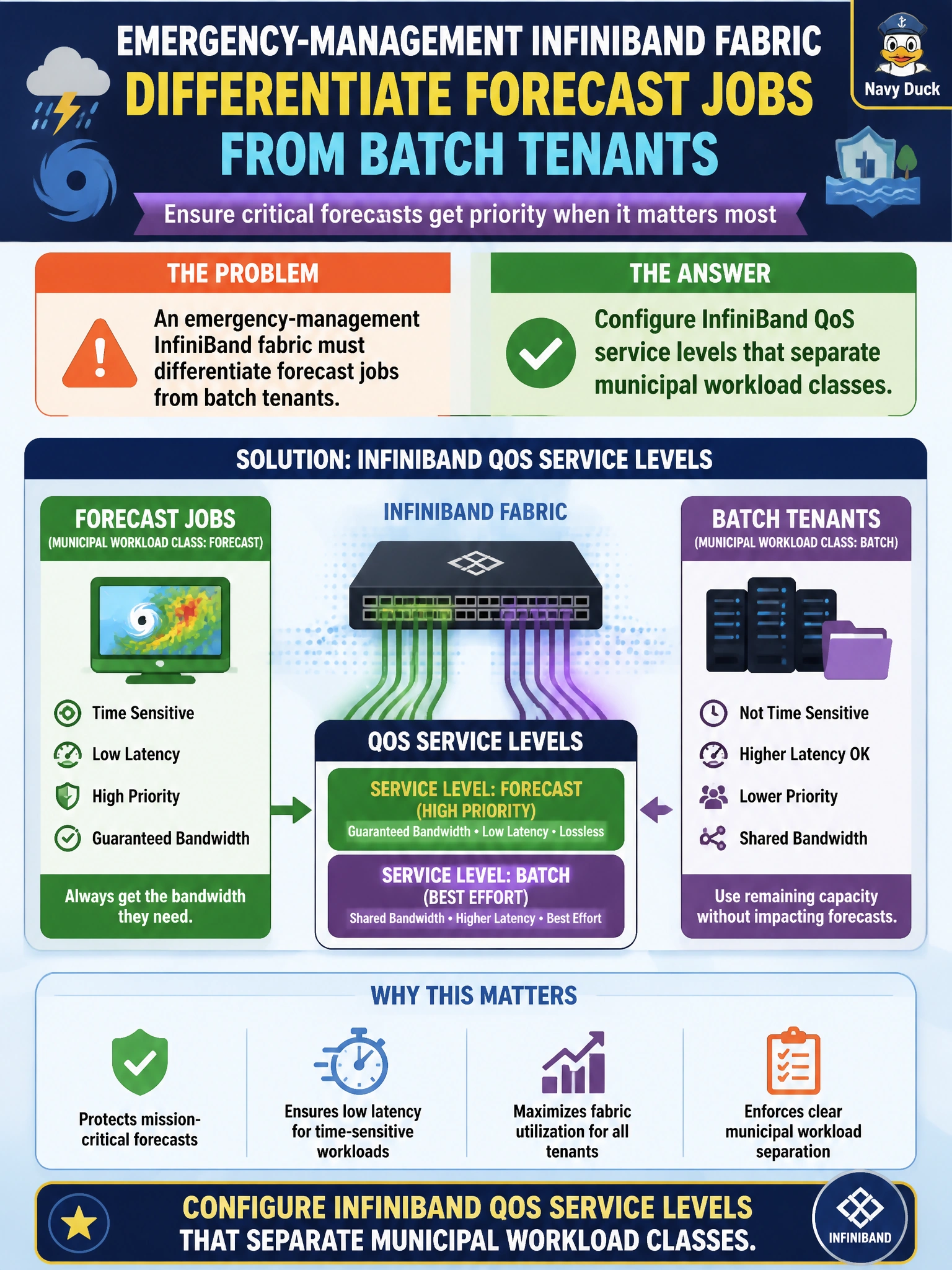
Forecast traffic and batch tenants are not the same kind of emergency. Configure InfiniBand QoS service levels so the emergency-management fabric can treat those municipal workload classes differently under load.
Full Explanation
An emergency-management InfiniBand fabric that must differentiate forecast jobs from batch tenants needs workload-class separation at the fabric layer. InfiniBand QoS service levels are the correct configuration: assign forecast and interactive emergency analytics to higher SL/VL priorities and keep overnight or bulk batch tenants in lower classes so arbitration favors time-critical municipal work when links are busy. That policy encodes the operational difference between forecast urgency and batch elasticity on a shared IB fabric.
Partition keys that isolate tenant membership for security fail by concept because PKeys enforce access boundaries, not workload-class priority; they do not differentiate forecast urgency from batch elasticity on a shared IB fabric. Virtual lane buffer allocations sized for large batch message transfers fail because sizing buffers for batch traffic does not create service-level separation between forecast and batch; it tunes buffer depth without assigning priority classes to municipal workloads. Adaptive routing settings that spread forecast traffic across alternate paths fail because load balancing across paths is not QoS service-level separation; it does not assign forecast and batch to different priority classes for arbitration when links are busy.
Exam caveat: Partition keys that isolate tenant membership for security handle access control, not workload priority; QoS prioritizes traffic classes—emergency-management designs often need both, but this stem asks specifically for differentiating forecast versus batch via QoS. Operational check: after configuring SL mappings in the SM/UFM, run concurrent forecast and batch jobs and verify forecast queues retain lower latency while batch continues without claiming equal or higher priority.