
County assessor InfiniBand jobs improve after congested flows are redistributed. What fabric feature produced that result?
Select an answer to reveal the explanation.
Short Explanation
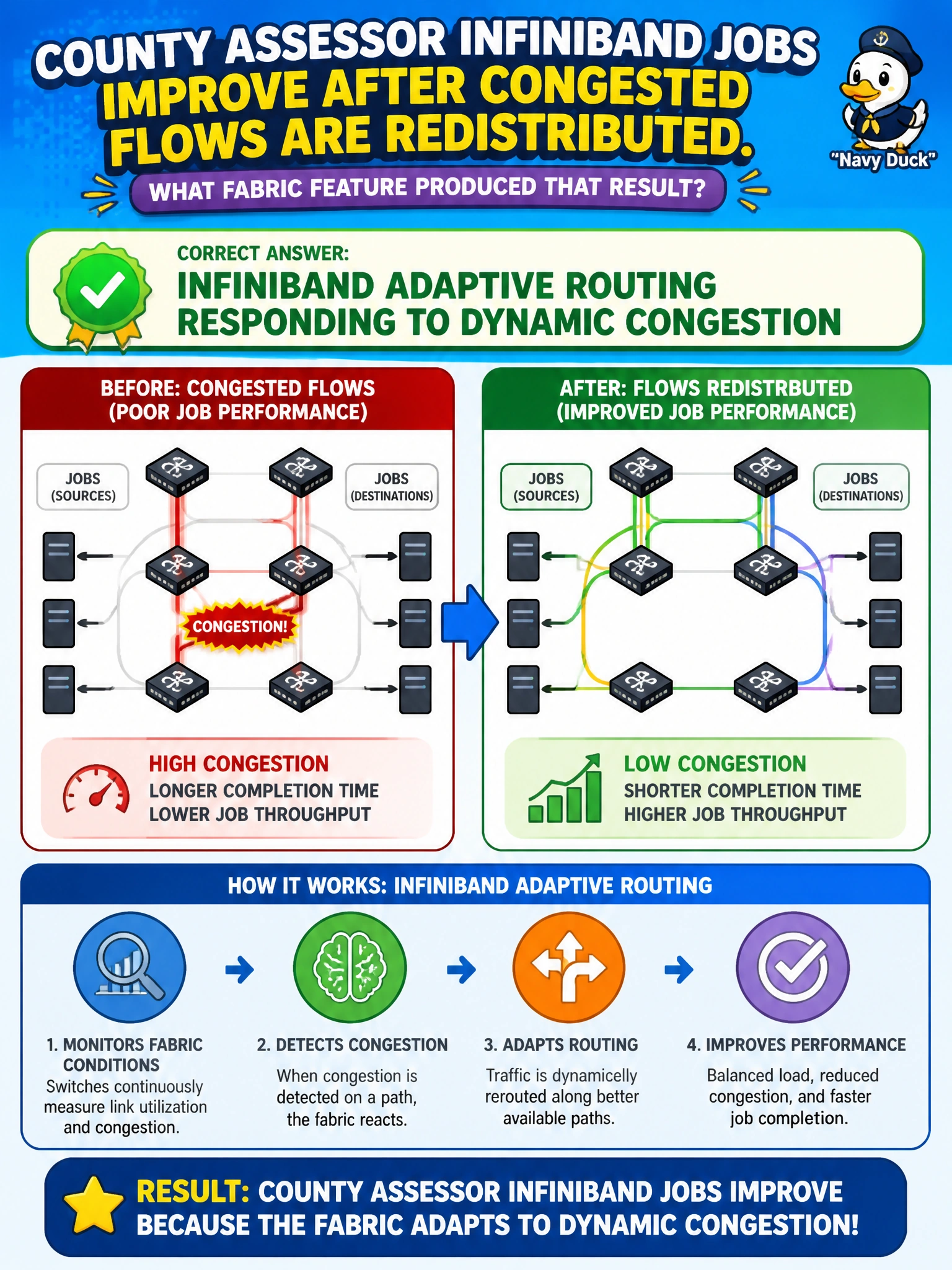
Static equal-cost paths and virtual-lane priority mapping won't explain why those county assessor jobs got better. You're looking at adaptive routing redistributing flows once congestion hits a link.
Full Explanation
County assessor imagery and valuation jobs that improve after congested flows are redistributed point to a fabric feature that moves traffic off hot paths in response to load. InfiniBand adaptive routing produced that result: when congestion metrics rise, the fabric can shift flows onto alternate routes rather than leaving them pinned to saturated spines or rails. That congestion-aware redistribution matches the observed recovery for municipal assessor workloads without requiring physical cable moves.
InfiniBand static routing balancing load across equal-cost paths fails by concept because fixed static IB pathing is exactly what leaves jobs stuck on congested links; it cannot explain post-redistribution improvement. InfiniBand service level mapping across virtual lanes fails because mapping service levels to virtual lanes manages priority and traffic classes; it does not dynamically redistribute congested flows onto alternate paths. Subnet Manager discovery updating fabric topology data fails because topology discovery only refreshes fabric state; it does not react to congestion by moving flows onto alternate routes.
Exam caveat: adaptive routing explains path redistribution under dynamic congestion; service level mapping across virtual lanes explains priority among classes on a path. Do not conflate the two on the exam when the stem emphasizes flows being redistributed after congestion. Operational check: compare UFM path or utilization maps before and after the assessor job window and confirm formerly hot links shed traffic onto alternate IB paths while the SM remains active.