
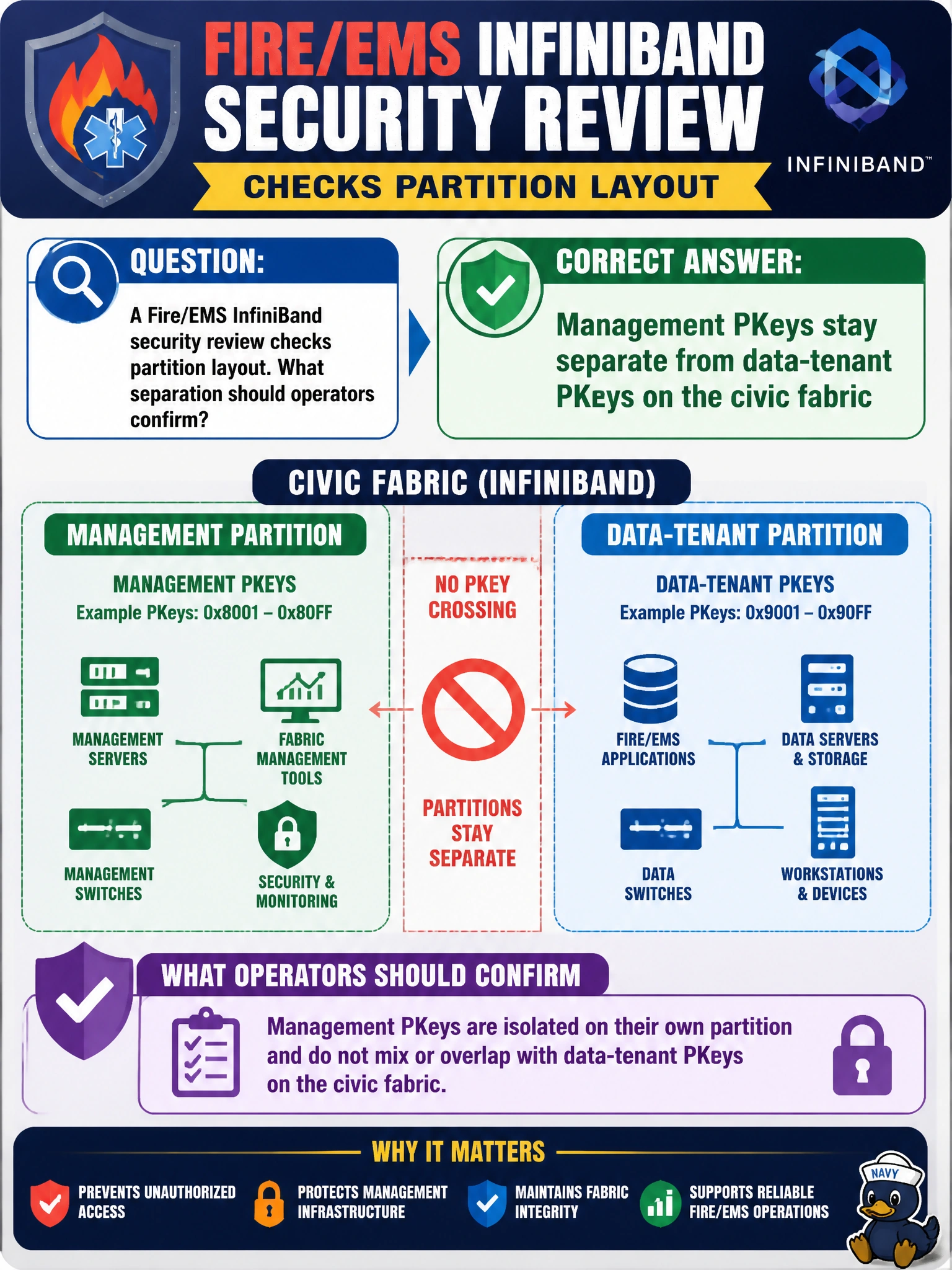
A Fire/EMS InfiniBand security review checks partition layout. What separation should operators confirm?
Select an answer to reveal the explanation.
Short Explanation
Ops keys and payload keys are different rings. Confirm Fire/EMS keeps InfiniBand management PKeys separate from data-tenant partitions.
Full Explanation
A Fire/EMS InfiniBand security review should confirm that management PKeys stay separate from data-tenant PKeys on the civic fabric. Separating ops/management partitions from agency data partitions limits which HCAs can reach management domains and reduces the chance that a compromised tenant GPU gains SM-adjacent or fabric-ops reachability. Management nodes joining tenant PKeys with limited membership on the civic fabric fails by concept: even limited membership lets ops reach into payload partitions and erodes the separation between management and data trust boundaries. Letting UFM agents join data-tenant PKeys for fabric telemetry on the civic fabric fails because telemetry access does not justify placing management-plane agents inside tenant data partitions. Letting the default PKey carry management traffic with full membership on the civic fabric fails because the default partition is not a substitute for dedicated management separation; full membership on the default PKey exposes management traffic to unintended members. Exam caveat: management versus data PKey separation is a multi-tenancy security control that applies regardless of partition; putting management traffic on the default PKey with full membership does not remove the need for dedicated partition design. Operational check: list management PKey members and data-tenant PKey members for Fire/EMS, confirm no management nodes hold tenant-PKey membership unless explicitly justified, and remediate any management-to-tenant partition overlap findings before sign-off.