
City planning must add a new InfiniBand PKey without breaking live tenants. What approach should operators take?
Select an answer to reveal the explanation.
Short Explanation
Don't shove the new PKey into the default 0xFFFF partition just to spread it fast. Add the city-planning InfiniBand PKey carefully so existing tenant partitions keep working.
Full Explanation
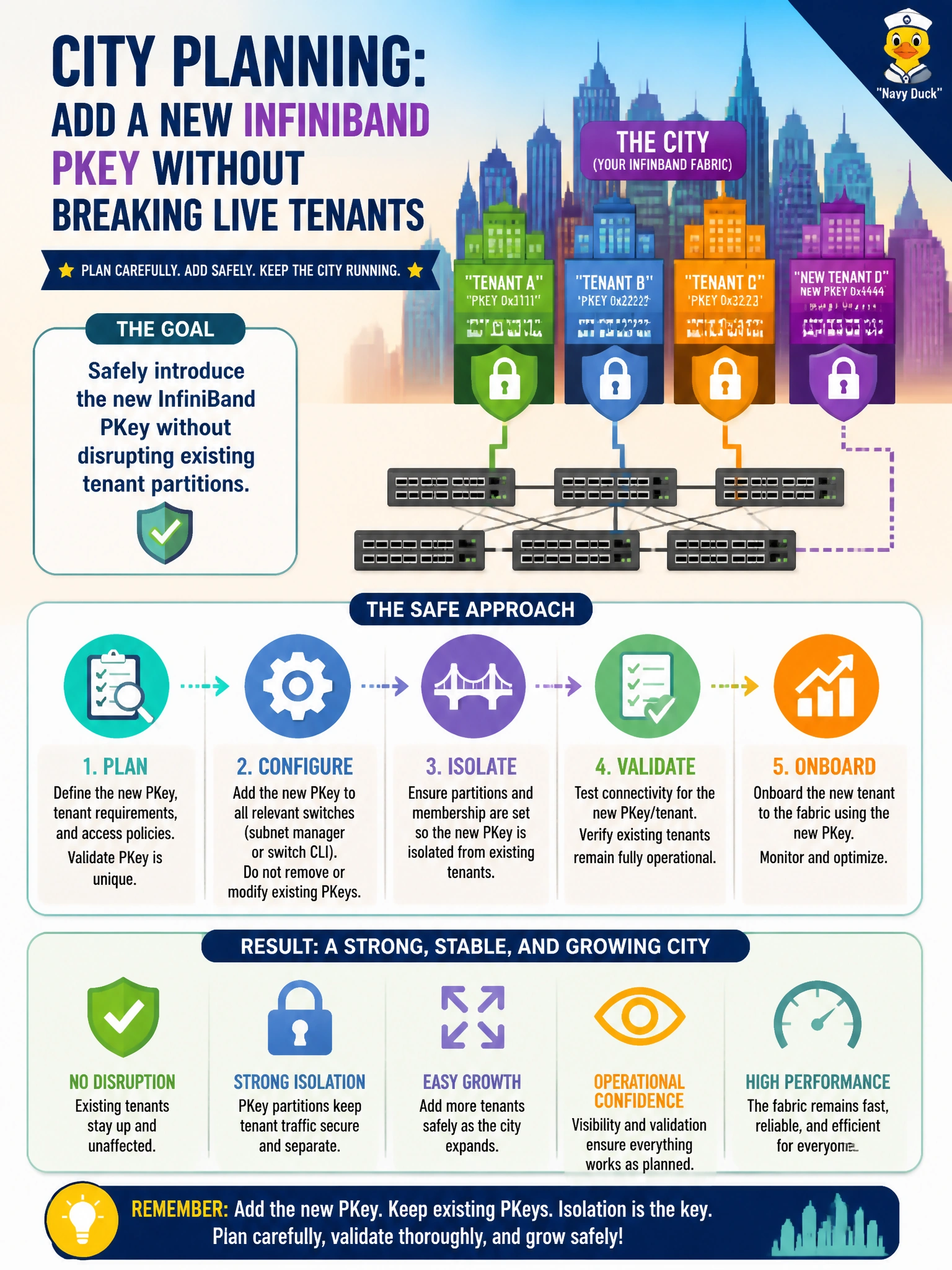
City planning must add a new InfiniBand PKey without disrupting live tenants by safely introducing the new partition alongside existing ones. Careful addition allocates a new PKey ID, updates only the intended GUIDs, and leaves other agencies’ partitions unchanged so municipal production continues. Defining the new PKey inside the default 0xFFFF partition entry fails by concept: the default partition is a shared fabric-wide scope, not a safe additive tenant slot, and placing a new PKey there can expose live tenants to unintended membership and break partition isolation. Allocating the new tenant PKey from the management-reserved range fails because reserved PKeys are intended for fabric management, not tenant workloads, and using them for a tenant blurs control-plane and data-plane isolation. Programming the new PKey with limited membership on compute and storage channel adapters fails because it arbitrarily restricts partition membership to a subset of adapters and can exclude required tenant endpoints rather than safely adding the PKey to all intended GUIDs. Exam caveat: live multi-tenant IB changes should be additive and scoped; do not embed the new PKey in the default 0xFFFF partition, allocate it from the management-reserved range, or limit membership only to compute and storage adapters. Operational check: create the new city-planning PKey, add only approved GUIDs, verify existing tenant partitions still pass intra-tenant RDMA and fail cross-tenant RDMA, and confirm the PKey is not arbitrarily limited to compute and storage channel adapters.