
A library computer-vision InfiniBand stack claims tenant isolation. How should operators verify it?
Select an answer to reveal the explanation.
Short Explanation
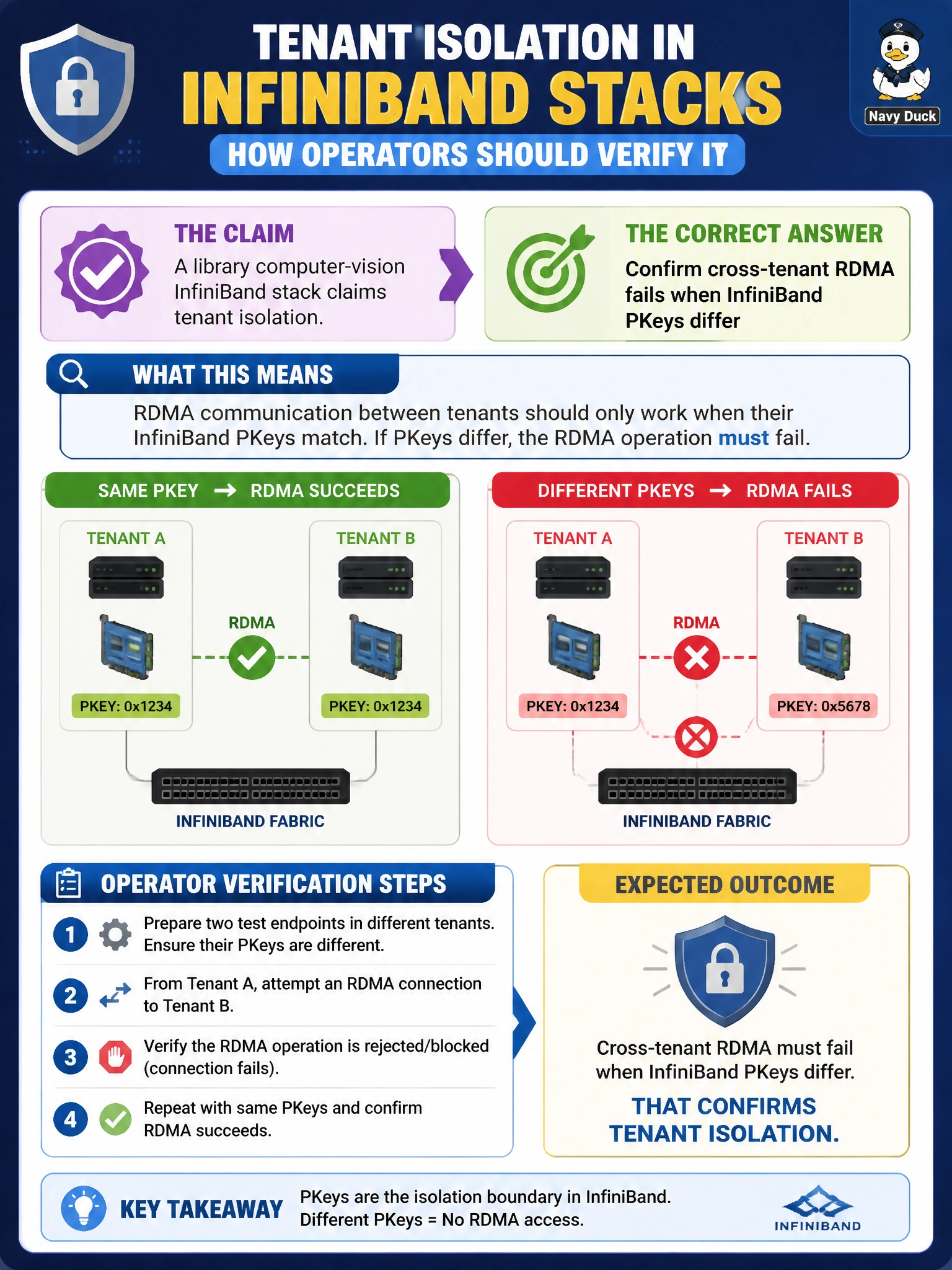
Trust but verify with a failed handshake. Prove library tenants with different InfiniBand PKeys cannot complete cross-tenant RDMA.
Full Explanation
To verify that a library computer-vision InfiniBand stack truly isolates tenants, operators should confirm that cross-tenant RDMA fails when InfiniBand PKeys differ. Isolation is demonstrated by a negative test: endpoints in different partitions must not complete unauthorized RDMA, while same-PKey peers still can. That failure is the evidence that multi-tenancy policy is enforced on the IB data path, not merely documented. Verifying RDMA succeeds between nodes sharing the same InfiniBand PKey fails by concept: successful same-PKey RDMA proves intra-tenant connectivity, not that PKey policy denies cross-tenant traffic. Pinging only the Ethernet management network between tenants fails because Ethernet management reachability does not validate InfiniBand partition enforcement on the IB data plane. Auditing Subnet Manager tables for correct PKey assignments fails because reviewing table entries does not test the data plane; it proves configuration intent, not that cross-tenant RDMA is actually blocked. Exam caveat: same-PKey RDMA success or Ethernet ping checks are insufficient for NCP-AIN-style isolation proof; IB multi-tenancy verification requires PKey-differentiated RDMA failure. Operational check: pick two library tenants on different PKeys, attempt RDMA between them and record failure, attempt RDMA within each PKey and record success, then audit Subnet Manager PKey table entries to confirm they match intended tenant partitions.