
Emergency-management inference latency regressions need correlation with fabric measurements. Where should operators look first?
Select an answer to reveal the explanation.
Short Explanation
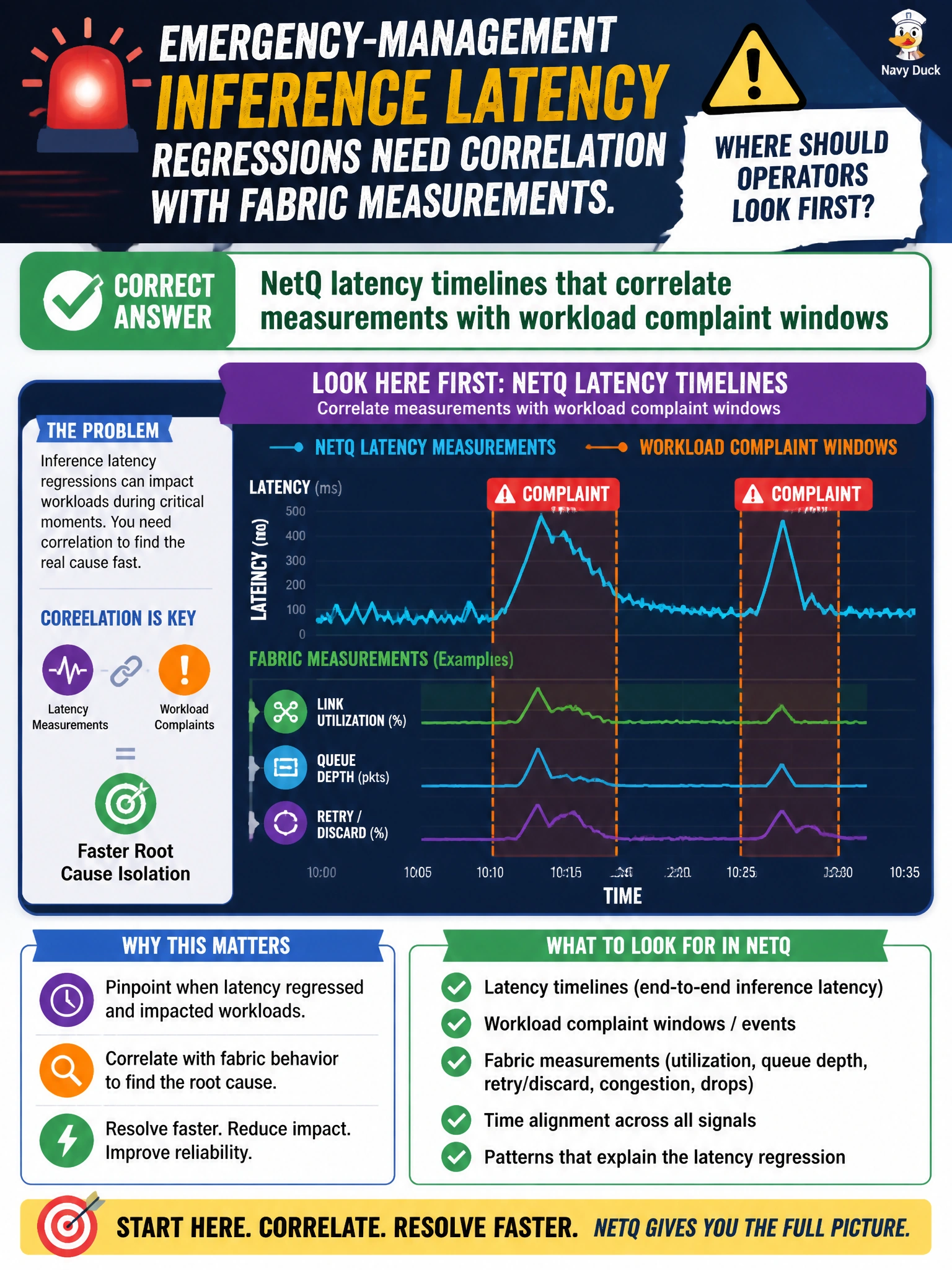
When wildfire models feel sluggish, you want a timeline, not switch hardware inventory records. NetQ latency timelines let emergency-management ops match fabric delay spikes to the exact complaint windows.
Full Explanation
Emergency-management inference latency regressions need correlation with fabric measurements, so operators should look first at NetQ latency timelines that correlate measurements with workload complaint windows. Those timelines place Spectrum path delay on the same clock as wildfire-model or shelter-planning job complaints, letting municipal ops prove whether the fabric contributed to the regression and when the spike started and cleared.
Switch hardware inventory records listing leaf models and installed ASIC revisions fail by concept: inventory names boxes and hardware revisions; it does not chart latency versus time or line up with complaint tickets. BGP EVPN route type advertisements reflecting control-plane convergence during complaint intervals fail because route advertisements are control-plane signals, not latency sensors—they cannot explain inference delay. QoS buffer occupancy counters showing egress queue depth on spine-facing interfaces fail because buffer occupancy measures local queue depth, not time-aligned latency versus complaint windows—it cannot show whether the fabric caused the regression.
Exam caveat: correlation requires time-aligned NetQ latency data and workload complaint timestamps. Do not treat switch hardware inventory records, BGP EVPN route type advertisements, or QoS buffer occupancy counters as substitutes for latency timelines on Spectrum Ethernet fabrics used by civic AI.
Operational check: pull NetQ latency timelines for the emergency-management leaf pairs covering the complaint window, overlay ticket or job-start times, identify whether fabric delay spikes match the regression, and capture leaf pair, severity, and duration for the municipal post-incident record.