
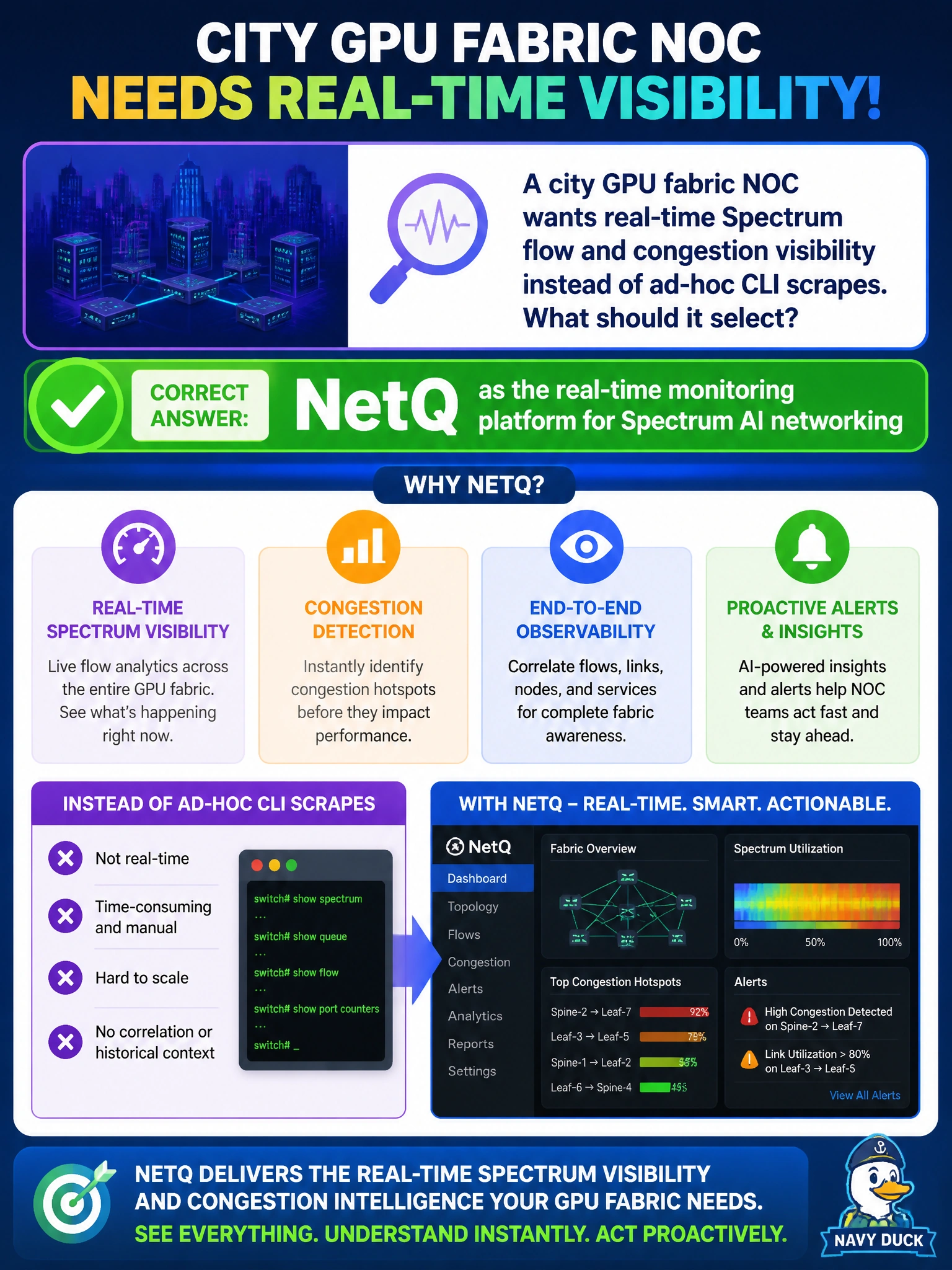
A city GPU fabric NOC wants real-time Spectrum flow and congestion visibility instead of ad-hoc CLI scrapes. What should it select?
Select an answer to reveal the explanation.
Short Explanation
Ad-hoc CLI scrapes are like checking traffic cams one intersection at a time. NetQ is the citywide board that keeps Spectrum flow and congestion visible in real time for the GPU fabric NOC. sFlow sampling to an offline collector, What Just Happened telemetry for CLI inspection, and syslog keyword filters all miss the real-time flow and congestion view you need.
Full Explanation
A city GPU fabric NOC that wants real-time Spectrum flow and congestion visibility should select NetQ as the real-time monitoring platform for Spectrum AI networking. NetQ aggregates Spectrum switch telemetry into operational views so municipal operators see flow and congestion continuously instead of reconstructing reality from intermittent CLI sessions. For a civic GPU fabric, that platform choice is what turns Spectrum Ethernet into an observable AI network service rather than a set of opaque boxes.
Syslog aggregation from leaf switches with keyword filters for errors fails by concept: syslog captures discrete error events after they're logged, not the continuous flow and congestion telemetry a NOC needs to see rising congestion before it becomes an error. sFlow sampling to an offline collector for weekly capacity review fails because it provides only periodic, offline samples rather than continuous real-time flow and congestion visibility, so the NOC cannot detect rising congestion as it happens. What Just Happened telemetry stored for on-demand CLI inspection fails because it captures historical snapshots only when manually queried, not continuous real-time telemetry, so the NOC loses the live flow and congestion visibility it requires.
Exam caveat: NetQ is the Spectrum Ethernet monitoring and validation plane; it is not replaced by sFlow sampling to an offline collector for weekly capacity review, What Just Happened telemetry stored for on-demand CLI inspection, or syslog aggregation from leaf switches with keyword filters. Real-time visibility implies collectors and dashboards remain enabled and scoped to the civic AI fabric.
Operational check: verify NetQ is ingesting Spectrum telemetry for the city GPU leafs and spines, open flow and congestion views during a representative municipal AI load, confirm the NOC sees live updates without relying on manual greps, and document which dashboards are the authoritative civic view.