
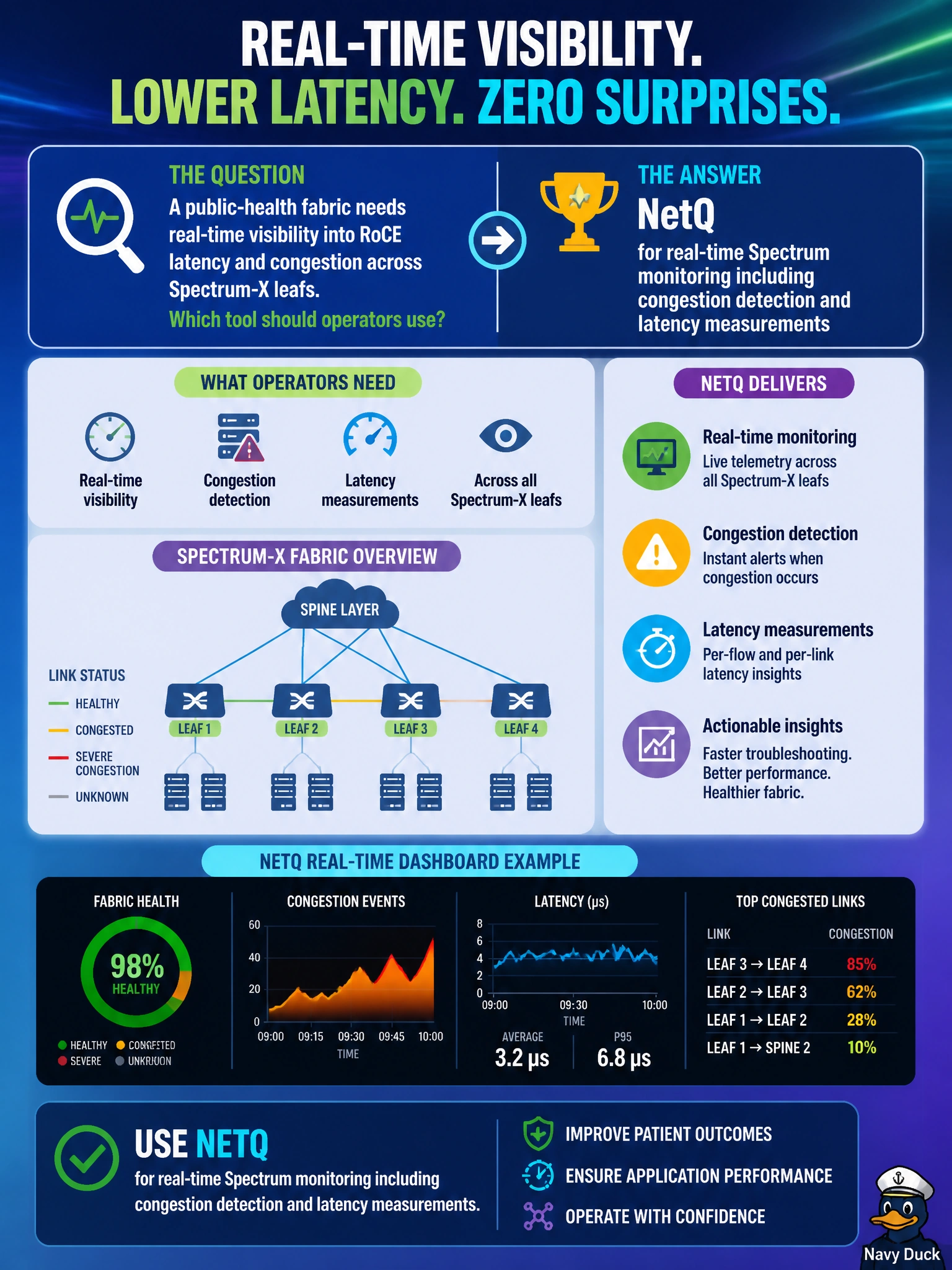
A public-health fabric needs real-time visibility into RoCE latency and congestion across Spectrum-X leafs. Which tool should operators use?
Select an answer to reveal the explanation.
Short Explanation
Public-health RoCE needs a live scoreboard, not a quarterly clipboard. NetQ watches Spectrum-X congestion and latency in real time so clinic inference issues show up while they are still happening.
Full Explanation
A public-health fabric that needs real-time visibility into RoCE latency and congestion across Spectrum-X leafs should use NetQ for real-time Spectrum monitoring including congestion detection and latency measurements. NetQ is the NVIDIA fabric observability platform positioned for continuous validation and monitoring of Spectrum Ethernet AI networks—latency, congestion, and related fabric health—rather than ad-hoc manual scrapes. For clinic and public-health inference/training paths, that real-time view is how operators catch RoCE degradation before outages become tickets.
Quarterly manual CLI scrapes with no continuous congestion view fail by concept: they cannot provide real-time RoCE latency visibility across leafs. Paper latency logs updated only after clinic outages fail because they are post-incident and non-continuous. Disabling RoCE telemetry so NetQ has nothing to report fails—it removes the signals NetQ needs to monitor the public-health Spectrum-X fabric.
Exam caveat: NetQ provides fabric monitoring and congestion/latency visibility; it does not replace WJH’s deep discard-event analysis or Air’s pre-production simulation, and operators should use the right tool for the question asked. Operational check: onboard the public-health Spectrum-X leafs into NetQ, enable congestion and latency views for RoCE-relevant paths, establish baselines before clinic peaks, alert on deviations, and verify that a controlled congestion test appears in NetQ so municipal operators trust the scoreboard before the next production incident.