
City planning jobs recover after engineers fix a PFC problem that WJH highlighted. What does that outcome demonstrate?
Select an answer to reveal the explanation.
Short Explanation
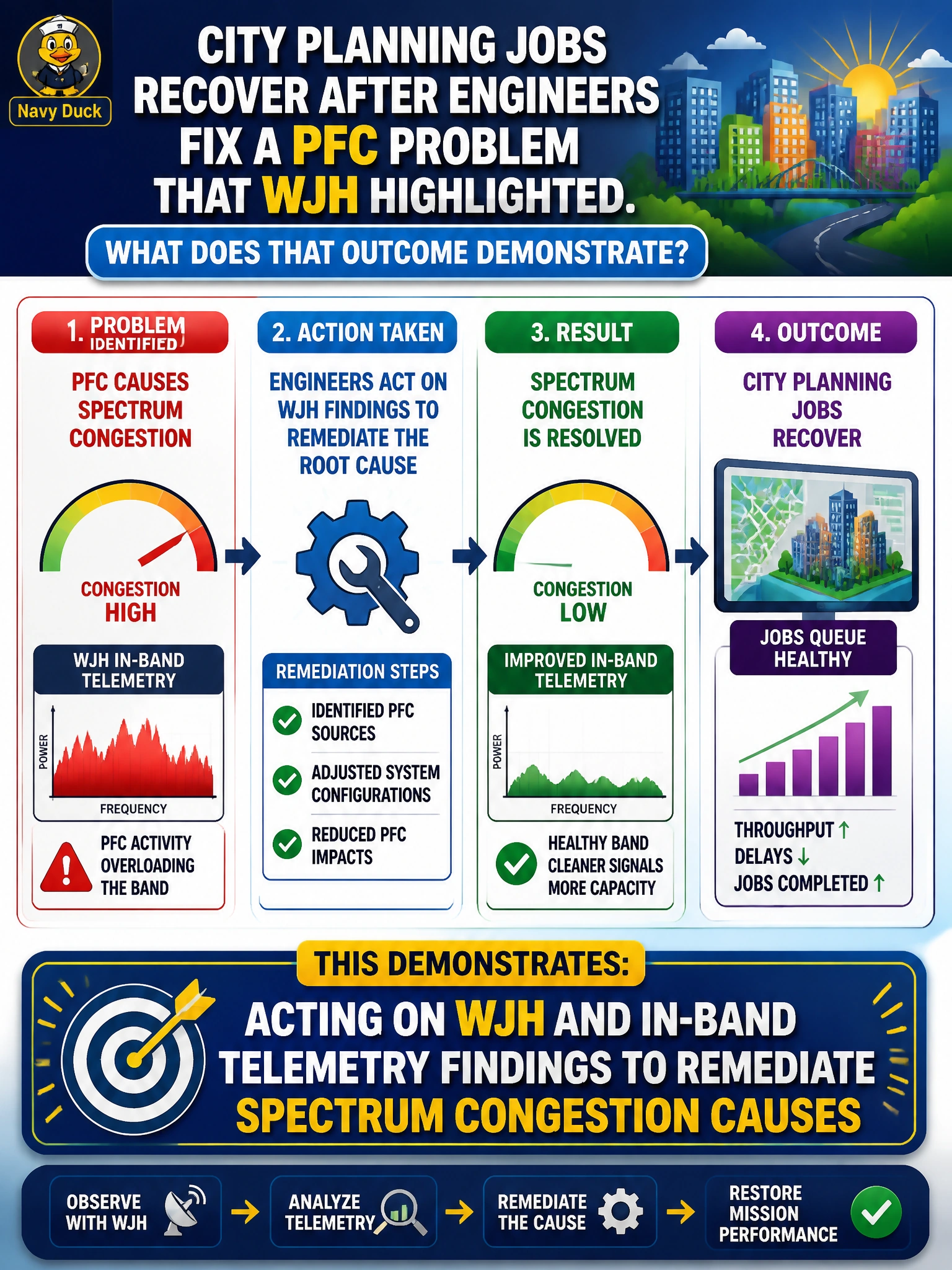
WJH pointed at a bad PFC setup; fixing it brought city planning jobs back—that is the full loop. Use the telemetry finding, remediate the Spectrum cause, and watch the civic workloads recover.
Full Explanation
When city planning jobs recover after engineers fix a PFC problem that WJH highlighted, the outcome demonstrates acting on WJH and in-band telemetry findings to remediate Spectrum congestion causes. Observability only creates value when operators close the loop: detect with WJH/telemetry, interpret the PFC-related signal, change the Spectrum congestion configuration, and confirm jobs recover. That remediation loop is what municipal AI factory operations are measured on—not dashboard tourism.
Rebalancing city planning jobs across GPU nodes using workload scheduler policies fails by concept: moving jobs across GPU nodes does not address the PFC-related congestion finding WJH highlighted, so any recovery would be scheduler-side coincidence rather than fabric remediation. Exporting WJH event histories to object storage for long-term capacity reporting fails because archiving telemetry without remediation follow-through leaves the Spectrum congestion cause in place. Tuning Spectrum ECN thresholds for RoCE traffic based on baseline profiles also fails—it adjusts a related congestion knob without fixing the specific PFC cause WJH identified, so it treats symptoms rather than the root cause.
Exam caveat: job recovery after a PFC fix strongly supports that congestion control was causal for that incident; keep monitoring because a different hotspot can appear under new city-planning traffic matrices. Operational check: document the WJH PFC signature, the Spectrum config change applied, before/after discard and latency metrics, and city-planning job success rates; add a follow-up NetQ/WJH watch for the next planning batch so the civic fabric stays in the detect–remediate–verify loop.