
Transit ML operators want alerts when Spectrum leaf-to-leaf latency exceeds civic SLOs. Which NetQ capability should they configure?
Select an answer to reveal the explanation.
Short Explanation
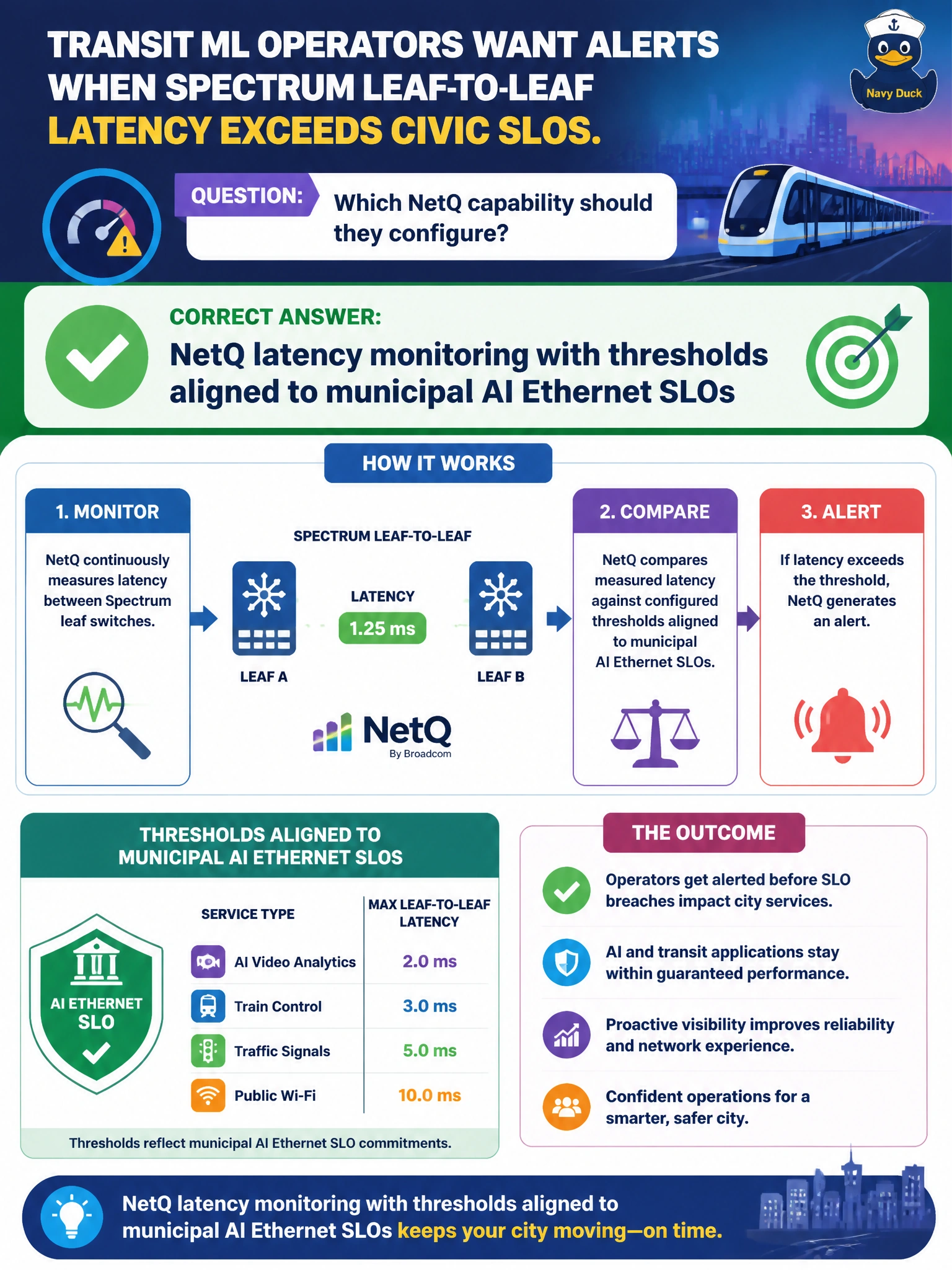
Transit SLOs are like bus arrival windows—you need a live clock, not a sticky note. Point NetQ at leaf-to-leaf latency and set thresholds that match the civic AI fabric’s service targets.
Full Explanation
Transit ML operators treat leaf-to-leaf latency as a civic service level, not a one-off lab curiosity. NetQ latency monitoring with thresholds aligned to municipal AI Ethernet SLOs is the correct capability because it continuously measures Spectrum fabric delay, compares it against the same SLO windows the transit agency already publishes for inference and training jobs, and fires alerts when leaf-to-leaf paths breach those targets. That gives NOC and platform teams a shared, time-series view instead of ad-hoc spot checks.
NetQ interface utilization polling on leaf uplinks for weekly capacity trend analysis tracks bandwidth usage trends but does not measure leaf-to-leaf latency or trigger real-time SLO alerts, so it leaves transit operators without the immediate notification they need. Real-time ASIC counter monitoring on leaf fabric ports for latency measurement captures raw numbers but, without SLO-aligned thresholds and alerting layered on top, still leaves transit operators staring at counters instead of getting paged when a path breaches the civic SLO. NetQ What Just Happened tracing on leaf nodes for packet drop diagnostics reveals drop causes but does not measure latency against municipal AI Ethernet SLOs or page the NOC when a path breaches those targets.
Exam caveat: NetQ is the NVIDIA Ethernet/Spectrum operations plane for visibility and validation; do not confuse it with InfiniBand UFM or with host-only tools. Latency alerts must be tied to leaf-to-leaf (or path) measurements that match the municipal AI Ethernet SLO definition—generic interface counters alone are not enough.
Operational check: confirm NetQ collectors are healthy on the Spectrum leaves, define latency thresholds that match the transit AI Ethernet SLOs, generate a controlled delay or use a validation window to prove alerts fire, and verify the civic NOC ticket or paging path receives the event with leaf pair and timestamp.