
Before changing Spectrum-X QoS for a public-health fabric, engineers want to catch issues without touching production. What should they do?
Select an answer to reveal the explanation.
Short Explanation
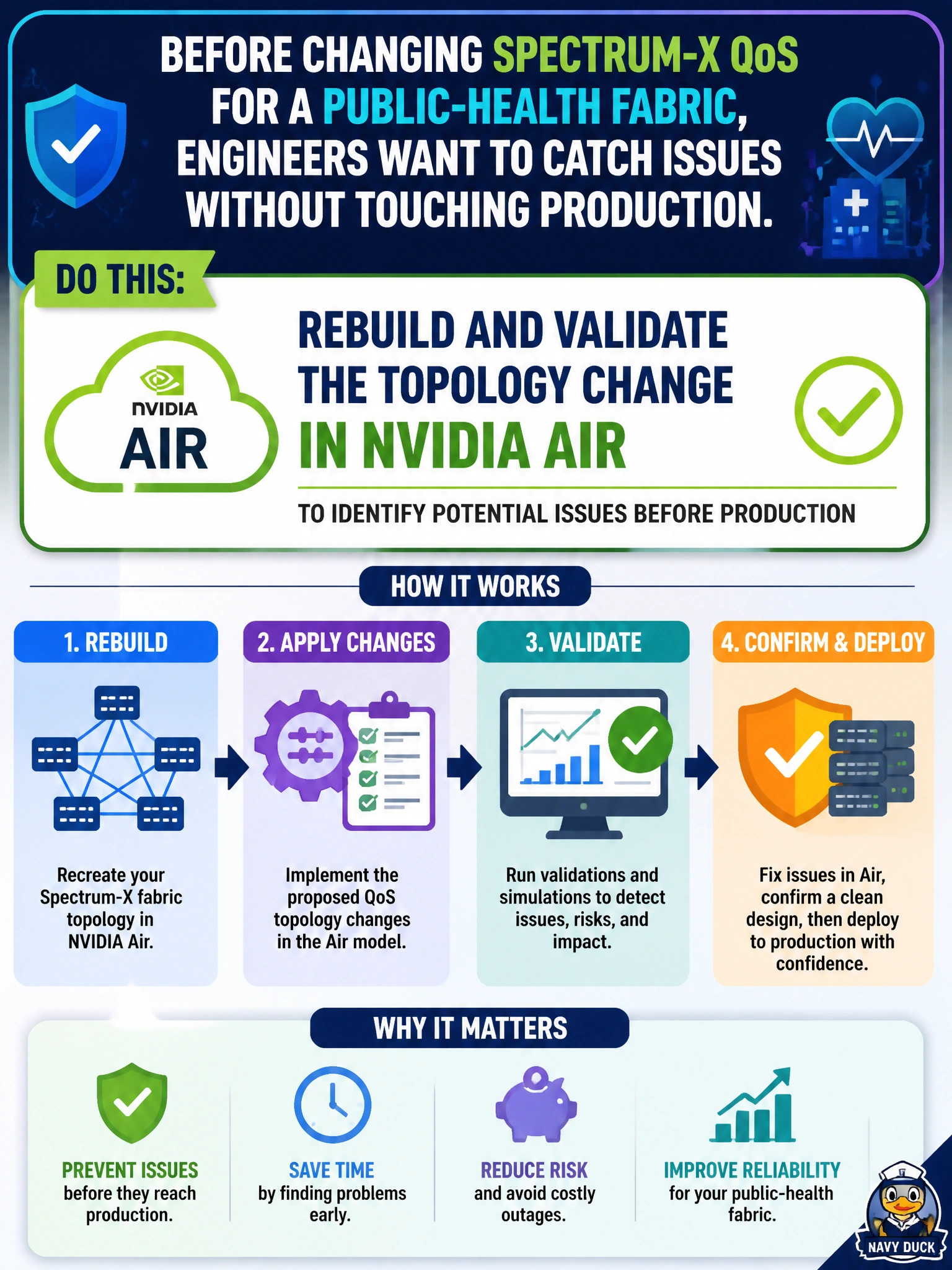
Public-health fabrics are not the place for live QoS experiments at noon—NVIDIA Air is the digital twin sandbox. Rebuild the change there first so you find gotchas before any clinic GPU sees them.
Full Explanation
Before changing Spectrum-X QoS for a public-health fabric, engineers need a way to catch issues without touching production clinic inference paths. They should rebuild and validate the topology change in NVIDIA Air to identify potential issues before production. NVIDIA Air provides a digital-twin style simulation environment where Spectrum topologies, routing, and related network behaviors can be modeled so QoS or topology edits are proven in a safe sandbox. For regulated public-health AI Ethernet, that pre-production validation reduces the chance that a QoS mistake creates RoCE stalls or loss during peak care workloads.
Modeling RoCE ECN thresholds with NetQ fabric validation using production telemetry snapshots fails by concept: it relies on production telemetry rather than proving the change in a safe sandbox, and it checks thresholds in isolation instead of validating the full topology and QoS edit. Staging the Spectrum-X buffer profile on BlueField DPUs for host-side PFC response testing is not a safe pre-production substitute because it tests on live host hardware rather than in NVIDIA Air, and it cannot catch fabric-wide topology or QoS issues before cutover. Applying the updated Spectrum-X QoS profile during a clinic maintenance window with NetQ event monitoring active also fails; it still rolls the change into production instead of proving it first in NVIDIA Air, so issues can still reach live clinic inference paths.
Exam caveat: Air simulation catches many topology and configuration classes of issues, but it is not a substitute for a controlled production canary with monitoring still enabled after cutover. Operational check: import or rebuild the public-health Spectrum-X topology in NVIDIA Air, apply the proposed QoS change there first, review failures or unexpected path behavior, only then stage the same change in production with NetQ/WJH watching, and keep the Air project as the living twin for the next civic change.