
A transit authority wants to know whether RoCE paths survive a Spectrum-X leaf failure before the change window. What should engineers do?
Select an answer to reveal the explanation.
Short Explanation
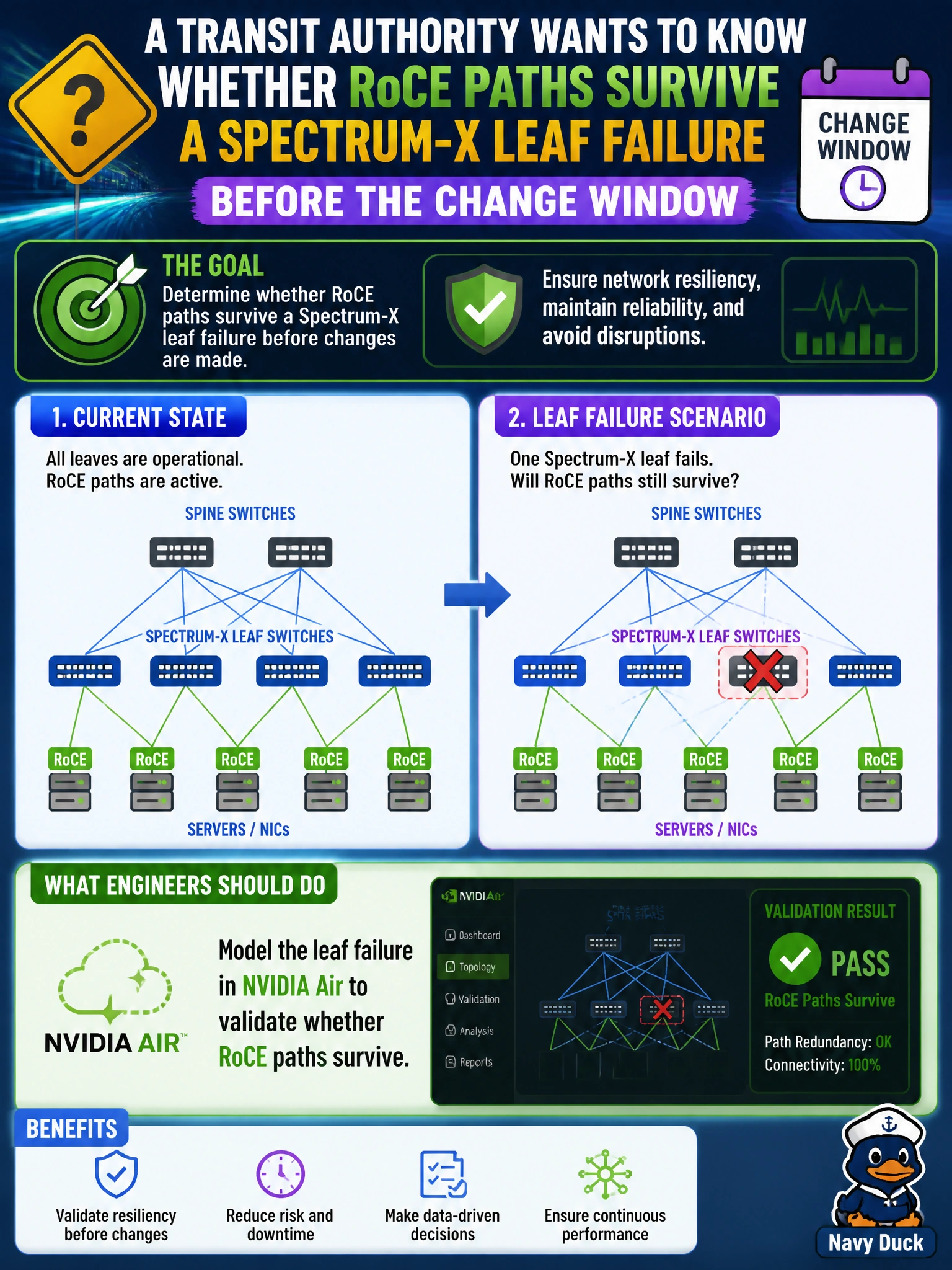
You wouldn't learn whether RoCE paths survive a leaf failure by reviewing congestion counters in NVIDIA NetQ—simulate it in Air instead. Model the Spectrum-X leaf failure in NVIDIA Air and see whether transit RoCE paths stay alive.
Full Explanation
A transit authority that needs to know whether RoCE paths survive a Spectrum-X leaf failure should not rely on reviewing RoCE congestion counters in NVIDIA NetQ to assess fabric health. Engineers should model the leaf failure in NVIDIA Air to validate whether RoCE paths survive. Air lets operators represent the planned or current Spectrum topology and inject failure scenarios—losing a leaf, uplink, or path—so they can see how EVPN/ECMP and dual-homed attachments behave before the maintenance window. That is the digital-twin approach to resilience validation for municipal AI Ethernet. Reviewing RoCE congestion counters in NVIDIA NetQ to assess fabric health fails as validation: counters show current congestion and health but do not simulate losing a leaf or prove that RoCE paths reconverge across surviving leaves. Recreating the leaf topology in Containerlab to test BGP EVPN convergence fails as a substitute: Containerlab validates generic container-based BGP EVPN behavior, not Spectrum-X RoCE path survival with adaptive routing, dual-homed attachments, and the actual switch fabric. Verifying Spectrum-X adaptive routing profiles on the switches before the window fails as validation: checking a profile is a configuration review, not a failure model, and it does not show whether RoCE paths actually survive losing a leaf.
Exam caveat: a successful Air failure model increases confidence; real hardware quirks, firmware, and traffic matrices can still differ, so production failover tests in a maintenance window remain wise. Operational check: build the transit Spectrum-X topology in NVIDIA Air, fail the candidate leaf in simulation, confirm RoCE-relevant paths reconverge to surviving dual-homed leaves, document gaps (single-homed GPUs, missing ECMP), and fix those before the live change window.