
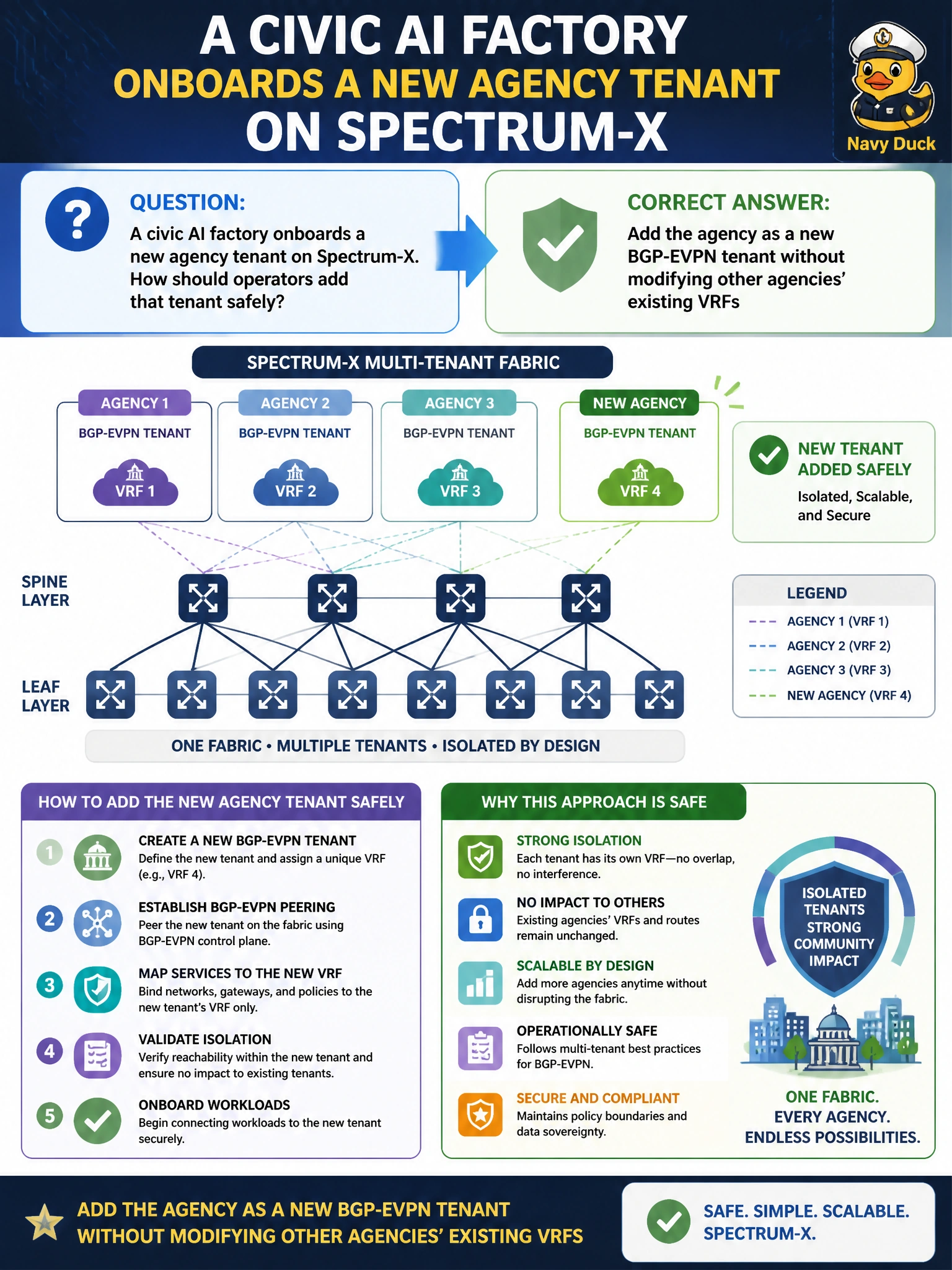
A civic AI factory onboards a new agency tenant on Spectrum-X. How should operators add that tenant safely?
Select an answer to reveal the explanation.
Short Explanation
Onboarding a new city agency should feel like handing out a new keyed office—not reusing another agency’s route targets in a dedicated VRF. You’ll create a fresh BGP-EVPN tenant and leave the other agencies’ VRFs alone.
Full Explanation
A civic AI factory onboarding a new agency tenant on Spectrum-X should expand multi-tenancy without destabilizing existing agencies. Operators should add the agency as a new BGP-EVPN tenant without modifying other agencies’ existing VRFs. Fresh VRF/tenant objects, unique route distinguishers, and carefully scoped route targets give the new agency its own overlay while leaving production tenants untouched. That is the safe Spectrum multi-tenancy growth pattern for municipal AI Ethernet fabrics.
Provisioning the new agency in a dedicated VRF that reuses route targets from an existing agency VRF fails because shared route targets leak reachability between agencies and destroy the isolation a separate tenant is supposed to provide. Creating a new VRF for the agency and importing selected prefixes from peer VRFs for shared onboarding fails because pulling peer prefixes into the new tenant’s VRF erodes the boundary and mixes unrelated civic routes into the onboarding domain. Duplicating a production EVPN tenant VRF to host the new agency alongside existing agency workloads also fails—it forces the new agency to share a VRF and route policy with an incumbent tenant instead of giving it its own clean boundary.
Exam caveat: adding a tenant without touching peer VRF membership is the goal; shared underlay QoS, leaf capacity, and management access still need capacity and security review even when overlay VRFs remain untouched. Operational check: create the new EVPN tenant/VRF, attach only the new agency’s GPU endpoints, verify existing agency route tables are unchanged, run negative reachability tests from the new tenant into peer civic tenants, and record RT policy in the municipal change ticket.