
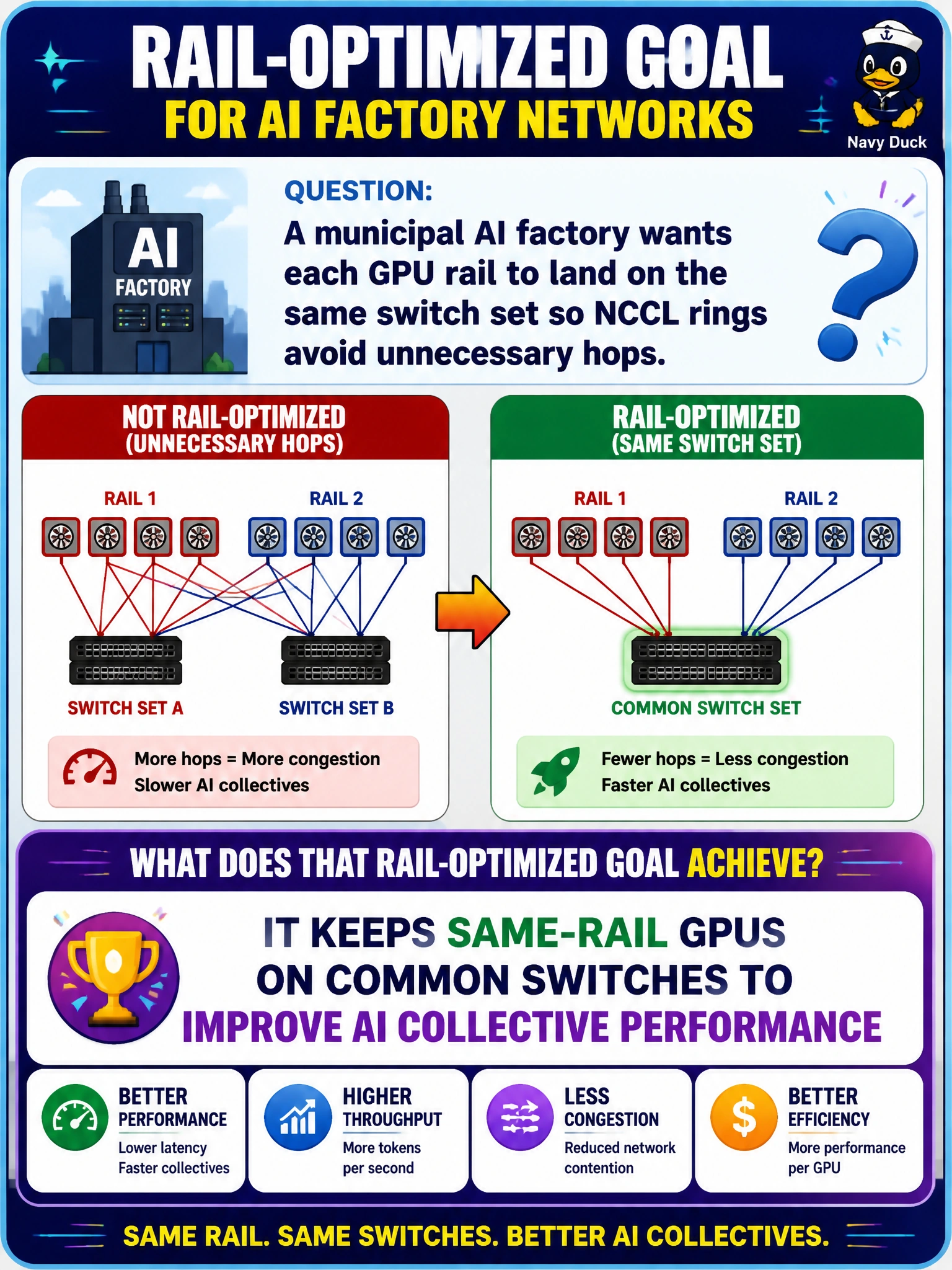
A municipal AI factory wants each GPU rail to land on the same switch set so NCCL rings avoid unnecessary hops. What does that rail-optimized goal achieve?
Select an answer to reveal the explanation.
Short Explanation
Imagine each GPU rail as a city bus route that always uses the same set of dedicated intersections. Landing same-rail GPUs on a common switch set keeps NCCL rings from taking scenic tours across extra hops—exactly what rail-optimized fabrics are aiming for.
Full Explanation
A municipal AI factory that lands each GPU rail on the same switch set so NCCL rings avoid unnecessary hops is pursuing rail-optimized locality: same-rail GPUs share common switches, which shortens collective paths and improves AI collective performance. Keeping rings on aligned switch neighborhoods reduces cross-rail tromboning, lowers congestion exposure, and makes latency more predictable for training and multi-node inference that depend on frequent all-reduce and all-gather patterns.
Spreading same-rail GPUs across leaf switches to increase ECMP path diversity breaks rail locality, forces NCCL rings to traverse extra switch hops, and is never the goal of rail optimization. Prioritizing rail locality for storage traffic to accelerate checkpoint writes misuses the rail fabric for a non-collective workload and can starve NCCL rings of the switch bandwidth they need. Reserving rail switches for management traffic to consolidate cluster control operations diverts the switch set away from GPU collectives and can leave NCCL rings without the dedicated paths they require.
Exam caveat: rail optimization is about GPU-to-switch alignment for collectives, not about scattering same-rail GPUs across leaf switches, diverting rail bandwidth to storage checkpoint writes, or reserving rail switches for management traffic. Operational check: verify cable and logical maps show each municipal GPU rail terminating on a defined switch set, run a collective bandwidth/latency test that stays on-rail, and confirm NCCL topology plugins or job schedulers place ranks consistent with that rail; escalate if rings routinely leave the rail for unrelated ECMP leaf spreading, storage checkpoint writes, or management traffic consolidation.