
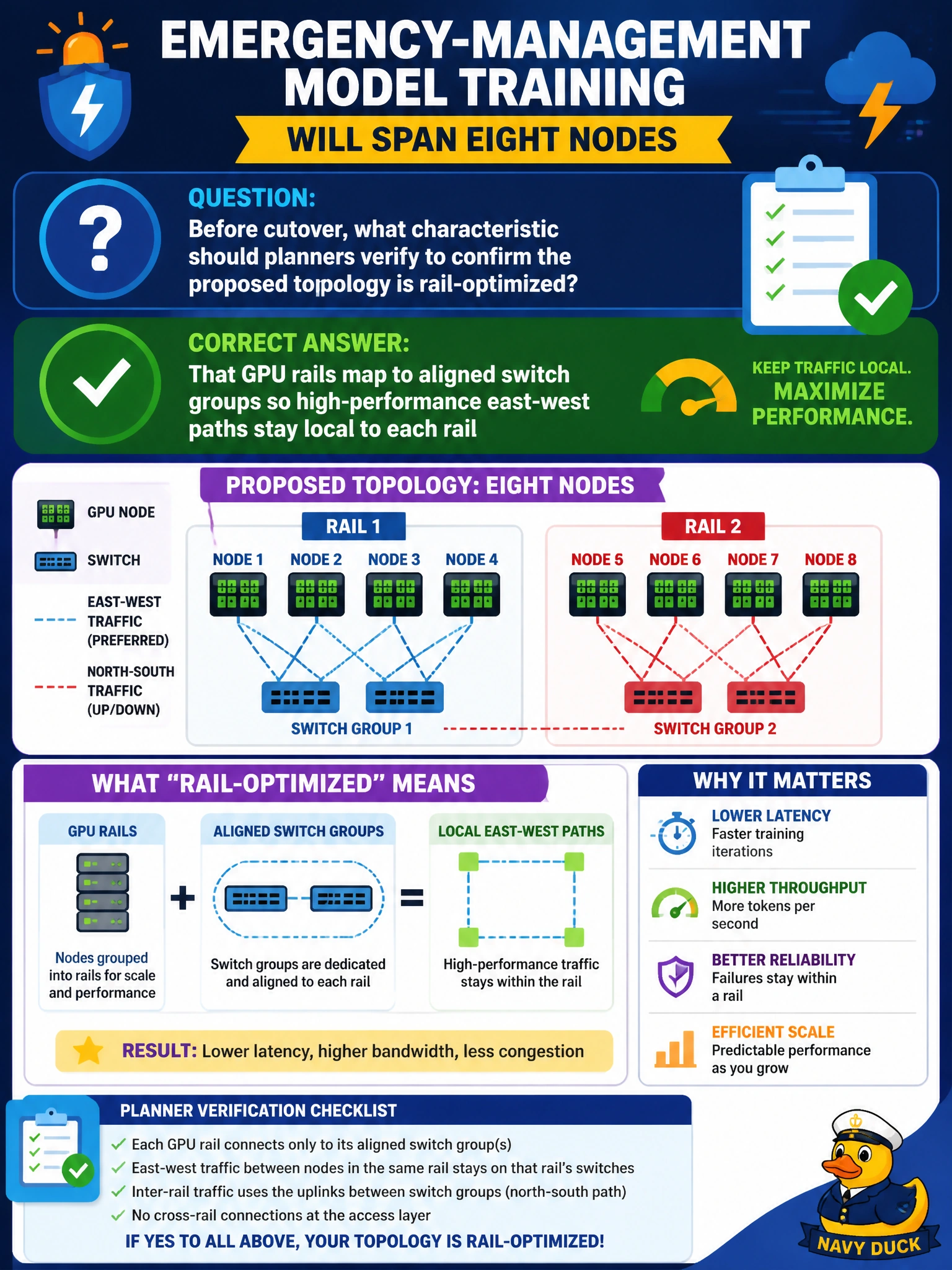
Emergency-management model training will span eight nodes. Before cutover, what characteristic should planners verify to confirm the proposed topology is rail-optimized?
Select an answer to reveal the explanation.
Short Explanation
Before the emergency-management jobs go live, check that each GPU rail lines up with a dedicated switch neighborhood—like confirming fire-engine routes stay on pre-cleared corridors. That rail-to-switch alignment is the tell that the topology is rail-optimized for civic AI performance.
Full Explanation
Before emergency-management model training spans eight nodes, planners should verify that GPU rails map to aligned switch groups so high-performance east-west paths stay local to each rail. That check confirms the proposed topology is rail-optimized: collective traffic for a rail prefers the shared switch neighborhood instead of scattering across arbitrary leafs and spines. For life-safety and incident models, predictable east-west locality reduces training-time variance and avoids last-minute fabric surprises at cutover.
Relying on evenly provisioned leaf-to-spine links so ECMP hashing balances flows across fabric uplinks does not ensure rail locality; it spreads traffic generically across the fabric rather than keeping high-performance east-west paths local to each GPU rail. Prioritizing storage VLANs for high-throughput north-south paths for bulk checkpoints and dataset ingest addresses north-south storage movement, not the rail-local east-west GPU collective paths this question requires. Configuring QoS policies to prioritize RoCEv2 traffic classes across shared fabric links preserves losslessness during congestion but does not by itself verify that GPU rails map to aligned switch groups for rail-local east-west traffic. None of those conditions prove rail optimization; only aligned GPU-rail-to-switch-group mapping does.
Exam caveat: “rail-optimized” is an attachment and locality property you verify before cutover—not a synonym for ECMP leaf-to-spine balancing, storage-VLAN north-south throughput, or RoCEv2 QoS prioritization. Operational check: for the eight-node emergency-management pod, produce a rail map (which GPUs share which leaf groups), ping/collective-test on-rail versus off-rail paths, and gate go-live on evidence that high-performance east-west stays local to each rail; reject cutover packages that only show evenly provisioned ECMP uplinks, storage-VLAN north-south paths, or RoCEv2 QoS policies.